Burg Daun: A Hilltop Castle Ruin and Ancestral Seat in Germany


Site at a Glance
- Rating
- 4.3
- Popularity
- Very Low
- Country
- Germany
- Primary era
- Medieval
- External website
- Open
- Eras represented
- Medieval, Early Modern, Modern
- Civilizations
- Holy Roman Empire, Kingdom of Prussia
- Site type
- Military
- Remains
- Castle
On this page14 sections
History
Burg Daun is a hilltop castle ruin in Daun, Germany, built by the Lords of Daun around 1000 as their urban residence. Rising on a basalt hill in the Vulkaneifel, it became the ancestral seat of the Lords of Daun and of related family lines at Oberstein an der Nahe, Densborn near Gerolstein, Bruch near Wittlich, and Zievel near Euskirchen.
Earlier Defenses and the Lords of Daun
The basalt hill had a defensive role before the medieval castle. A Celtic refuge fortress occupied the site around 700 BC. A fortified Roman watch post probably stood there around 50 BC, an interpretation connected with the discovery of a grave monument.
Toward the end of the ninth century, the Lords of Daun established the castle while they themselves resided at Altenburg near Schalkenmehren. Their family line ended in 1163. Richardus de Duna, a ministerial, meaning a dependent medieval official who could serve a noble lord in administrative or military work, then took control of the castle. He adopted the name and coat of arms of his former lords and founded the second Daun noble dynasty.
Daun in the Fourteenth Century
By the middle of the fourteenth century, Daun comprised the castle and a town built closely against the steep rock. The town held municipal rights, and officials at the castle collected tolls for Ägidius of Daun, who was known as “Mad Gilles.” In 1340, King John of Bohemia, a member of the House of Luxembourg, granted the town of Daun to Ägidius as a fief.
Ägidius served as an impartial arbitrator in several disputes, but an alliance of lesser knights opposed him. He defeated them in 1348 and later reached a reconciliation with his enemies. Complaints about robber knights in his jurisdiction then increased. The lordship also stood between the Electorate of Trier and the Electorate of Cologne, two ecclesiastical territories whose archbishops exercised both religious and secular power.
Archbishop Baldwin of Trier led a military expedition against Daun in 1352, but a peace treaty brought the campaign to an end. The following year, Baldwin and Archbishop William of Cologne joined forces and captured Burg Daun. They used the allegation that Ägidius was a robber knight as their pretext. The castle suffered little physical damage, but Ägidius was compelled to become Baldwin’s vassal and had to take on heavy debts to pay compensation.
After the conquest, Daun became territorially subject to the Electorate of Trier while remaining ecclesiastically within the Archdiocese of Cologne. The town and the castle-men’s houses below the fortress were demolished. Castle-men’s houses were residences for men assigned to garrison and administer a lord’s castle. The victors divided the castle buildings among themselves. Baldwin received House Nannstein, a tower, and the castle ring, while William of Cologne received House Rodemacher, which had its own wall. Ägidius regained the right to live at the castle two years later. From then on, the Lords of Daun and their many dependent villages in the Eifel-Moselle region were subject to the Archbishopric of Trier.
Family Division and the Counts of Daun
In the following decades, branches of the Daun family divided the castle houses among themselves. Burg Daun thus became a joint-inheritance castle, a fortress whose buildings and rights were shared among several family branches. Ägidius’s grandson Johann planned to rebuild the town in 1398, but the scheme was not carried out. A new town arose on the opposite side of the castle, while the steep side facing the Lieser was not resettled until the nineteenth century.
In 1643, the lords of the castle became Imperial counts and adopted the title “Counts and Lords of Daun.” Philipp Ernst von und zu Daun was the last count of this line to live at Burg Daun. His brother Wilhelm Johann Anton entered Austrian service in 1657. Wilhelm’s son Wirich Philipp also pursued a military career, and Wirich’s son Leopold Joseph became a field marshal under Maria Theresa of Austria and a Prince of Tiano. Leopold Joseph was an Austrian commander who served the Habsburg ruler Maria Theresa during the eighteenth century, including in the Seven Years’ War. This line of the Counts of Daun ended in the eighteenth century.
War, Destruction, and Rebuilding
The castle had already suffered heavy damage during the Thirty Years’ War. Money for repairs was unavailable after the plague killed half the population in 1637, leaving almost no tax revenue. Marauding soldiers continued to cross the region after the war. Following Philipp Ernst’s death in 1671, electoral officials occupied the buildings, while part of the collected tithe, a traditional levy commonly amounting to one tenth of agricultural produce or income, went to his descendants in Austria.
French troops serving King Louis XIV destroyed Daun and its castle in 1689 during the War of the Palatine Succession, also called the Nine Years’ War. This late-seventeenth-century conflict brought French attacks against territories and fortifications in the western German lands. The town was plundered, and its Catholic church was used as a stable for horses.
Elector Karl III Joseph of Lorraine rebuilt the severely damaged main building as a hunting lodge in 1712. The Austrian descendants of the former counts helped finance the work. In 1714, the heirs sold the ruins of the other buildings and their remaining landed property to the elector, while retaining ownership of the castle itself. Rents did not cover maintenance, however, and in 1722 they sold the partly ruined castle and all associated property rights to Elector Franz Ludwig.
From Electorate to Modern Ownership
The Electorate of Trier was confiscated during the French Revolution in 1793, and its possessions were auctioned. Burg Daun became ownerless, stood vacant for a long period, and suffered further damage and vandalism under the occupying forces.
In 1815, Daun and the castle became Prussian property. The town became the seat of a forestry office, and the Amtmann’s house was used as an administrative building. Between 1865 and 1867, a Protestant church in the neo-Gothic style was built on the castle grounds, mainly for Prussian officials because the population of the former Electorate of Trier was then predominantly Catholic.
The State of Rhineland-Palatinate assumed sovereign rights in 1948, and the town of Daun became the castle’s owner in 1957. In 1978, the main building passed into private ownership and was subsequently converted into a hotel. The restored castle-men’s houses below the castle also remain under monument protection.
Remains
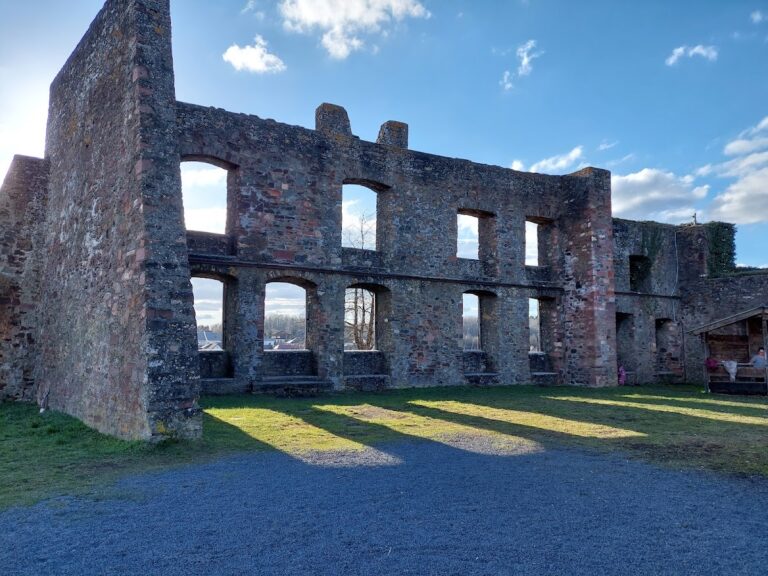
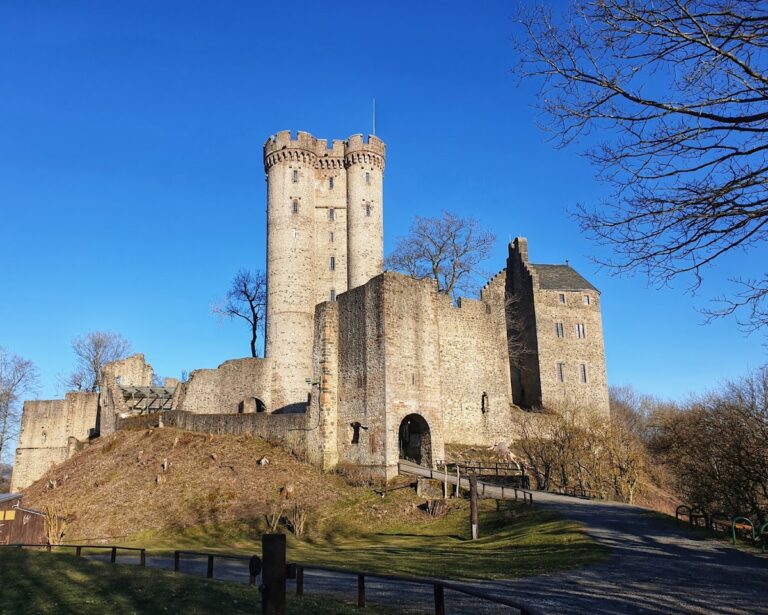
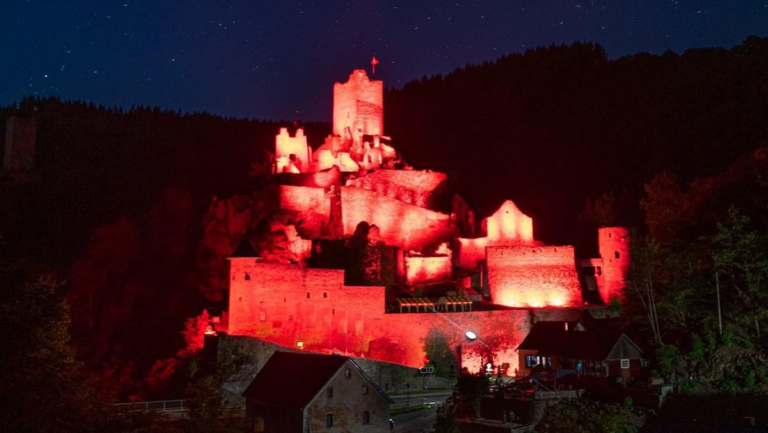
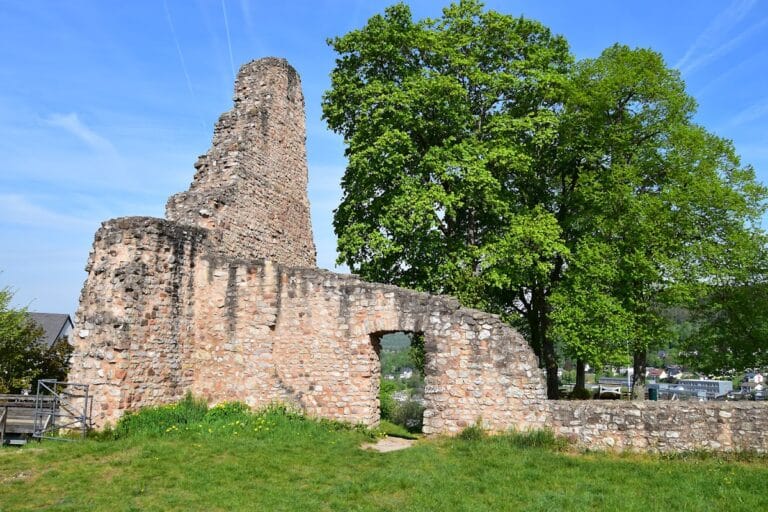
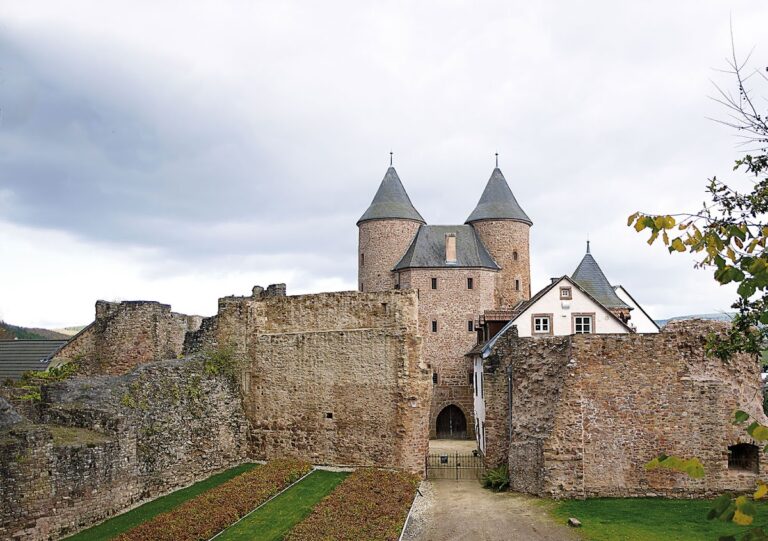
Burg Daun occupies a basalt hill at approximately 445 metres above sea level. The surviving complex is chiefly represented by a ring wall and a small bastion turret with loopholes. A bastion is a projecting defensive platform. The medieval complex was once more extensive, but most of its buildings were destroyed or fell into ruin.
Fortifications and Main Buildings
Ring Wall and Bastion Turret
The ring wall forms the principal surviving defensive element of the castle. Beside it stands a small bastion turret pierced by loopholes, openings used for defensive weapons. Together, these remains reflect the fortified character of the hilltop complex, whose other medieval buildings were largely lost through destruction and decay.
Main Building and Amtmann’s House
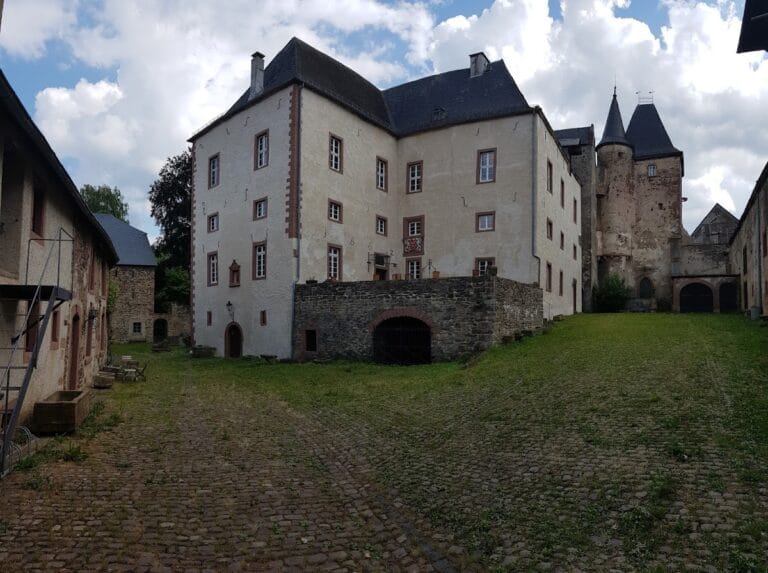
The main building was reconstructed in 1712 as a hunting lodge after the destruction of 1689. Its entrance carries the coat of arms of Karl III Joseph of Lorraine, restored during the 1990s. Later additions and alterations changed the building into the present hotel. The Amtmann’s house also developed from the 1712 hunting lodge through several alterations and additions and is now used as a hotel.
Ancillary Buildings and Associated Settlement
Tithe Barn
A large tithe barn stands at the eastern end of the castle complex. Built in 1740, it has a half-hipped roof and a broad gateway. The gateway’s keystone bears the cross of Trier. Its original function was connected with the storage of tithes, dues collected as agricultural produce or income.
Castle-Men’s Houses
Several restored castle-men’s houses lie below Burg Daun. They formed part of the settlement associated with the fortress and are protected historic buildings. Their position below the castle preserves the connection between the fortified residence and the people responsible for its garrison and administration.
Protestant Church
A Protestant church was built on the castle grounds between 1865 and 1867. It is a neo-Gothic structure and belongs to the later phase in which the former castle site was adapted for Prussian administration and religious use.
Nearby sites