Kasselburg: A Medieval Hill Castle in Germany


Site at a Glance
- Rating
- 4.5
- Popularity
- Low
- Country
- Germany
- Primary era
- Medieval
- External website
- Open
- Eras represented
- Medieval
- Civilizations
- Holy Roman Empire
- Site type
- Military
- Remains
- Castle
On this page12 sections
History
Kasselburg is a medieval hill castle in Germany, located near Pelm in Rhineland-Palatinate and built in the twelfth century, probably between 1100 and 1200. Its builders may have been the lords of Castel, a regional noble family, although this attribution remains uncertain. The castle later became the center of the lordship of Kasselburg, an imperial territory whose ruler was directly subordinate to the Holy Roman Empire rather than to an intermediate lord.
Origins and the Blankenheim-Kasselburg line
The castle first appears in written records in 1291 under the name Castilburg, followed by Castelberch in 1314. Ownership before 1335 is unresolved. In that year, Gerhard V of Blankenheim acquired Kasselburg through an inheritance division. He founded the Blankenheim-Kasselburg line, whose members were later raised to the rank of imperial counts.
The line ended in 1406 with the death of Count Gerhard VII. Kasselburg then passed by marriage to William I of Loen zu Heinsberg, who had inherited the principality of Heinsberg. Later owners included the counts of the Mark, the dukes of Arenberg, and the prince-electors of Trier. The latter were German princes entitled to elect the Holy Roman Emperor, while the archbishops of Trier also ruled a substantial ecclesiastical territory.
Disputes, military use, and abandonment
Repeated claims to Kasselburg produced prolonged property disputes. In 1674, the Imperial Chamber Court at Wetzlar awarded the castle to the dukes of Arenberg. This court was the highest judicial tribunal of the Holy Roman Empire and handled major disputes involving imperial territories and property.
Under the dukes of Arenberg, the buildings were used as barracks for the duchy’s artillery. The change from aristocratic residence to military accommodation contributed to the decline of the complex. In the early eighteenth century, Kasselburg temporarily housed Arenberg’s chief forester. By 1744, it had effectively been abandoned and local residents were using the buildings for storage.
French forces occupied Kasselburg during the Revolutionary Wars, the conflicts that followed the French Revolution and brought French military power into parts of Europe. France confiscated the castle in 1794. The ruin was subsequently treated as a source of building material, and local residents removed stone blocks and ceiling beams for houses and farm buildings.
Prussian ownership and conservation
After the Napoleonic Wars and the Congress of Vienna, Kasselburg passed to the Kingdom of Prussia in 1815. The ruin remained without substantial restoration for more than two decades. King Frederick William IV of Prussia visited it in 1838 and encouraged repair work.
After the Cologne to Trier railway was completed, the railway company donated 1,000 talers toward repairing and opening the double tower for railway passengers. State monument-preservation authorities carried out further restoration at the beginning of the twentieth century. The work stopped after the outbreak of the First World War, and the castle was never fully restored.
In 1946, the Castle Administration of Rhineland-Palatinate became the owner and began conservation measures intended to prevent further deterioration. Since 1998, the site has been managed by the Directorate for Castles, Palaces and Ancient Monuments of the General Directorate for Cultural Heritage Rhineland-Palatinate, successor to the former state castle administration. Kasselburg is recognized as a locally significant architectural monument and is municipal property. The castle and the surrounding Eagle and Wolf Park are under state protection.
Remains
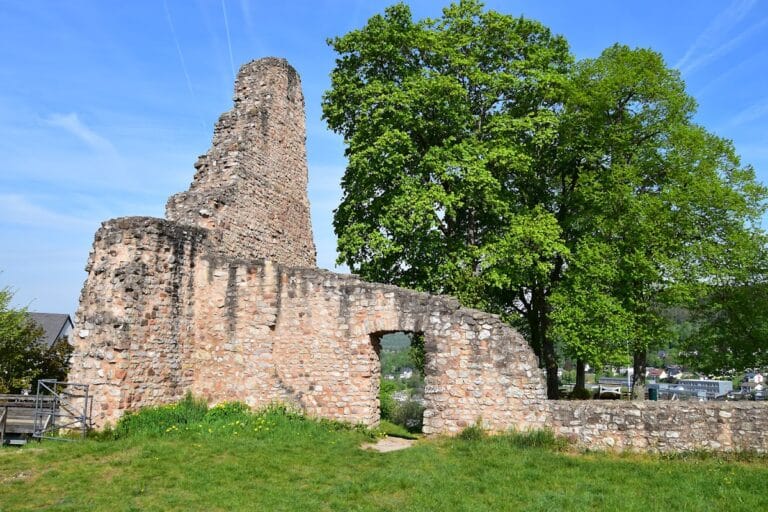
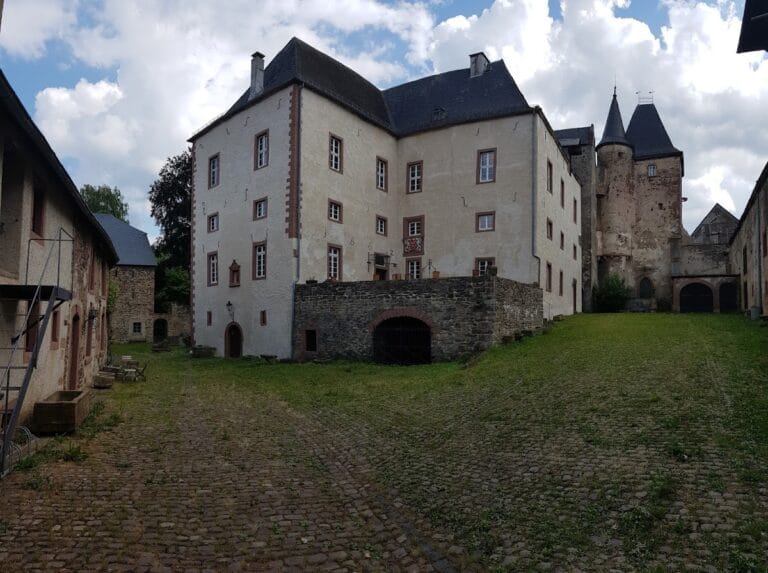
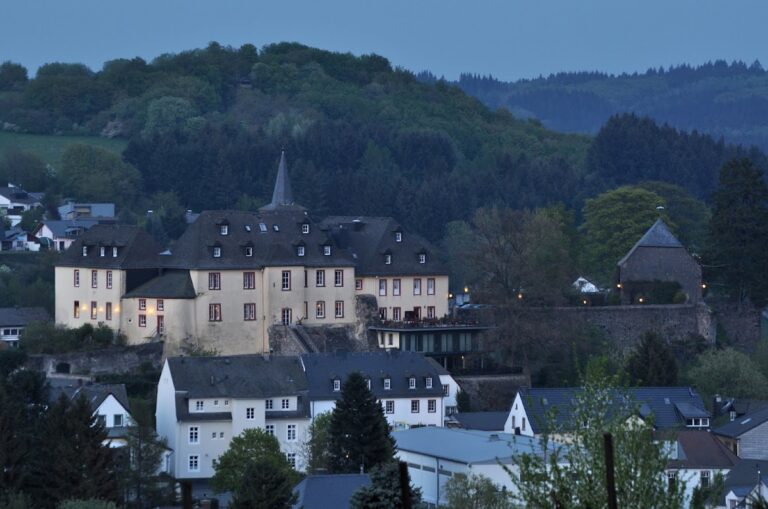
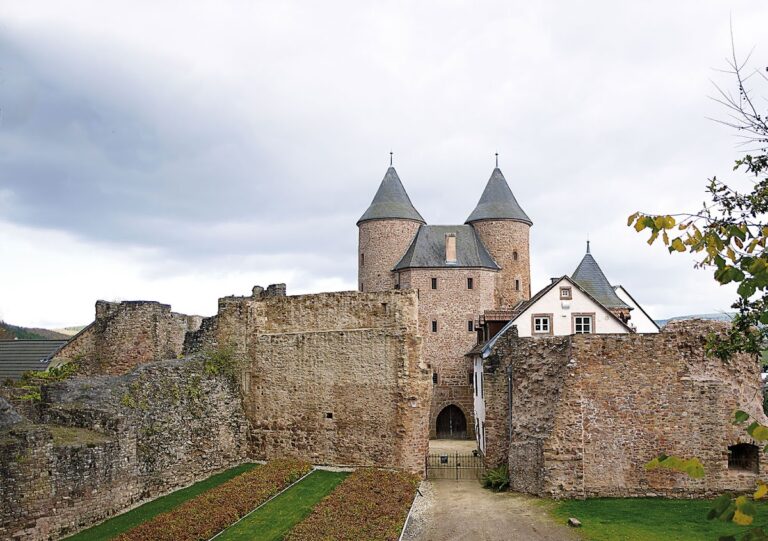
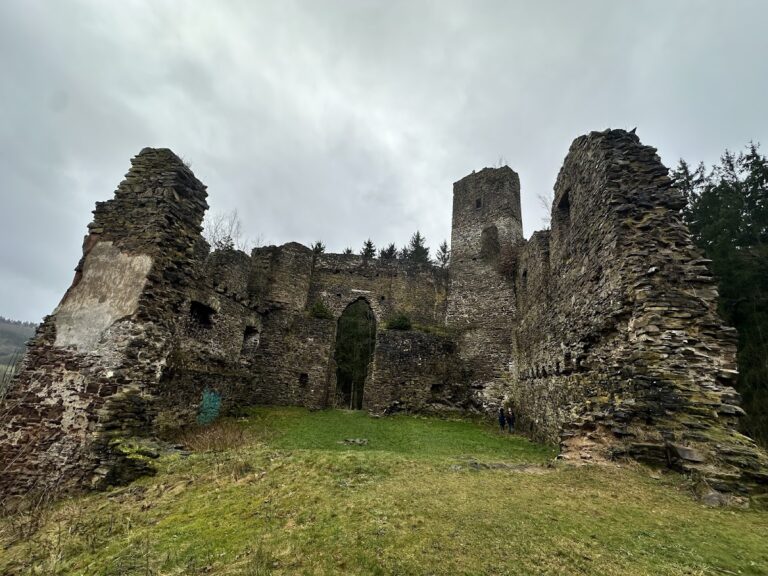
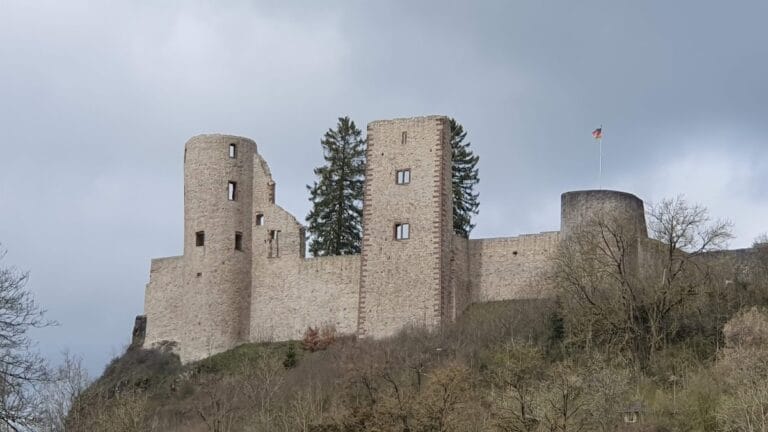
Kasselburg occupies a 490-metre-high basalt massif near Pelm, in the Vulkaneifel district. The hill castle is enclosed by a ring wall strengthened with rectangular defensive towers. Its surviving buildings belong to several stages of construction, and substantial parts of the complex remain ruined or unrestored. The restored double tower forms the principal surviving landmark, while the Eagle and Wolf Park extends through the castle grounds and incorporates animal facilities into parts of the ruins.
Outer defenses and double tower
Double tower
The 37-metre-high double tower combines a gate tower with a tower house, a building that joined residential and defensive functions. Its construction took place in several phases, so it cannot be assigned to a single builder. It was formerly attributed to the lords of Blankenheim shortly after 1335, but architectural research has shown a more complex development.
The double tower probably lost its defensive gate function when the castle was expanded from about 1452 onward. It has since been restored, and its upper platform is accessible as an observation tower. The structure is not Kasselburg’s bergfried, the principal defensive tower of a medieval German castle. The distinction separates the large gate and residential building from the older defensive tower in the inner bailey.
Outer bailey
The expansion from about 1452 produced an extensive outer bailey containing burgmann houses, residences for officials or military retainers responsible for the castle’s administration and defense, together with domestic and service buildings. These structures formed part of the enlarged castle complex beyond the earlier inner bailey and contributed to the site’s substantial surviving layout.
Inner bailey and residential buildings
Eastern defensive tower
The smaller bergfried stands in the eastern part of the inner bailey. Built around 1200, it has a square ground plan. During the fourteenth century, it was heightened into a tower house, adding residential use to its original defensive role.
Palas
The almost 33-metre-long palas, the principal residential or ceremonial building in a medieval castle, also belongs to the fourteenth-century inner bailey. It survives as an unrestored part of the complex and helps define the residential core alongside the eastern tower.
Animal facilities and later adaptation
The aristocratic complex historically included a menagerie and facilities for birds of prey, reflecting the popularity of falconry among the nobility. Some animal cages were built directly into the outer walls and castle buildings. The Eagle and Wolf Park continues to use spacious enclosures and bird-of-prey installations adapted to portions of the ruins, giving these surviving spaces a later function while retaining their connection with the castle fabric.
Nearby sites