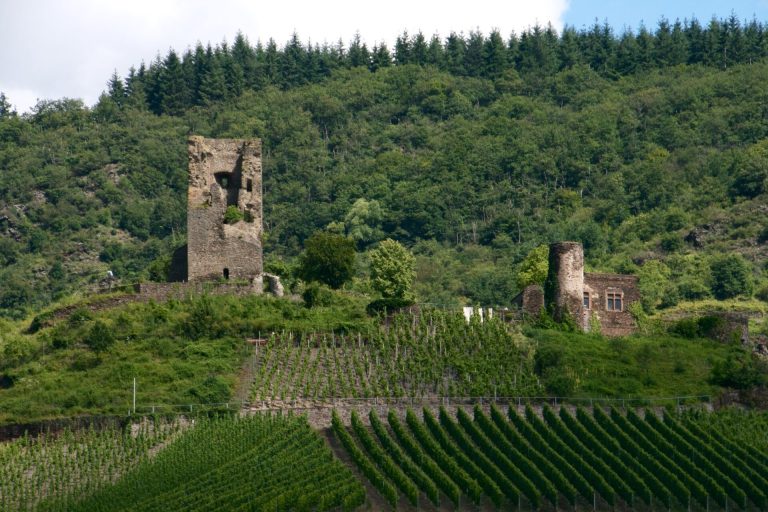
Burg Ulmen: A Medieval Castle Complex in Germany


Site at a Glance
- Rating
- 4.4
- Popularity
- Low
- Country
- Germany
- Primary era
- Medieval
- External website
- Open
- Eras represented
- Medieval
- Civilizations
- Holy Roman Empire
- Site type
- Military
- Remains
- Castle
On this page6 sections
History
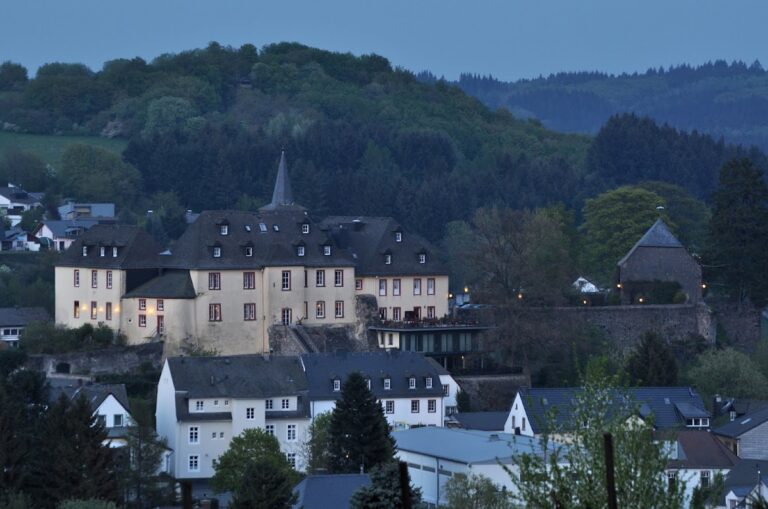
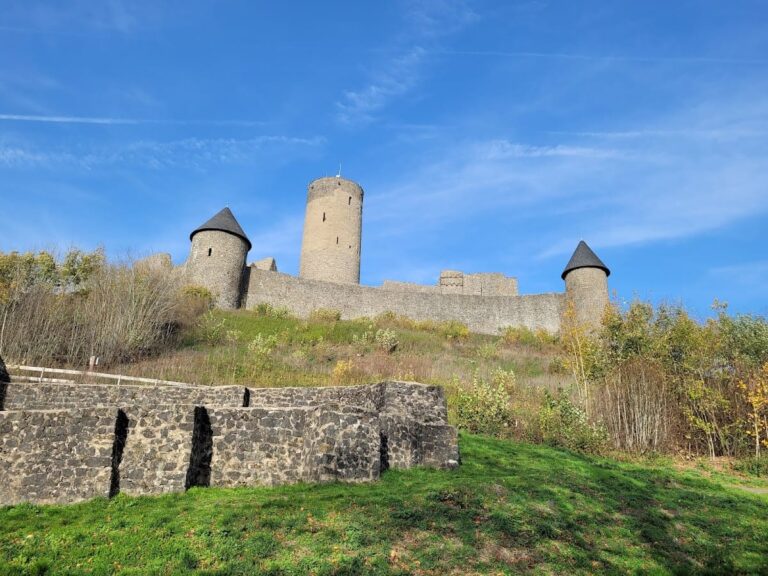
Burg Ulmen is a medieval castle complex in Ulmen, Germany, generally thought to have begun with the construction of its upper castle around AD 1000. It was first mentioned in a document in 1074 and later developed into a fortified complex of upper and lower castles.
Medieval development
From the late twelfth to the early thirteenth century, the upper castle was the residence of the knight Heinrich von Ulmen. He took part in the Fourth Crusade, a papally sanctioned expedition launched in 1202 that captured Constantinople in 1204 instead of reaching its intended destination in the eastern Mediterranean. Heinrich returned with valuable treasures, including the Limburg Staurotheke, a reliquary associated with the True Cross. The object is now kept in Limburg Cathedral.
The complex expanded in 1292 when a lower castle was built directly beside and downhill from the upper castle. At an uncertain date, the castle was also connected to Ulmen’s town wall, creating an integrated defensive system. The site later became associated with robber-knighthood, which reached its peak in the fourteenth century. In 1490, Ulmen became an administrative office of Electoral Trier, the territory ruled by the archbishop-electors of Trier, who also served as imperial electors in the Holy Roman Empire.
Legend and destruction
A legend that developed around 1508 tells of the knight Phillip Haust of Ulmen, who was supposedly released from captivity in the Holy Land by a loyal lady of the castle. The tradition forms part of the later historical memory attached to Burg Ulmen.
Between 1679 and 1689, fires and troops serving Louis XIV repeatedly damaged the castle. Louis XIV, the French king who ruled from 1643 to 1715, was associated with French military expansion during this period. French troops ultimately destroyed the castle. The upper castle was repaired in 1789, but it fell into disrepair again during the nineteenth century.
Ownership and preservation
Ulmen came under French rule in 1794. The castle was confiscated under Napoleon, the French military ruler and emperor, and became Prussian property in 1815. In 1822, a citizen of Cochem bought it at auction for use as a quarry. After Ulmen almost completely burned down in 1831, stone from the castle was used in rebuilding houses. The municipality became the owner in 1852, and local residents also used the ruin as a sheep market.
The upper castle has been legally protected as a monument since 1913. Restoration in 1967 and 1968 brought the surviving remains to their present condition.
Remains
The castle complex occupied a slope above the Ulmen Maar, a volcanic crater commonly filled by a lake. Its upper castle stood above the lower castle, which lay nearby and downhill, while the wider complex was once tied to the town wall as part of a coordinated defensive arrangement.
Upper-castle remains
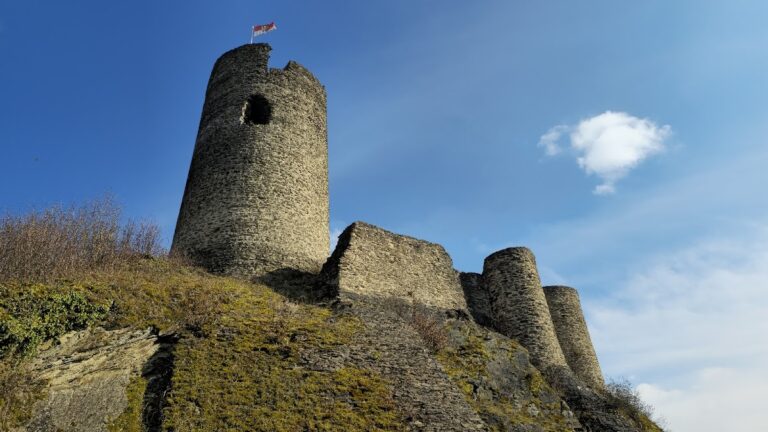
The surviving upper-castle fabric includes the enceinte, an enclosing defensive wall, together with remnants of an Electoral Trier administrative building. An exterior wall of the palas, the principal residential or representative building of a medieval castle, also remains. A cistern, used to collect or store water, survives within the complex, along with foundation remains from several other buildings.
The Limburg Staurotheke provides a surviving material link to Heinrich von Ulmen’s participation in the Fourth Crusade and his return with a reliquary associated with the True Cross. It is preserved in Limburg Cathedral rather than at Burg Ulmen.