Veste Niederhaus: A Hilltop Castle and Fortress in Passau


Site at a Glance
- Rating
- 4.6
- Popularity
- Very Low
- Country
- Germany
- Primary era
- Medieval
- Eras represented
- Medieval, Early Modern, Modern
- Civilizations
- Electorate of Bavaria, German, Holy Roman Empire
- Site type
- Military
- Remains
- Castle
On this page12 sections
History
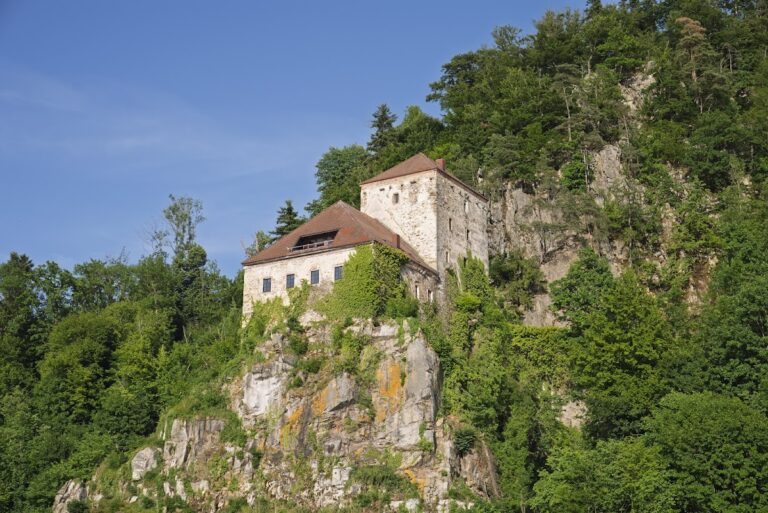
Veste Niederhaus is a hilltop castle in Passau, Germany, standing on a rocky peninsula at the confluence of the Ilz and Danube below Veste Oberhaus. The present castle existed around 1250, while an earlier building on the peninsula is estimated to date to 737.
Early foundations and the two fortifications
The first known building on the rocky peninsula was a temporary residence assigned by Odilo, the eighth-century duke of Bavaria, to Bishop Vivilo and nuns who had fled their monastery. By around 1250, a castle stood on the hilltop. Building accounts from the time of Prince-Bishop Otto of Lonsdorf, a bishop who also exercised territorial political authority, distinguished between an “old” and a “new” castle.
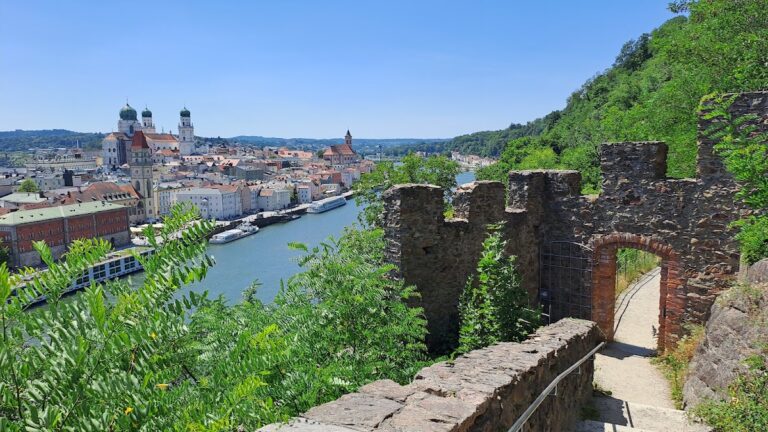
The names Oberhaus and Niederhaus became established for the two fortifications from the middle of the fourteenth century. Niederhaus was connected to Oberhaus in 1367 by a double defensive wall-walk, a protected route along the fortifications. The construction followed the capture of Niederhaus by Passau’s citizens during a conflict with the bishop.
Residence, destruction, and reconstruction
In 1358, a lodging room for 13 pilgrims was established in the large cellar vault. In the fifteenth century, Niederhaus also served as a secondary residence for the bishops. A gunpowder explosion destroyed the castle in 1435, after which Prince-Bishop Leonhard von Laiming ordered its rebuilding. The work was complete by 1444 at the latest.
That year, the future Pope Pius II, whose name was Enea Silvio Piccolomini, described Niederhaus as containing splendid halls and rooms. The complex included a knights’ hall and two castle chapels, reflecting its role as a residence as well as a fortified site.
Prison, penitentiary, and military fortress
During the seventeenth century, Niederhaus was converted into a prison for disobedient clergy. In 1762, under Prince-Bishop Joseph von Thun, it became a workhouse and penitentiary. The same year, a tunnel was cut through the mountain immediately west of the fortress. Known as the Ilzdurchbruch, it remains in use and is one of Europe’s oldest tunnels.
In 1805, the Elector of Bavaria assigned Niederhaus a military role as a war magazine and a blocking fort on the Danube. The castle was altered so that the guns of Veste Oberhaus would have an unobstructed field of fire. Its nine-storey tower was reduced to four storeys, and the eastern keep, the principal fortified tower of a castle, was dismantled to half its former height.
The fortress walls on the Ilz, Danube, and Holzgarten sides were strengthened in 1815, when a howitzer battery, a group of artillery positions equipped with guns designed for relatively high-angle fire, was installed. Niederhaus retained its fortress function until 1867.
Bridges, private ownership, and conservation
A footbridge called the Kettensteg was built directly above the fortress in 1869, linking Ilzstadt with Passau’s Old Town. In 1900, the construction of the Luitpold Bridge, a suspension bridge across the Danube, was decided upon as a replacement for the Kettensteg.
Historian-painter Ferdinand Wagner acquired Niederhaus in 1890. He opposed construction of the Luitpold Bridge and sold the castle in 1907 to the painter Eduard Strobelberger. From 1996 onward, the Brunner family carried out comprehensive repairs. The family received the Bavarian Monument Protection Medal in 2008 for this work.
Niederhaus is listed as an architectural monument of Passau and as an archaeological monument containing underground medieval and early-modern remains and finds.
Remains
Niederhaus occupies the tip of a rocky peninsula where the Ilz meets the Danube, below Veste Oberhaus. The peninsula and the right bank of the Ilz to the north belong to the Bschütt locality within Passau’s Old Town district. The preserved complex combines medieval residential and defensive elements with later prison, penitentiary, and military alterations.
Medieval residential and defensive features
Pilgrimskeller
The large cellar vault known today as the Pilgrimskeller contains the lodging room established for 13 pilgrims in 1358. It forms part of the castle’s surviving underground fabric and preserves evidence of a function connected with accommodation within the fortified complex.
Wall-walk and episcopal residence
A double defensive wall-walk joined Niederhaus to Veste Oberhaus. By 1444, the castle also contained splendid halls and rooms, a knights’ hall, and two castle chapels. These spaces formed the bishops’ secondary residence during the fifteenth century.
Later fortress structures
Tower and eastern keep
The castle’s military conversion changed the height of its principal defensive structures. The nine-storey tower was reduced to four storeys, while the eastern keep was dismantled to half its former height to open the field of fire from Veste Oberhaus.
Ilzdurchbruch and artillery defenses
The Ilzdurchbruch tunnel was cut through the mountain immediately west of the fortress in 1762 and remains in use. In 1815, the walls facing the Ilz, Danube, and Holzgarten were expanded or strengthened, and a howitzer battery was added. Underground medieval and early-modern features and finds form part of the site’s archaeological remains.