Ardgowan Castle: A Late-Medieval Tower House in Scotland


Site at a Glance
- Rating
- 4.7
- Popularity
- Very Low
- Country
- United Kingdom
- Primary era
- Medieval
- External website
- Open
- Eras represented
- Medieval
- Civilizations
- Kingdom of Scotland
- Site type
- Military
- Remains
- Castle
On this page6 sections
History
Ardgowan Castle is a late-fifteenth-century tower house in the United Kingdom, near Greenock, built on the site of the earlier Inverkip Castle. The compact stone residence replaced a medieval fortress that played a part in the First War of Scottish Independence, the conflict between the Scottish kingdom and the campaigns of Edward I of England.
Inverkip Castle in the Wars of Independence
The site was originally known as Inverkip Castle. A wooden watchtower probably stood there before the stone fortress and may have been intended to guard against Viking raiders. In 1301, Edward I planned for two English armies to meet at Inverkip, but the western army had captured Turnberry and Bothwell castles, and the forces instead rendezvoused at Linlithgow before overwintering.
In 1303, Edward ordered a force that included Robert the Bruce and Aymer de Valence to advance through Clydesdale and join a seaborne army led by the Earl of Ulster. After the ships attacked Rothesay Castle, the combined force besieged Inverkip Castle and captured it by early September. Robert the Bruce is said to have taken part in the seizure. He was then responsible for moving siege engines north for the English assault on Stirling Castle. In a letter dated 16 April 1304, Edward thanked him for finding a wagon capable of carrying the frame of the “great engine of Inverkip.”
In 1306, Sir Adam Gordon held Inverkip for Edward I. Around the middle of March, supporters of Robert the Bruce, led by Robert Boyd of Cunningham, besieged the castle. After Bruce was defeated at Methven, Edward ordered on 24 July that Sir Thomas Randolph be held there as a prisoner under Gordon’s supervision. Randolph appears to have been free by September 1307. Later that year, after Sir James Douglas defeated Sir Philip Mowbray, Mowbray fled to Inverkip, where the English garrison received him before escaping from the castle by sea.
From Inverkip to Ardgowan
In 1403, King Robert III granted the lands of Ardgowan to his illegitimate son, Sir John Stewart. The later castle was built on the site of the earlier Inverkip fortress. The surviving ruin belongs to a late-fifteenth-century tower house, a fortified multi-storey stone residence characteristic of late-medieval Scotland.
In 1667, Archibald Stewart was created a baronet, a hereditary British rank below a baron. The title later passed to the Shaw Stewart family. In 1730, the third baronet married Helen Houston, heiress of the Shaws of Greenock. Their son, Sir John Shaw Stewart, 4th Baronet, commissioned Hugh Cairncross to design Ardgowan House. Construction began in the late eighteenth century and was completed around 1801. The old castle was then abandoned, and its ruin was consolidated and repaired in 1936. Ardgowan Castle has been protected as a Category B listed building since 10 June 1971.
Remains
Cliff-top tower house
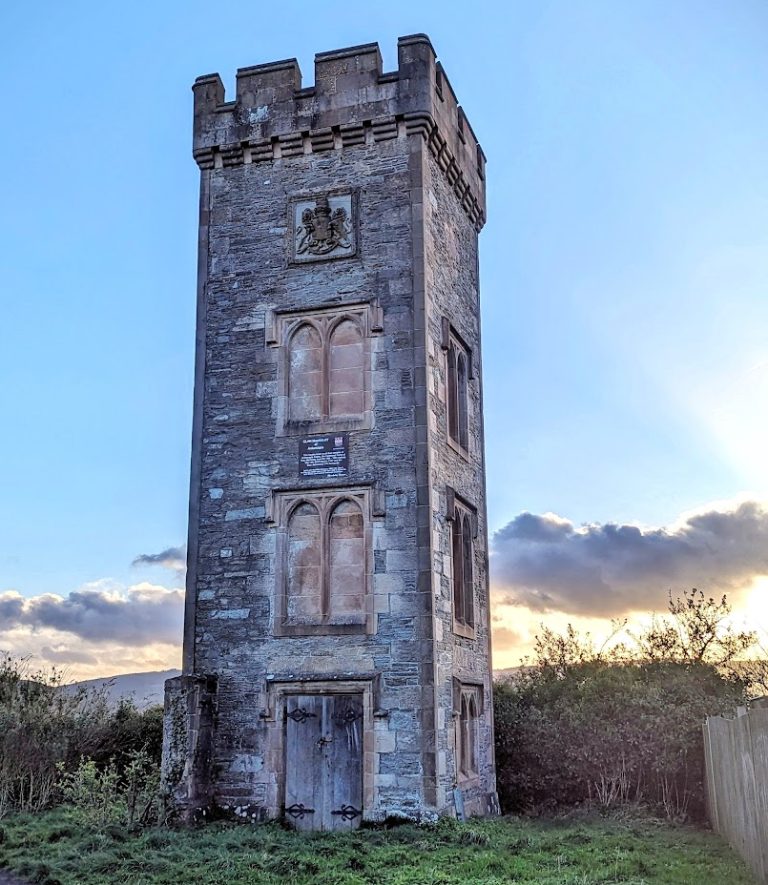
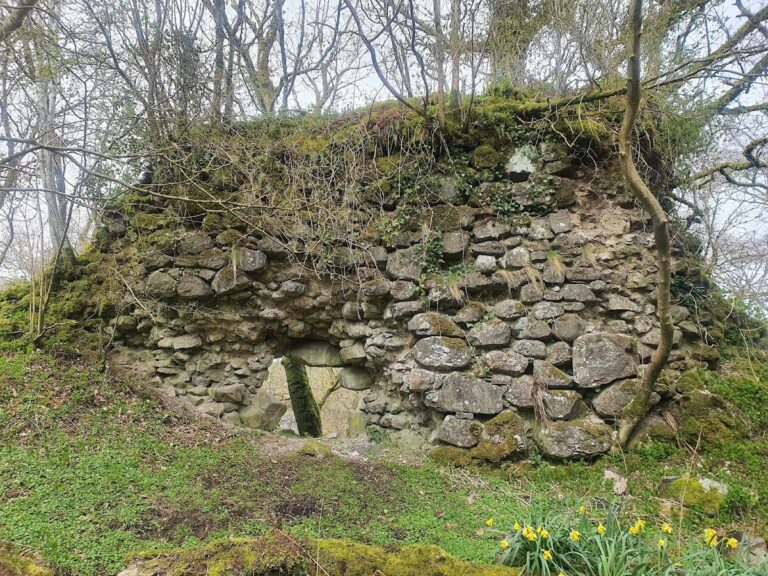
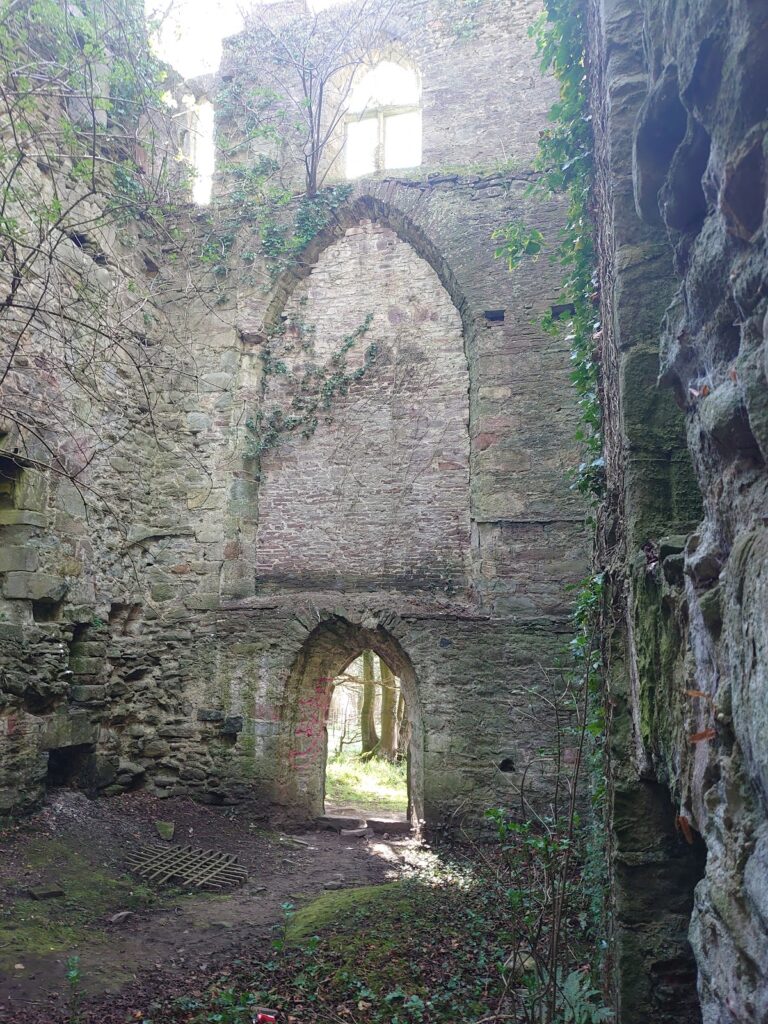
Ardgowan Castle survives as a three-storey ruin on the southern edge of a promontory formed by a raised beach, an ancient shoreline now standing above the present coast. The promontory has a level top approximately 60 feet (18 metres) above the coastal flats. Steep slopes or cliffs defend both sides, while the tower itself is perched on a cliff. An entrance stair is associated with the surviving structure.
Relationship to the estate
The ruin stands within the private gardens of Ardgowan House, near the Firth of Clyde. It occupies the site of the earlier medieval fortress of Inverkip Castle. After Ardgowan House was completed around 1801, the old tower was abandoned; consolidation and repair in 1936 secured the surviving fabric.