Bétera Castle of the Boil: A Medieval Fortress and Municipal Landmark in Spain


Site at a Glance
- Rating
- 4.1
- Popularity
- Very Low
- Country
- Spain
- Primary era
- Medieval
- Eras represented
- Medieval, Modern
- Civilizations
- Crown of Aragon, Spanish
- Site type
- Military
- Remains
- Castle
On this page11 sections
History
Bétera Castle of the Boil is a castle in Spain that originated as an Islamic defensive fortress protecting Muslim farmsteads around Bétera. Its historical origins are associated with Muslim rule, although earlier remains exist in the area. The castle occupies a strategic position at the centre of the settlement and later became a commandery, noble lordship, military stronghold, and municipal complex.
Islamic origins and Christian conquest
During James I’s thirteenth-century conquest of Valencia, the inhabitants of Bétera, together with those of Paterna and Bufilla, voluntarily surrendered to the king. The agreement, placed around 1237 and 1238 while James I was preparing the siege of Valencia at El Puig, preserved their religion and property. In 1237, James I granted the castle to the Order of Calatrava through Friar Lupo Martín, commander of Alcañiz. The Order of Calatrava was a medieval military religious order that held lordships and commanderies in the Iberian Peninsula. A commandery, an administrative estate or jurisdiction managed for such an order, was established at Bétera and later associated with other settlements.
Rebuilding and noble lordship
In 1329, the commandery was linked to the Barony of Bétera. In 1364, Pedro the Ceremonious, also known as Peter IV of Aragon, ordered the castle and the town walls demolished because Bétera had supported the Unionist forces during the Wars of the Union, a conflict involving opposition to royal authority in the Crown of Aragon. Both the castle and the walls were later rebuilt, largely replacing the earlier Islamic structure.
The castle was ceded to the Boil family for a specified period in 1386, and the family became its owners in 1437. They received perpetual rights of lordship and criminal jurisdiction, while the Order of Calatrava retained direct superior lordship. This arrangement continued through the Bétera commandery under a special agreement involving payments by its holders. The property later passed to the family of the Marquises of Dos Aguas.
Military use and civic transformation
Bétera’s strategic importance made the castle a setting for military actions. Bourbon troops commanded by the Count of Las Torres attacked it during the War of the Spanish Succession, the early-eighteenth-century conflict over the Spanish throne. During the Peninsular War, the part of the Napoleonic Wars fought in Spain and Portugal, French forces under General Suchet attacked forces commanded by O’Donnell at the castle. Carlist bands, supporters of a traditionalist branch of the Spanish Bourbon succession, also carried out numerous actions in the surrounding territory.
In 1888, the owner, the Marquis of Dos Aguas, Genaro María del Rosario Rabassa de Perelló Palafox, transferred the castle to Bétera’s Junta de Montes y Señorío Territorial on the condition that it serve social purposes. It subsequently functioned for a time as a school and an asylum. During the twentieth century, religious women lived in the building while maintaining a nursery school, and repeated alterations changed the complex and caused the loss of some structures.
Restoration and municipal ownership
The castle was donated to Bétera Town Council in 1983. The council then promoted its recognition as a Historic-Artistic Monument and began rehabilitation and consolidation works. Restoration carried out between 1984 and 1989 used new materials and forms that did not respect the original appearance and substantially altered the building.
Since May 2019, further rehabilitation work supported by European Union funds has been under way. Bétera Town Council owns the castle, which contains court facilities, part of the municipal library, the council chamber, an auditorium, and other municipal facilities. The castle was declared an Asset of Cultural Interest in 2003 and appears in regional and national heritage registers under the codes 46.11.070-002 and RI-51-0011126.
Remains
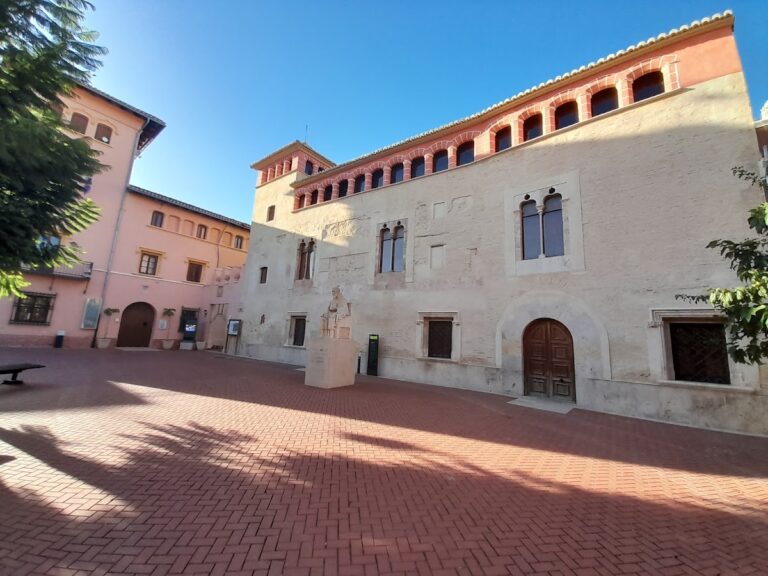
The castle stands beside a small square in the oldest part of Bétera, on the highest point of the low hill occupied by the town. It is built directly on the underlying rock. The complex forms a single irregular polygon adapted to the rocky foundations and encloses approximately 1,500 square metres. Its towers and residential buildings surround an interior courtyard, while many connecting structures added during the twentieth century conceal earlier fabric. The present arrangement largely reflects rebuilding after the demolition of 1364.
Towers and residential enclosure
Principal tower
The principal tower is rectangular, measuring approximately 8 by 6 metres and rising about 16 metres. A smaller tower stands very close to it, contributing to the defensive group at the centre of the complex. These structures are connected by multi-storey residential buildings that enclose the courtyard.
Surviving perimeter towers
Four towers survive from the castle’s six-tower arrangement. Two occupy the western and northern sides of the enclosure and have semicircular interiors. Older photographs also preserve evidence of another tower that no longer forms part of the surviving complex. The connecting residential buildings, many of them constructed during the twentieth century, give the enclosure much of its present internal form.
Keep and Clock Tower
The tallest surviving tower is the keep, also known as the Clock Tower because a clock was installed in it in 1897. Its body rises approximately 25 metres, narrows gradually towards the top in a slightly truncated-pyramidal form, and ends in crenellations, battlements made of alternating raised sections and openings.
Entrance and heraldic features
The main entrance bears Bétera’s coat of arms. Its shield combines the red-and-gold bars of the Crown of Aragon, the cross of the Order of Calatrava, the Boil family arms in the second quarter, the arms of the Perellós and Rocafull families in the third, and those of the Marquisate of Dos Aguas in the fourth. The Crown of Aragon was the medieval composite monarchy that included the Kingdom of Aragon and Valencia. The present shield was installed in 1984 during the municipal rehabilitation works.