Fautsburg: A Medieval Hill Castle in Germany


Site at a Glance
- Rating
- 4.5
- Popularity
- Very Low
- Country
- Germany
- Primary era
- Medieval
- External website
- Open
- Eras represented
- Medieval
- Civilizations
- Holy Roman Empire
- Site type
- Military
- Remains
- Castle
On this page8 sections
History
Fautsburg is a ruined hill castle in Germany, located above Rehmühle in Aichelberg, a district of Bad Wildbad in Baden-Württemberg. The Counts of Calw are thought to have built it, although the Counts of Hohenberg may have established the castle in the late twelfth or early thirteenth century. Fautsburg is first mentioned on 23 February 1276, when it was in the possession of the Counts of Calw.
Medieval ministerial seat
During the medieval period, Fautsburg served as a ministerial seat, meaning a residence and base for officials or lower nobles serving a greater lord. The castle was associated with the Knights of Vogtesberg, whose heirs, the Lords of Hornberg, sold half of it to Count Eberhard of Württemberg in 1323 for 300 pounds heller. The other half later passed through Count Palatine Rudolf IV of Tübingen to the House of Württemberg, the dynasty that ruled Württemberg.
Control of the castle was administered through the lower nobility of the surrounding region. In 1476, Count Eberhard of Württemberg gave Cathedral Dean Count Johann of Helfenstein refuge at Fautsburg. Helfenstein had previously criticized Bishop Rupprecht of Strasbourg, from whom he was seeking protection.
Württemberg fiefs
On 22 April 1561, Duke Christoph granted Fautsburg as a fief to Johannes Brenz, a Protestant reformer associated with the Reformation in Württemberg. In 1570, at Brenz’s request, Duke Ludwig reclaimed the grant and compensated him. That same year, Ludwig granted the property to Hirsau Abbey, a Benedictine monastery in the northern Black Forest region.
In 1594, Duke Frederick of Württemberg granted the estate to Eberhard Zangmeister, a forestry official. Fautsburg returned to Württemberg in 1603, and a forestry servant was living there in 1604, when the castle was already in decay.
Decline and preservation
The Rehmüller family later owned the property and quarried the castle walls for building material. In the mid-nineteenth century, the state purchased the woodland-use rights and redistributed them, assigning the plot containing Fautsburg to Johann Georg Rentschler.
Initial attempts to secure the ruin took place in 1910 and 1939. During the early 1960s, the keep was rebuilt as an observation tower, and the ruin opened to the public in 1967. Vegetation soon covered the walls again, and the site fell into obscurity until it was cleared in 2000. A castle festival was held there in 2004, and the tower received a roof in 2007.
Remains
Keep
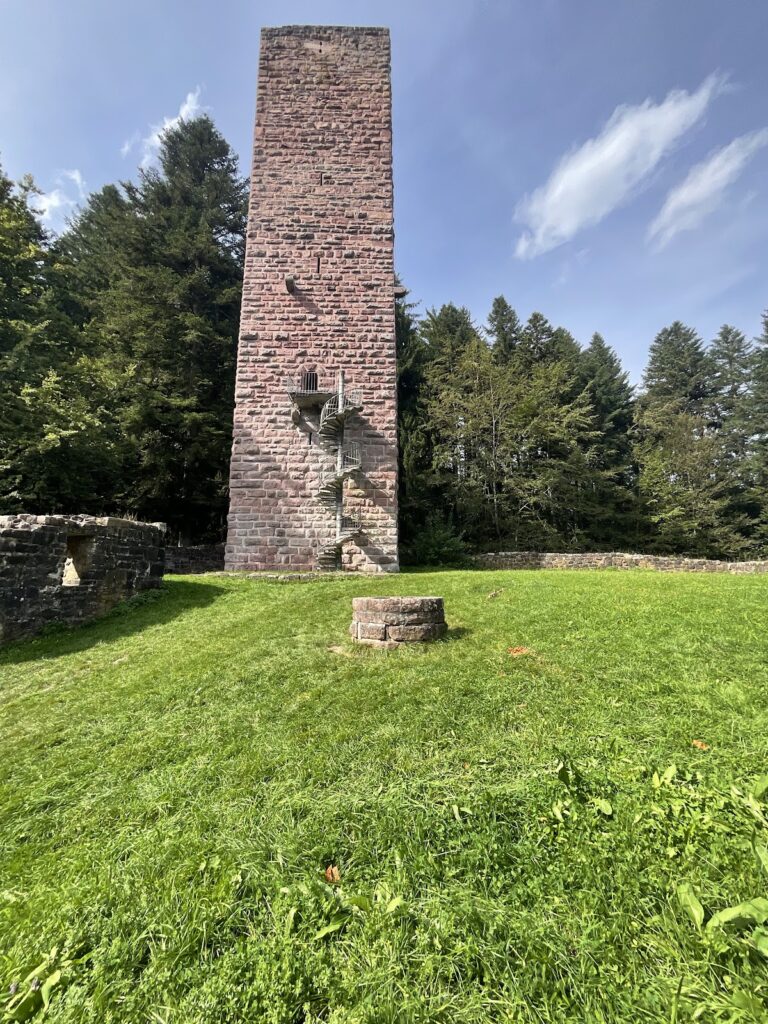
The surviving keep, the principal fortified tower of a medieval castle, has a footprint measuring 7.15 by 6.7 metres. Its walls are approximately two metres thick, and the roofed tower rises about 20 metres. A wooden staircase of 33 steps climbs through the interior, passing an intermediate landing before reaching an observation platform 14.3 metres above the ground. The rebuilt tower is the most prominent surviving element of the ruin.
Defensive works and castle buildings
A superficial examination in 1930 indicated that a shield wall, a particularly strong defensive wall protecting a vulnerable side of a castle, probably stood west of the keep. It was about three metres thick. Because no bond connected the wall to the keep, the wall was probably built later than the tower. The palas, the principal residential and representative building, probably adjoined the shield wall, while service buildings stood opposite it. A fortified gate enclosure was identified in the northeast. Apart from the rebuilt keep and several wall fragments, no visible traces of the former complex survive.
Approach and setting
Fautsburg stands at about 670 metres above sea level on a slope above Rehmühle. The keep is approached from the higher northern side by a path with steps leading to a small wooden bridge at the elevated entrance. The entrance is roofed and flanked by a roughly man-high wooden figure. From the observation platform, the tower overlooks the valley of the Kleine Enz.