Château de Bazouges: A Former Fortress and Renaissance Residence in France


Site at a Glance
- Rating
- 4
- Popularity
- Very Low
- Country
- France
- Primary era
- Early Modern
- Eras represented
- Medieval, Early Modern, Modern
- Civilizations
- French
- Site type
- Domestic
- Remains
- Castle
On this page7 sections
History
Château de Bazouges is a former fortress in France, built in the eleventh century at Bazouges-sur-le-Loir to defend Haut-Anjou against threats from the House of Blois and the County of Maine. It later became a Renaissance Loire residence through successive alterations carried out from the sixteenth through the nineteenth century.
Medieval fortress and Angevin defense
The fortress was substantially remodelled in the fifteenth century, when the Hundred Years’ War, a prolonged conflict chiefly between England and France, affected fortifications and political control across France. Château de Bazouges formed part of Anjou’s defensive system and marked the boundary with the seneschalcy of Baugé and its fief of Durtal. A seneschalcy was a territorial administrative and judicial district governed by a seneschal on behalf of the crown or a major lord. Administratively, the château depended on the seneschalcy of La Flèche, while Durtal Castle dominated the neighboring fief.
The château was associated with the Champagne family, whose members owned it. One fifteenth-century Baudouin de Champagne was a knight and chamberlain to René of Anjou, the fifteenth-century duke of Anjou known as King René. During the war against the English, he served as captain of Le Mans and Tours. A later Baudouin de Champagne became chamberlain to Louis XII and Francis I, successive kings of France in the late fifteenth and early sixteenth centuries, and Francis I appointed him extraordinary ambassador to several kingdoms.
Transformation into a residence
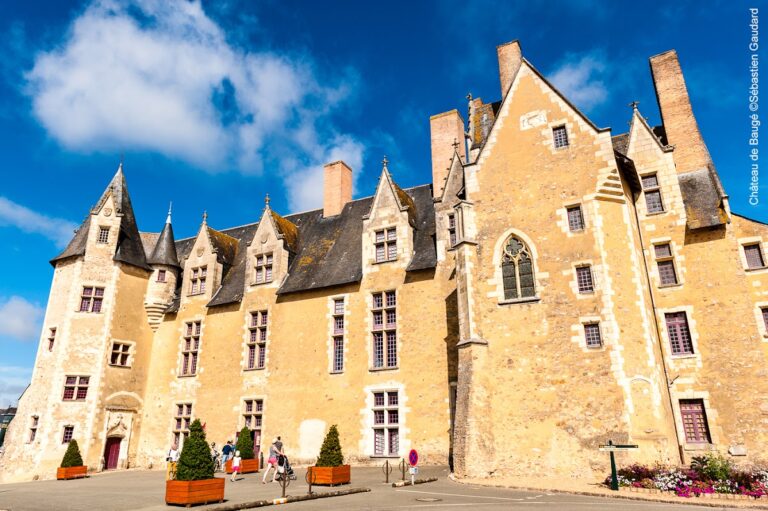
From the sixteenth century onward, successive owners gradually altered the medieval stronghold and converted it into a Renaissance pleasure residence. Residential wings were added over time, producing the configuration that survives today. The château changed ownership in 1910, when Adrien Mithouard purchased it. His descendants retain ownership, and the privately owned property functions as a museum.
Château de Bazouges has been classified as a historic monument since 30 January 1928. Its enclosed outbuildings, mills, inner courtyard, moat, château island, gardens, orchard grounds, and ice house have been registered as historic monuments since 28 December 1994.
Remains
Entrance and medieval defenses
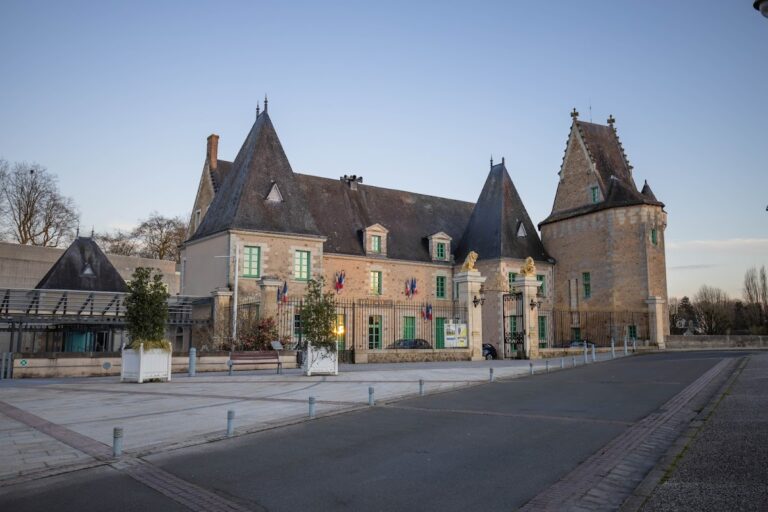
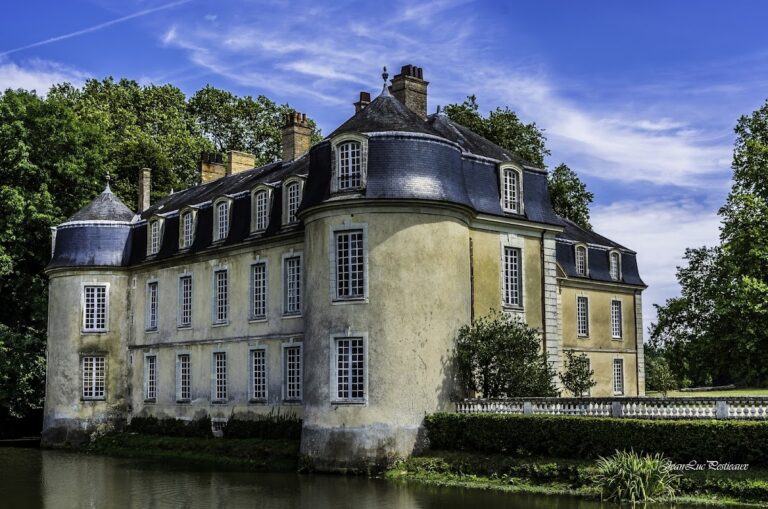
The château stands directly on the banks of the Loir. Its entrance is formed by a gatehouse flanked by two oval towers with conical roofs and machicolations, projecting openings that allowed defenders to observe or attack people below. The entrance complex has early Renaissance features, while the wider medieval setting includes moats, ditches, and a drawbridge.
One of the entrance towers contains a fifteenth-century chapel with an Angevin vault, a broad domed form of Gothic vaulting associated with Anjou and the surrounding region. The medieval complex also includes an orchard, an ice house used to store ice for later use, and the château island enclosed by the surrounding water.
Residential wings and interior spaces
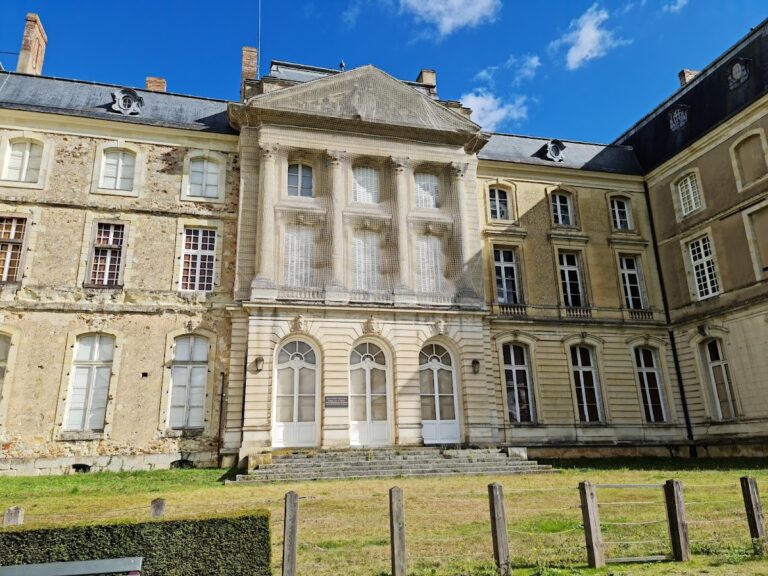
Several residential wings were added progressively as the fortress became a Renaissance Loire château. The guards’ room retains an imposing fireplace, and adjoining salons date from the eighteenth century. Together, these spaces reflect the property’s change from a fortified stronghold into a residence shaped by successive owners.
Gardens and seigneurial mill
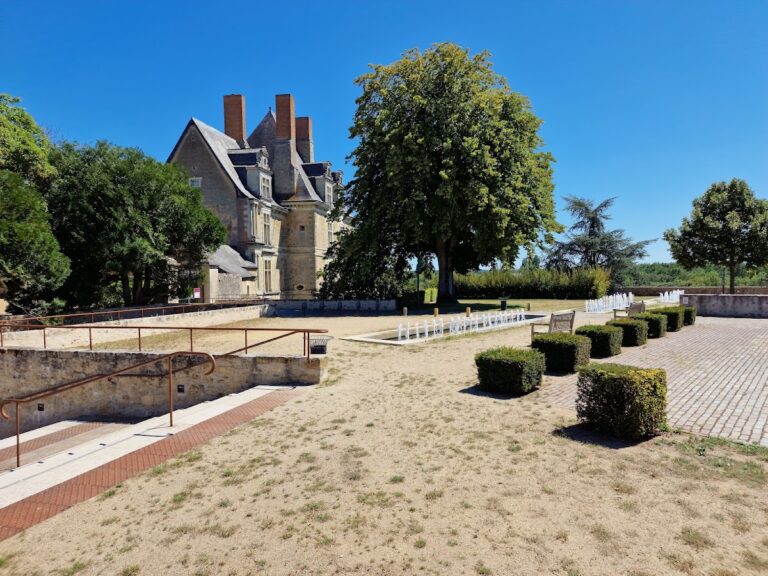
French formal gardens surrounded by water encircle the château. The park contains cypresses and yew trees, while the grounds also include the orchard associated with the medieval part of the complex.
A seigneurial mill in the park was built between the fifteenth and sixteenth centuries. Associated with the lord’s estate, it survives with its millrace, the channel conveying water to or from the mill, together with a wooden transmission mechanism and a wooden waterwheel.
Nearby sites