Scharfeneck Castle Ruin: A Medieval Spur Castle in Germany


Site at a Glance
- Rating
- 4.6
- Popularity
- Very Low
- Country
- Germany
- Primary era
- Medieval
- External website
- Open
- Eras represented
- Medieval
- Civilizations
- Holy Roman Empire
- Site type
- Military
- Remains
- Castle
On this page7 sections
History
Origins and the Scheinfeld Family
Scharfeneck Castle Ruin is a medieval spur castle in Germany, northeast of Oberscheinfeld in Bavaria. Probably founded shortly after 1100 by the Edelfreien of Scheinfeld, medieval nobles of free status, it stood on the Schlossberg in the Steigerwald. Until the sixteenth century, the castle was known as Veste Scheinfeld, or Fortress of Scheinfeld.
The Scheinfeld family originated in Mönchsondheim and can be traced across four generations. Its members included Lupold, Bishop of Worms. The family ended with Friedrich IV, who died on 1 April in a year between 1258 and 1263. No remains of the family’s first castle above Oberscheinfeld have been identified.
Transfer to Bamberg and Medieval Administration
Probably at the beginning of 1197, Friedrich III of Scheinfeld pledged his property to Bishop Timo of Bamberg to secure a loan for preparations for a crusade. The exact date when the castle passed to the Bamberg bishopric remains uncertain, but the transfer probably took place only after 1258. Friedrich III returned from the crusade and was recorded at Erfurt in 1207 with his brother Lupold.
The first documented Bamberg official at the castle was Konrad Zollner, recorded there in 1313. In 1339, the castle appeared in the Bamberg castle-guard register. Johann von Dachsbach, the bailiff and knight of Scheinfeld, received a hearth behind the tower together with vines. After 1366, ownership changed repeatedly. Among the later owners were Albrecht of Wertheim, a Bamberg cathedral canon, and the Knights of Kappel.
Decline, Dismantling, and Conservation
By 1504, the castle was described as dilapidated. Around 1545, Bamberg officials dismantled it and reused its stones to construct a more convenient new castle in the center of Oberscheinfeld. The keep remained on the Schlossberg as a lookout tower.
The surviving tower is maintained as a lookout by the Oberscheinfeld branch of the Steigerwald Club. Repairs and careful replacement of stone took place between 1999 and 2001, including work on the viewing platform.
Remains
Castle Setting and Layout
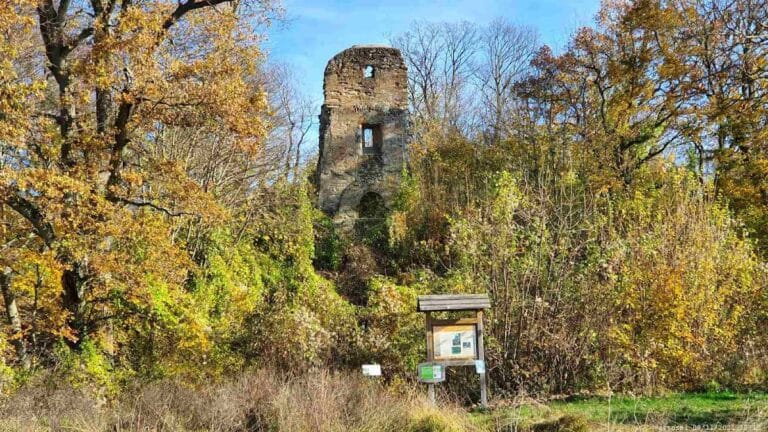
The castle occupied a 425-meter-high spur of the Steigerwald. Two neck ditches, defensive cuts across the narrow connection between the spur and the higher ground behind it, separated the site from the surrounding terrain. The keep is the only standing castle structure and preserves the principal surviving evidence of the medieval complex.
The Keep
The square keep was probably built between 1240 and 1250. It now rises 16 meters, compared with an original height of approximately 20 meters, and measures 7.2 meters along each side. Its walls are 2.8 meters thick, and the tower ends in a viewing platform at 442.6 meters above sea level. As the castle’s principal tower, it probably served authority and representation as well as observation and secure storage.
The tower is built from carefully dressed reed sandstone blocks. Gray sandstone forms the main material, while beige-yellow blocks mark the corners. These corner stones have prominently projecting, bossed faces, a masonry treatment in which the outer surfaces of blocks stand forward in a cushion-like form. The contrasting stones create an ornamental pattern across the tower’s corners.
The west wall retains the original elevated entrance, positioned 10 meters above ground. This entrance led into a small room with a window chamber covered by a rounded-arch Romanesque vault, a heavy medieval form associated with rounded arches and vaulted construction. A fireplace was planned in this area but apparently never built.
In the late nineteenth century, a passage was cut through the masonry at ground level and a wooden staircase with 77 steps was installed. The staircase was renewed in 1972 and 1973 and reduced to 74 steps. A viewing platform now terminates the tower. A chapel dedicated to Saint Catherine was mentioned on the Schlossberg in 1504.