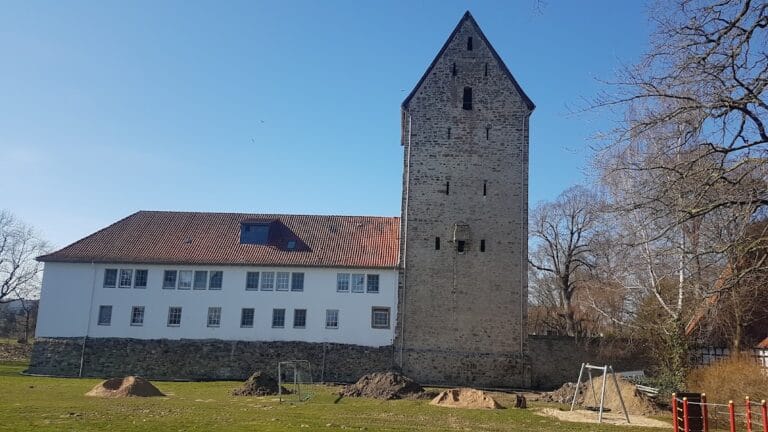
Ellerburg: A Moated Castle and Estate in Germany


Site at a Glance
- Rating
- 4
- Popularity
- Very Low
- Country
- Germany
- Primary era
- Early Modern
- Eras represented
- Early Modern
- Civilizations
- Holy Roman Empire, Kingdom of Prussia
- Site type
- Domestic
- Remains
- Manor House
On this page9 sections
History
Ellerburg was a moated castle and estate in Germany, located in Fiestel, now part of the city of Espelkamp. First mentioned in 1475, the estate belonged at that time to Hardecke von Münch, also recorded as von Monick. Its position on an island surrounded by water made it a water castle, a fortified residence protected by moats or other surrounding water.
Medieval and early modern ownership
In 1510, Ellerburg was divided between Hardecke von Münch’s two sons. The settlement also involved neighboring Benkhausen Castle, linking the ownership history of the two estates. In 1633, Imperial and Swedish troops confronted each other in an engagement for control of the castle during the Thirty Years’ War, the major European conflict that affected much of the German lands in the seventeenth century.
After a prolonged dispute, Ellerburg passed through the female line of inheritance to the von Ripperda family. The family had expanded from the eastern Netherlands and the Emsland into the Minden bishopric, the territory governed by the prince-bishop of Minden. Strategically arranged marriages played a part in this expansion and in the family’s acquisition of estates such as Ellerburg.
Rebuilding and nineteenth-century administration
Around 1795, the Prussian officer Friedrich Wilhelm Freiherr von Ripperda had the estate buildings rebuilt. He was at times stationed at the fortress of Minden. Financial difficulties later weakened the von Ripperda family’s position, and Freiherr Karl von der Horst acquired Ellerburg in 1825. Von der Horst, a former president of the Minden government, had himself been placed in temporary retirement on 24 February 1825 because of disordered financial circumstances.
Karl von der Horst’s son Adolf served as district administrator of the Lübbecke district from 1838 to 1870. He conducted most of his official work from Ellerburg, although he lived at Hollwinkel Castle from 1840. During the 1840s, the Ellerburg estate district was separated from the municipality of Alswede within the Alswede administrative office and the Lübbecke district. An estate district was a separate administrative unit centered on a landed estate rather than an ordinary municipality. The unit was dissolved on 1 October 1928 and divided between Alswede, which received the larger part, and Hedem.
Twentieth-century decline
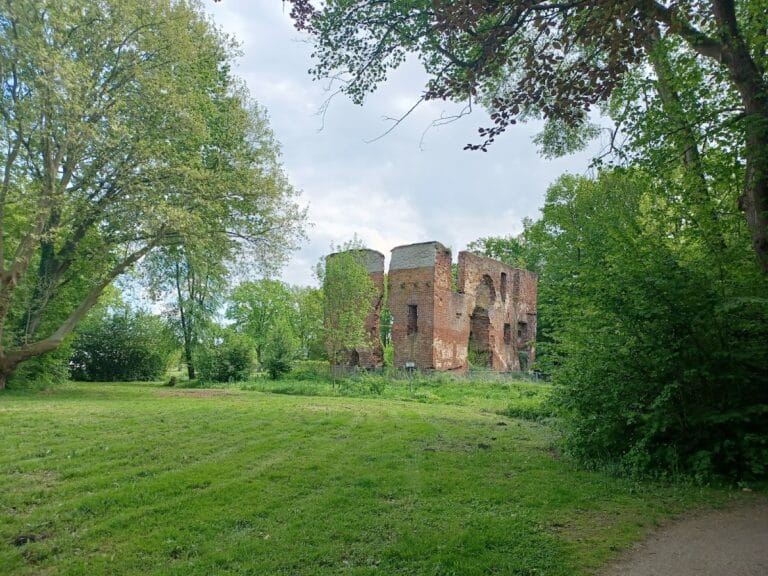
The estate remained in the von der Horst family’s possession until the 1990s, when it became the property of the city of Espelkamp. By then, the buildings had long been at risk of collapse, prompting several preservation initiatives. Demolition was approved in March 2012, with the park and parts of the ruins intended for retention. Around 6 September 2014, the buildings were demolished down to their foundations.
Remains
Moated estate and grounds
Manor house and bridge
The castle complex covered approximately four hectares east of the Große Aue and north of the Mittelland Canal, at the transition between the Alswede lowlands and the Rahden Geest. A Geest is a relatively elevated, sandy or gravelly landscape beside lower and wetter lowlands. The manor house stood on a small island enclosed by moats, while a representative stone bridge led to the estate courtyard. The buildings were severely deteriorated and structurally dangerous before their removal, leaving the foundation walls as the level to which they were demolished.
Ellerburger Mühle
North of the manor house stood the Ellerburger Mühle, a watermill driven by the impounded bypass channel of the Große Aue. In 1595, Johann Monnich of Ellerburg transferred the mill to Curdt von Aßweide, senior of the Minden cathedral chapter, to settle his debts. The mill forms part of the Westphalian Mill Route, a regional heritage route linking historic mills in Westphalia.
Avenues, trees, and meadowland
An avenue of chestnut trees along the southeastern edge of the grounds originally connected Ellerburg with Hollwinkel Castle. Three very old lime trees stood in the building area, including one in the castle courtyard estimated to be about 400 years old. The Ellerburger Wiesen nature reserve consists largely of former agricultural land that belonged to the estate.
Nearby sites