Wesenberg Castle: A Medieval Motte-and-Bailey Fortress in Germany


Site at a Glance
- Rating
- 4.1
- Popularity
- Low
- Country
- Germany
- Primary era
- Medieval
- External website
- Open
- Eras represented
- Medieval
- Civilizations
- Holy Roman Empire
- Site type
- Military
- Remains
- Castle
On this page8 sections
History
Wesenberg Castle is a medieval motte-and-bailey fortress in Germany, founded by Prince Nicholas I of Werle in the mid-thirteenth century to protect the city of Wesenberg. Its construction period is broadly dated from around 1200 to 1276, placing it within the high Middle Ages and the period when a ruling lordship in the southern Baltic region established fortified centers of authority.
Contested medieval stronghold
From 1276, the castle changed hands repeatedly during the Mecklenburg-Brandenburg disputes, also known as the Margrave Wars. These struggles involved competing territorial claims between the ruling powers of Mecklenburg and Brandenburg, making the castle’s position important to control of the surrounding region.
From 1329, the Mecklenburg rulers held the Land of Stargard as a fief, a territory granted under feudal allegiance. In 1352, Mecklenburg-Stargard became an independent duchy under John of Mecklenburg, a ruler of a branch of the Mecklenburg dynasty. Wesenberg Castle temporarily served as the residence of Catherine, the widow of Duke Ulrich II of Mecklenburg-Stargard.
Administrative use and destruction
After 1500, the castle became a princely administrative office, a territorial institution managed on behalf of the ruling prince. Its military and residential importance declined during the early modern period. The complex was largely destroyed during the Thirty Years’ War, with a fire in 1630 specifically associated with its destruction. Around 1660, the Great House was described as uninhabitable, and by about 1677 the castle was regarded as completely derelict.
Later management and present use
In 1752, the castle grounds passed to the ducal chamber. A local administrative officer was appointed as manager in 1812. The original residential building was later replaced by a plain structure, which was destroyed by fire twice and rebuilt after each fire. After 1950, the building was used by the forestry administration.
The city of Wesenberg now owns the castle. The site houses the local tourism office and the Heimatstube, a local-history collection concerned with fishing, forestry, and regional history. A castle association was founded in Wesenberg in 1994.
Remains
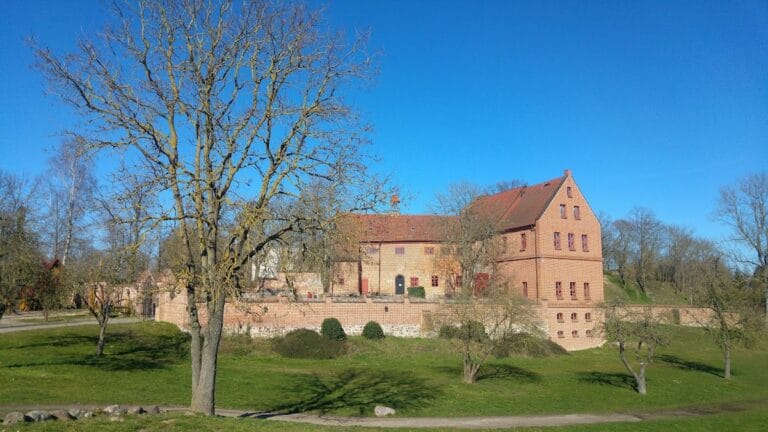
Wesenberg Castle stands on a hill northeast of the city in Mecklenburg-Vorpommern. It is identified as both a lowland castle and a motte-and-bailey castle, a type that combined a raised earthwork mound carrying a fortified tower with an adjoining enclosed area for other buildings and activities. The surviving fabric represents only part of the medieval complex, whose construction is broadly dated from around 1200 to 1276.
Fortified tower
The principal surviving medieval structure is the torso, or remaining main body, of the bergfried, also called the Fangelturm. A bergfried was a fortified castle tower used mainly for defense and refuge rather than as an ordinary residence. At Wesenberg, this remnant preserves the central defensive element of the original castle, although the tower survives only in fragmentary form.
Encircling walls
An adjoining remnant of the former encircling wall survives beside the tower. Additional sections of the castle wall remain on the southern side. Together, these fragments indicate the defensive boundary of the medieval stronghold and preserve parts of its relationship to the raised castle site.
Residential buildings
The Great House was the residential building within the castle complex. It had become uninhabitable by about 1660 and was later described as completely ruined. The original residence was subsequently replaced by a plain building, which was twice destroyed by fire and rebuilt after each occurrence. This later structure reflects the continued adaptation of the castle grounds after the medieval residential complex had been lost.