Husen Castle: A Medieval Tower House and Estate in Dortmund



Site at a Glance
- Rating
- 4.5
- Popularity
- Low
- Country
- Germany
- Primary era
- Early Modern
- External website
- Open
- Eras represented
- Early Modern, Modern
- Civilizations
- Holy Roman Empire, Kingdom of Prussia
- Site type
- Military
- Remains
- Castle
On this page7 sections
History
Husen Castle is a medieval tower house and historic estate in Germany, located in Dortmund-Syburg. Its origins probably reach back to the thirteenth century, and the site was first mentioned in 1259. The estate, also known as Ten Husen or Haußen, was the ancestral seat of the von Husen family and belonged to the County of Mark, a historical territory in Westphalia.
Origins and Noble Inheritance
Around 1330, Johann von der Husen held the estate as a feudal tenant of the Counts of Dortmund. A feudal tenant held land from a higher-ranking lord in return for obligations such as service or payment. The property later changed hands through the marriages of the daughters of the knight Aleve, also called Adolf, van Husen. The lower and upper farms passed to Godert von Frydag and Arnt von Frydag, after which the estate came to the von Romberg family.
In 1479, Diedrich von Aldinghof of Laer married Christine von Romberg. Their son, Vinzenz von und zu Laer, inherited Husen after his marriage in 1524 to Margarethe von Eller zu Lobach. Vinzenz served as a Droste of Zons and Menden, a regional administrative and judicial official broadly comparable to a bailiff or governor. In 1585, Anton von Laer sold Husen to Bernhard von Romberg, lord of Massen, returning the estate to the von Romberg family.
From the Rombergs to the Nineteenth Century
Bernhard’s daughter, Christina Cunegunda von Romberg zu Massen, inherited the property. She married Dietrich Wilhelm Abraham von Syberg zu Wischelingen, a captain in the service of Electoral Brandenburg. Electoral Brandenburg was the state ruled by the Margrave-Electors of Brandenburg before the later Kingdom of Prussia. The marriage produced no children.
The estate later passed to Goswin Friedrich, Baron von Romberg, who lived from 1736 to 1768. He was the grandson of Christina Cunegunda’s brother, Johann Friedrich von Romberg, who died in 1706. In 1767, Goswin Friedrich probably sold Husen to his sister, Josina Engel Christina von Romberg, who was married to Wilhelm Gisbert, Baron von Frydag zu Lippholthausen.
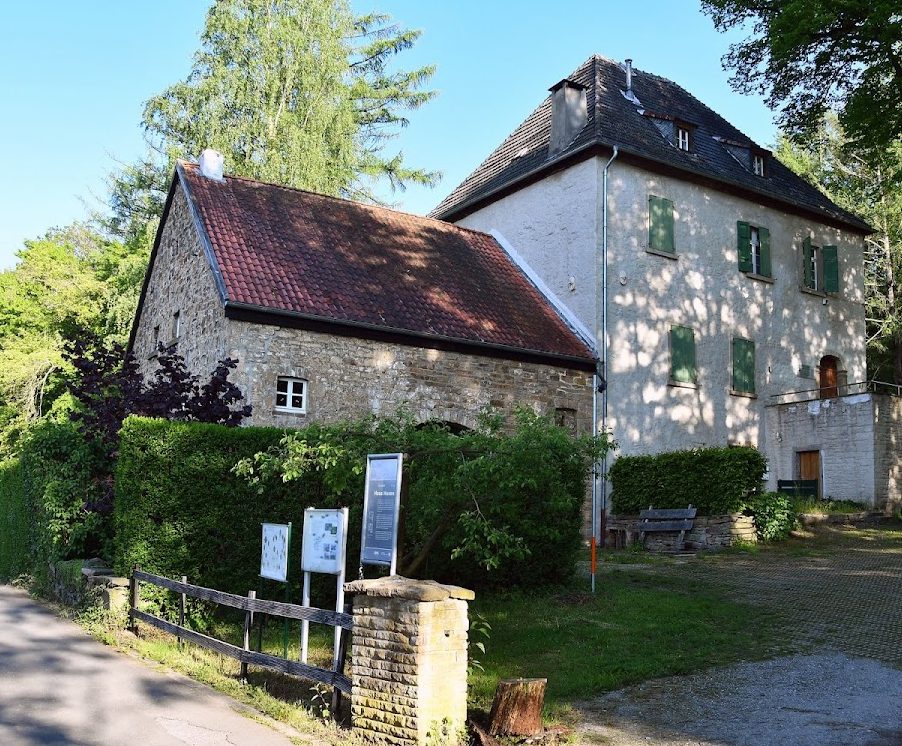
In 1801, Husen passed to the Prussian major Samuel Louis von Favre des Coffrane and then to Lieutenant Franz Schulz. The royal confirmation of Schulz’s acquisition followed in 1804. In 1830, a Neoclassical manor house, Gutshaus Husen, was built directly beside the older house because the original building no longer met contemporary requirements. The inheritance passed in 1850 to Helena Sophia, Baroness von der Leithen, née Schulz, and later to her daughter Marie von der Leithen. In 1903, the property passed to the von Basse family.
Modern Ownership and Protection
Haus Husen came into the possession of the Protestant Church of Westphalia in 1956. Since 1984, Husen Castle has belonged to the Westphalia regional branch of the Association of Christian Guides and Scouts, a German Christian youth-scouting organization. The property serves as a youth holiday home and youth campsite. The tower house is listed as a protected building in the monument register of the City of Dortmund.
Remains
Medieval Tower House
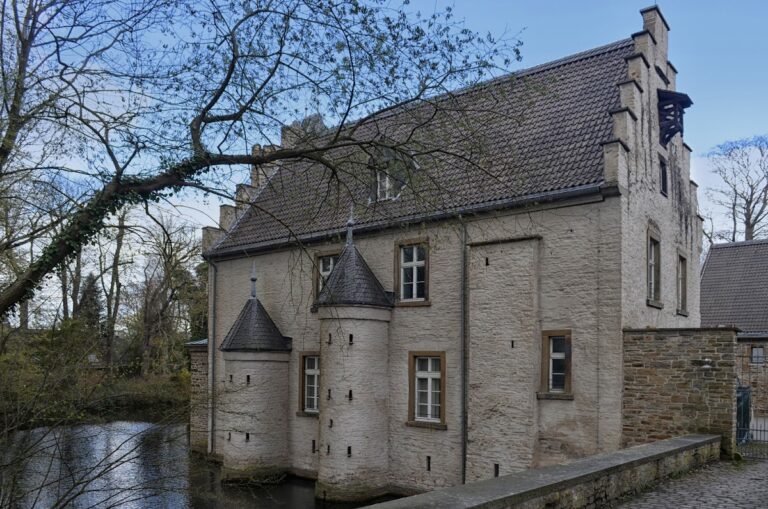
The surviving medieval tower house has a rectangular core measuring 9.3 by 11.3 metres. Its walls are built from rubble masonry, using irregularly shaped Ruhr sandstone, a local building material. Although the site probably originated in the thirteenth century, the present form of the tower house dates to the seventeenth century. The older building stands beside the Neoclassical manor house erected in 1830, preserving the physical relationship between the estate’s earlier residence and its later replacement.
Estate Grounds and Setting
The associated property covers approximately 7,000 square metres and includes meadows and stands of trees. It lies within the urban triangle formed by Dortmund, Schwerte, and Hagen, not far from the Ruhr and from Hohensyburg, a historic hilltop site known for the Kaiser Wilhelm Monument dedicated to the German emperor Wilhelm I.
Nearby sites