Schloss Werdringen: A Water Castle and Archaeological Museum in Germany


Site at a Glance
- Rating
- 4.5
- Popularity
- Medium
- Country
- Germany
- Primary era
- Medieval
- External website
- Open
- Eras represented
- Medieval, Modern
- Civilizations
- Holy Roman Empire
- Site type
- Military
- Remains
- Castle
On this page11 sections
History
Schloss Werdringen is a medieval water castle in Germany that developed from a fief of the Lords of Volmestein into a noble residence and, later, a regional archaeological museum. It is first recorded in the mid-thirteenth century, when it belonged to the possessions of the Archbishops of Cologne. The medieval complex consisted of several fortified buildings, and its later rebuilding created the water-castle form that survives today.
Medieval lordship and rebuilding
From the thirteenth to the fifteenth century, Werdringen was held by the knightly Dobbe family. The Dobb es were connected with Dortmund’s urban nobility, related by marriage to the Lords of der Recke, and associated with the Counts of the Mark, a medieval and early modern territory in what is now western North Rhine-Westphalia. After the Counts of the Mark conquered Volmarstein Castle in 1324, Werdringen became part of the County of Mark.
Ownership changed several times during the late Middle Ages and early modern period. The estate passed among the Dobbe, Düdinck, Haer, Capelle, von Berchem, and von Grüter families. In 1617, the barons of der Recke-Volmerstein received the entire estate as heirs of the extinct Dobbe family.
The aristocratic seat suffered major damage during the Soest Feud, a fifteenth-century conflict in and around the city of Soest. It was shelled, partly destroyed, and burned in 1449. Reconstruction during the fifteenth century transformed the fortified seat into a water castle.
Later residence and nineteenth-century transformation
By the end of the eighteenth century, the complex was badly damaged and partly ruinous. In 1800, its wooden drawbridge was demolished and replaced with a permanent stone bridge. The ring walls, which had once stood more than 2 metres high, were dismantled to about half that height.
In 1850, a branch of the von der Recke von Volmerstein family returned to Werdringen. Count Friedrich Wilhelm von der Recke-Volmerstein received the estate from his father, Ottomar, as a residence for his marriage to Baroness Louisa von Plessen. In 1856 and 1857, he renovated and enlarged parts of the medieval and early modern buildings in the Neo-Gothic, or historicist, style. The chapel and tower belong especially to this phase.
Count Ottomar also established a mausoleum in the wooded Kaisberg area beside the castle. It served as a burial place until about 1880. In 1895, Count Otto von der Recke-Volmerstein moved the family residence to Silesia. Werdringen then became an overseer’s residence and later an agricultural property, while the complex increasingly deteriorated during the twentieth century.
Repair, public ownership, and museum history
The Bochum civil-engineering contractor Niebur acquired the castle in the late 1920s and undertook repairs after its prolonged decline. These included new slate roofing for all the towers and the replacement of the old bridge over the moat. During the National Socialist period, the castle was transferred to the German Labour Front, the state organization that replaced independent trade unions and controlled labour institutions and activities. A model settlement was planned for the surrounding area, and in 1939 Werdringen was designated as a proposed branch of Hagen’s Sauerland Friedrich Harkort Museum.
The City of Hagen acquired Werdringen in 1977. Extensive renovation began in 1985 in cooperation with a citizens’ association and culminated in the establishment of a museum of prehistory and early history. A permanent exhibition opened on 7 November 2004 as a museum of the City of Hagen and a branch of the Historic Centre Hagen. The institution was renamed Archaeological Museum Hagen in 2021.
The museum’s collections grew from more than 200 years of geological and archaeological discoveries in the region. Important collections assembled in the nineteenth and early twentieth centuries by Friedrich Harkort, a German industrialist and public figure, and Karl Ernst Osthaus, an industrialist, art collector, and patron of the arts, entered the Sauerland Museum of Prehistory and Early History during the 1930s. Much of that collection was lost when the museum building was destroyed by bombing between 1943 and 1945.
From 1975, the archaeologist Wilhelm Bleicher brought the surviving Hagen collections together at Hohenlimburg Castle. That museum was dissolved in 2002 after operating in severely restricted accommodation, and the opening at Werdringen in 2004 provided a scientifically based presentation of the regionally important holdings. The Archaeological Museum Hagen cooperates with the universities of Münster and Cologne, other research institutes, and archaeological heritage authorities. It is directed by Ralf Blank.
Werdringen lies within a protected landscape area named for the castle. Its natural and archaeological importance has also contributed to recognition as a regionally significant cultural-landscape area. The surrounding landscape has supported fossil and archaeological discoveries for more than 200 years.
Remains
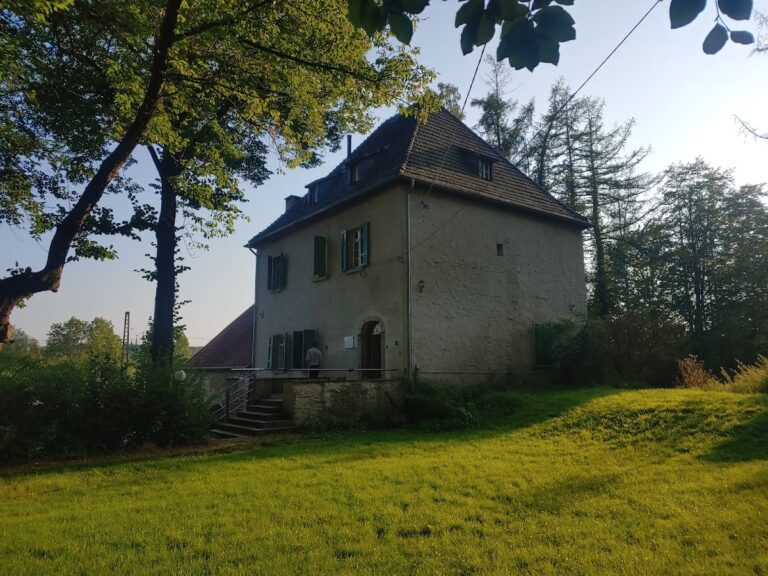
Schloss Werdringen stands in Hagen-Vorhalle near the Ruhr, below the Kaisberg and close to the Harkortsee reservoir. Mature trees surround the water castle, whose buildings are enclosed by moats and other water-filled ditches. The surviving complex combines medieval and early modern fabric with the Neo-Gothic additions of 1856 and 1857. A possible motte, an earth mound used for a fortified residence, also survives, although the relationship between this feature and the later castle has not been established.
Castle buildings and water defences
Manor house
The thirteenth- or fourteenth-century manor house retains its stepped gable. It remained largely unchanged during the nineteenth-century rebuilding, allowing this part of the castle to preserve its medieval and early modern character within the later water-castle complex.
Residence and carriage house
A late-medieval building originally used as a residence was later converted into a carriage house. It too remained largely unaltered during the nineteenth-century work. The stone bridge now provides the permanent crossing that replaced the wooden drawbridge in 1800, while later repairs included another replacement of the old bridge and new slate coverings for the towers.
Chapel, tower, and walls
The chapel and tower are characteristic survivors of the 1856–1857 Neo-Gothic phase. The ring walls preserve only about half of their former height, having once exceeded 2 metres. The castle’s moats and ditches retain ecological value, supporting rare animal and plant species, including varied amphibian life and numerous protected dragonfly species.
Mausoleum
The castle’s associated mausoleum stands in the wooded Kaisberg area. Count Ottomar established it as a family burial place, and it remained in use until about 1880.
Museum collections and exhibition
An ancillary castle building houses the Archaeological Museum Hagen. Across three floors, the exhibition presents geological and archaeological finds spanning 450 million years in the southern Ruhr region, the Sauerland, the central Ruhr valley, and the lower Lenne valley. Its sequence follows the development of life and settlement from the Ordovician, Carboniferous, Cretaceous, Tertiary, and Ice Age periods through human settlement from the Paleolithic to the Middle Ages.
The former Vorhalle brickworks quarry near the castle produced the oldest known flying insects in the geological record. These insects lived during the Carboniferous, approximately 316 million years ago. Archaeological material includes three long swords from the later Bronze Age, found at the foot of the Kaisberg in 1876 and regarded as among North Rhine-Westphalia’s archaeological treasures.
Human remains from the early Mesolithic, or Middle Stone Age, were found and scientifically investigated in the Blätter Cave at Hagen. The collections also contain a small bronze water-bird sculpture from the Hallstatt period, an early Iron Age period in central Europe conventionally dated to approximately the eighth through sixth centuries BC. The object reached the Sauerland from the southern Alpine region.
Other exhibition areas include finds from the Balver Cave and regional sites, together with material from Raffenburg that illustrates everyday life at a thirteenth-century territorial castle. Original objects are supplemented by scientific reconstructions and museum-quality models. The entrance contains a dermoplastic reconstruction, a three-dimensional animal model based on anatomical and scientific evidence, of a mammoth measuring 3.70 metres high and 6.50 metres long. Reconstructions of a woolly rhinoceros and a reindeer accompany a life reconstruction of the giant dragonfly Namurotypus sippeli, made by preparator and palaeontologist Werner Kraus. Practical stations provide hand axes and other tools for study.
Nearby sites