Rio Castle: An Ottoman and Venetian Fortress in Greece


Site at a Glance
- Rating
- 4.7
- Popularity
- Low
- Country
- Greece
- Primary era
- Early Modern
- Eras represented
- Early Modern
- Civilizations
- Ottoman, Venetian
- Site type
- Military
- Remains
- Castle
On this page12 sections
History
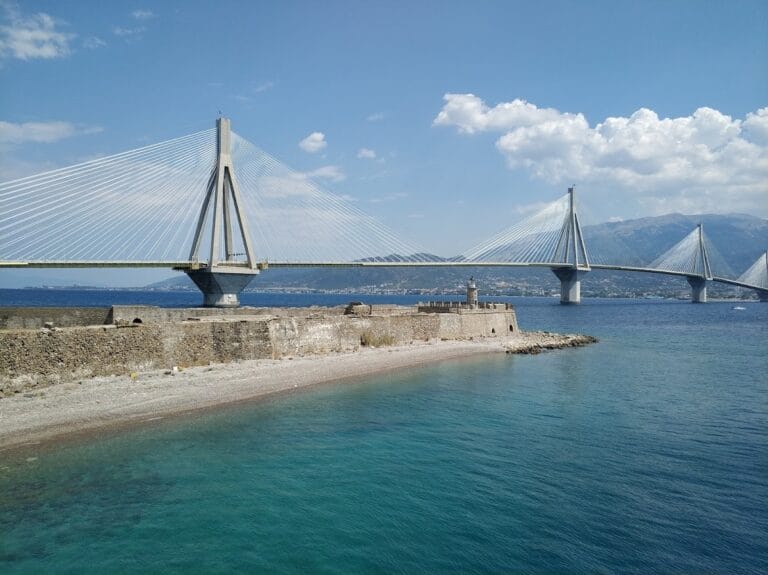
Rio Castle is a coastal fortress in Greece, built by the Ottoman Empire in 1499 on the northern tip of the Peloponnese. Rising on the southern shore of the strait between the Gulf of Patras and the Gulf of Corinth, it controlled access to the Gulf of Corinth together with the fortress of Antirrio on the opposite shore.
Ancient foundations and Ottoman construction
The location had been fortified under Roman rule, and a temple dedicated to Poseidon stood at or near the site. The present castle was ordered by Ottoman Sultan Bayezid II, who ruled from 1481 to 1512. Construction reportedly took only three months and used the ruins of the ancient temple. The paired fortresses of Rio and Antirrio became known as the “Little Dardanelles,” while the Romans referred to the passage as the “jaws of the Gulf of Corinth.”
Sixteenth- and seventeenth-century conflicts
Genoese forces commanded by the admiral Andrea Doria seized Rio Castle briefly in 1533. The Ottomans recovered it later in the same year. The Knights of the Order of Saint John seriously damaged the fortress in the early seventeenth century.
Venice captured Rio Castle during the Morean War in 1687, a late-seventeenth-century conflict between Venice and the Ottoman Empire for control of the Peloponnese and nearby strategic positions. During the siege, the Ottoman powder magazine exploded and caused extensive destruction. The Venetians then rebuilt the fortress, strengthened it with new towers and the bastions of Saint Mark, Saint Mary, and Saint Anthony, equipped it with 60 cannon, and added a small chapel. The Church of the Life-Giving Spring also dates from this Venetian phase.
French transfer and later military use
The Ottomans retook Rio Castle in 1715 and held it until 1828, when the garrison surrendered to the French expedition commanded by General Nicolas Joseph Maison. Maison led the French Morea expedition, and the French repaired the fortress before transferring it to the Greek authorities.
Between 1831 and 1912, the castle first operated as a military prison and later as a civilian prison. The Municipality of Patras employed prisoners in street-cleaning work in Rio. During the Second World War, German forces stationed a garrison there. In the Greco-Italian War of 1940–1941, thick metal chains were stretched across the strait between Rio and Antirrio to prevent enemy ships from entering the Gulf of Corinth.
Rio Castle is owned by the Greek Ministry of Culture and the Ephorate of Antiquities of Achaia. It is recognized in Greece as an archaeological site, a legally protected building, and an ancient monument. Its present use includes cultural events, particularly concerts.
Remains
The fortress occupies a coastal promontory and follows a polygonal plan that is broadly triangular. Two corners face the shore, while the third points toward the mainland. The sea protects the northern side, and a broad seawater moat defends the southern side. The moat connects with the sea and contains two outer defensive works, or ravelins, linked to the main fortress by stone bridges. The principal entrance also crosses the moat by a bridge.
Gates and defensive works
Land and sea gates
Two gates serve the fortress. A central land gate opens toward the mainland, while a sea gate connects the enclosure with the coastal side. Together with the walls and bastions, they form the principal defensive system.
Moat and ravelins
The seawater moat forms the major southern defense. Its two ravelins stand beyond the main walls and are joined to the fortress by stone bridges, protecting the approaches and the principal entrance.
Venetian bastions
The Venetian reconstruction added the bastions of Saint Mark, Saint Mary, and Saint Anthony, as well as new towers. The fortress was equipped with 60 cannon during this period, giving the rebuilt enclosure a heavily armed role in controlling the strait.
Central and religious buildings
Eastern building
A taller building with circular sections occupies the central part of the eastern side. It rises within the defensive enclosure and forms one of the castle’s prominent surviving structures.
Venetian chapel and Church of the Life-Giving Spring
A small chapel was added during the Venetian rebuilding. The Church of the Life-Giving Spring was also constructed in that period, preserving a religious element within the fortress complex.
The Rio–Antirrio Bridge now lies beside the castle, and ferry piers occupy both sides of the surrounding crossing. These modern structures are part of the present physical setting of the fortress and its strait.
Nearby sites