Kropsburg: A Medieval Hilltop Castle in Germany


Site at a Glance
- Rating
- 4.2
- Popularity
- Low
- Country
- Germany
- Primary era
- Early Modern
- External website
- Open
- Eras represented
- Early Modern
- Civilizations
- Holy Roman Empire
- Site type
- Military
- Remains
- Castle
On this page8 sections
History
Kropsburg is a medieval hilltop castle in Germany, associated with St. Martin in the southern Palatinate. It was established under the Hohenstaufen dynasty around 1200 as part of a chain of castles protecting the imperial castle of Trifels, approximately 20 kilometres away, and observing the Rhine Plain.
Hohenstaufen Foundation and Feudal Lordship
Kropsburg was initially the seat of a ministerial, a member of the medieval service aristocracy who held administrative or military responsibilities for a ruler or ecclesiastical lord. After the Hohenstaufen dynasty ended in the second half of the thirteenth century, the castle passed to the Bishopric of Speyer, an ecclesiastical principality governed by the bishop of Speyer. The bishop granted parts of Kropsburg as feudal holdings to noble families including the Kropsberg, Ochsenstein, and Odenbach families.
A small lordship was attached to the castle and included St. Martin, Maikammer, and Winnweiler. Inherited rights gradually turned Kropsburg into a co-owned castle, with several proprietors holding divided rights and residences. The complex consequently developed into an upper castle and a lower castle.
The Kämmerer von Worms
Johann III Kämmerer von Worms acquired a house within Kropsburg from his son-in-law Merkel von Kropsburg in 1323. In 1345, he purchased Merkel’s entire half-share in the castle and its associated estates. His descendants obtained the remaining half between 1393 and 1439, bringing the whole castle into the possession of the Kämmerer von Worms, a noble family whose members held and expanded rights at Kropsburg.
Johann XXII Kämmerer von Worms ruled Kropsburg and St. Martin from 1492 to 1531. His elaborate tomb remains in St. Martin’s parish church. A chapel dedicated to Saint Giles was documented at Kropsburg in 1522. Georg von Schwalbach, cathedral custodian and general vicar of the Bishopric of Speyer, authorized the preservation of the Blessed Sacrament, the consecrated Eucharist kept for Christian worship, and allowed the chaplain of St. Martin to provide pastoral care there.
Destruction and Later Reuse
Kropsburg survived the German Peasants’ War and the Thirty Years’ War with little damage. French troops completely and permanently destroyed it in 1689 during the War of the Palatine Succession, a late-seventeenth-century European conflict in which French forces campaigned in the Palatinate.
In 1771, Jakob Amandus von Dalberg built a new aristocratic residence from the ruins in the courtyard of the lower castle. The Dalberg family had links with Kropsburg, which was formerly a seat of the knights of Dalberg. After later alterations and modernization, the residence was used as a restaurant during the twentieth century. That restaurant later closed, while a newer restaurant was established in the outer bailey.
Remains
Hilltop Setting and Castle Layout
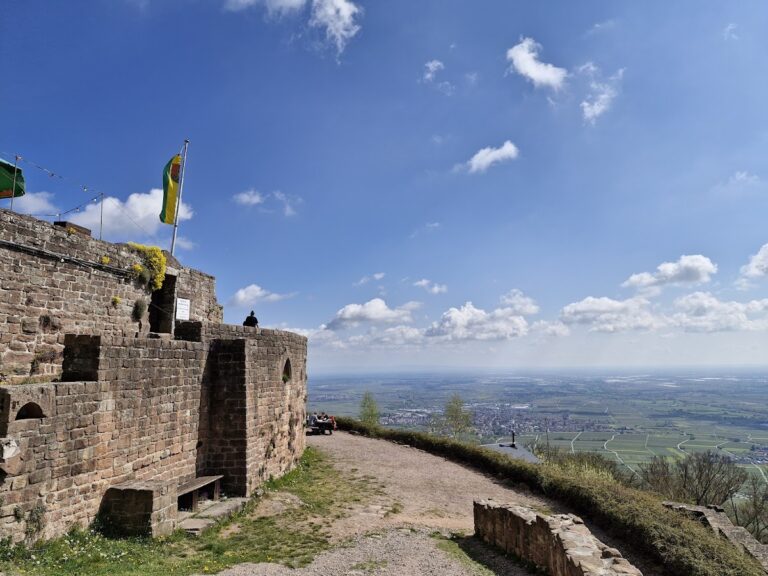
Kropsburg occupies a hilltop spur at approximately 331 metres above sea level, south of St. Martin, on a foothill of the 635.3-metre Hochberg in the Haardt range. The site stands at the transition between the Palatinate Forest and the Rhine Plain, in an elevated position overlooking the plain. The Kropsbach flows through the valley north of the castle from west to east before joining the Speyerbach near Hanhofen. The complex comprised an upper castle, a lower castle, and an outer bailey, with the surviving remains principally associated with the lower castle.
Lower Castle and Later Residence
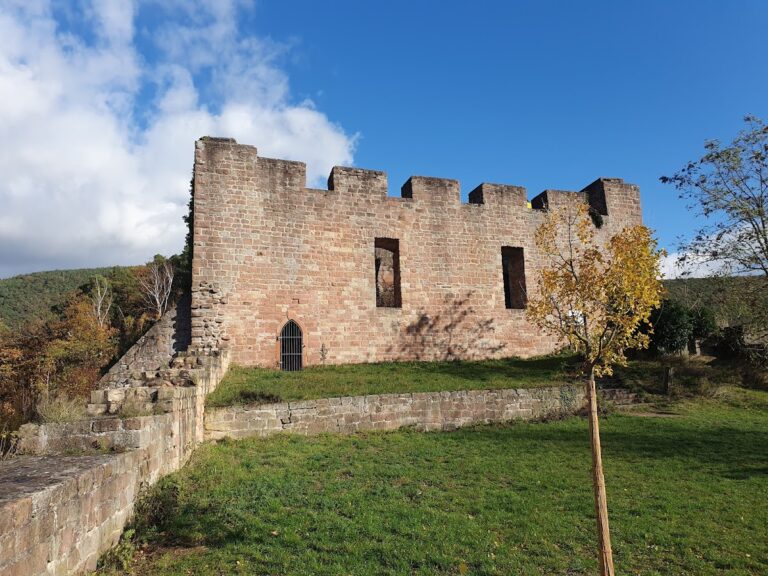
The lower castle contains the courtyard where the medieval complex was destroyed and where the 1771 aristocratic residence was built from its ruins. This later building represents a post-medieval reuse of the lower castle site. Its subsequent alterations and modernization reflect a later phase of use, when the residence served as a restaurant during the twentieth century.
Chapel and Outer Bailey
The castle chapel was dedicated to Saint Giles and formed part of Kropsburg’s religious life by 1522, when permission was granted for the Blessed Sacrament to be preserved there and for pastoral care to be provided by the chaplain of St. Martin. A newer restaurant stands in the outer bailey, which also provides a panoramic view across the Rhine Plain.
Nearby sites