Wildegg Castle: A Medieval Fortress and Renaissance Palace in Austria


Site at a Glance
- Rating
- 4.5
- Popularity
- Low
- Country
- Austria
- Primary era
- Medieval
- External website
- Open
- Eras represented
- Medieval, Early Modern
- Civilizations
- Duchy of Austria, Holy Roman Empire
- Site type
- Military
- Remains
- Castle
On this page7 sections
History
Wildegg Castle is a medieval fortress and later Renaissance palace in Austria, standing at Sittendorf in the Wienerwald. It was probably built between the foundation of Heiligenkreuz Abbey, a Cistercian monastery in Lower Austria, in 1133 and its first documentary mention in 1188 as “Wildekk.” Its position on a rocky elevation formed part of a defensive belt along the Wienerwald, intended to protect against incursions by Hungarians from the east.
The Wildegger and Altenburger Families
Heinrich, the first known Wildegger, probably built the castle, although the family’s origins remain uncertain. The Wildegger family held it until 1261. Konrad von Wildegg, its last member, was buried at Heiligenkreuz Abbey. Through the inheritance of his daughters, the property passed to the Altenburger family.
The Altenburger-Wildegg family probably lost the castle in 1346. Leutold Veusel, a forest master whose estate also included Sparbach and parts of Alland, then became its owner. Ownership changed repeatedly until 1486, including a period when the mercenary commander Hans Holuber held the property. It was later sold to the Neidecker family.
Renaissance Palace and Abbey Property
Under the Neideckers, the medieval fortress was transformed into a Renaissance palace. The Renaissance was a European cultural and architectural period associated with renewed interest in classical forms. The family adopted Protestantism during the Reformation, producing repeated conflicts with Heiligenkreuz Abbey. The Neideckers were consequently buried in the nearby church at Sittendorf rather than at the abbey.
The castle was greatly enlarged in 1621, but increasingly frequent Ottoman incursions caused severe damage, particularly during the Second Ottoman Siege of Vienna, the Ottoman campaign against Vienna in 1683. The Neideckers could not finance the repairs, so the palace was sold to Heiligenkreuz Abbey on the advice of Leopold I, a Habsburg emperor of the Holy Roman Empire. Leopold wanted to hunt there but could not afford to buy it himself, while the abbey had to sell other nearby properties to raise the purchase money.
Abbot Clemens Schäffer began repairs immediately, including the installation of a new roof. Administrators appointed by the abbey, which had regained strength during the Counter-Reformation, lived at Wildegg until 1776. The Counter-Reformation was the Catholic Church’s institutional and religious response to the spread of Protestantism. During this period, the complex reached its present size.
Twentieth-Century Survival and Use
A Catholic hiking association leased the castle in 1923 and renovated it over the following years. In 1945, Waffen-SS units, the armed branch of the SS in Nazi Germany, temporarily occupied the building and intended to establish a base there, bringing it close to destruction. Advancing Soviet troops planned to blow up the castle, but a member of the hiking association negotiated with them and prevented its destruction.
The Catholic Children’s Movement, a Catholic organization focused on children’s religious education and youth activities, was founded at Wildegg in 1947 and operated the castle as a self-catering house. Since 1986, the Catholic Children’s Movement of the Archdiocese of Vienna has owned the property. Wildegg is protected as a monument. Its literary history also includes Ida Friederike Görres’s 1949 short story The Bride of Alexis, written by the twentieth-century German Catholic writer and set at the building shortly after the 1683 Ottoman siege, when the story calls it Wildegg Palace.
Remains
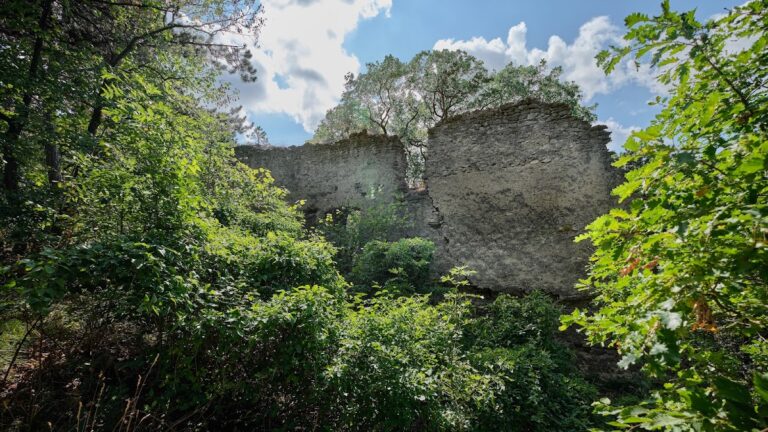
Wildegg Castle stands on a steeply descending rock at about 460 metres above sea level in Sittendorf, within the Wienerwald Nature Park and at the edge of the Sparbach Nature Park. The complex forms a high, strongly vertical fortress on an irregular, approximately triangular medieval ground plan. Much of the present building follows the foundations of the medieval castle. The original structure was only one storey high, and its moat was later filled in.
Medieval Fabric and Later Towers
The lower storey contains partly unplastered ashlar masonry from the twelfth century. Ashlar is masonry made from carefully shaped stone blocks. The section containing the tower and chapel was built later than the earliest castle. The southeast tower rises above the roofline and is covered by a tent-shaped roof, while the Renaissance rebuilding brought the various roof forms into a unified roofscape.
Renaissance Courtyard
North of the main fortress stands the triangular Renaissance courtyard, described as the first of its kind north of the Alps. Its form belongs to the rebuilding that changed the medieval castle into a Renaissance palace while retaining much of the earlier ground plan.
Nearby sites