Barnard Castle: A Medieval Fortress Above the River Tees


Site at a Glance
- Rating
- 4.6
- Popularity
- Medium
- Country
- United Kingdom
- Primary era
- Medieval
- External website
- Open
- Eras represented
- Medieval
- Civilizations
- English, Norman
- Site type
- Military
- Remains
- Castle
On this page14 sections
History
Barnard Castle is a ruined medieval castle in England, built by the Norman-origin Balliol family above the River Tees at the town of Barnard Castle. A stone fortress was constructed around 1095–1125, replacing an earlier wooden defensive work established after the Norman Conquest, and the castle and settlement took their names from Bernard I and Bernard II de Balliol.
Balliol foundation and expansion
The site had belonged to the bishops of Durham since the ninth century. After the Norman Conquest, it passed to Guy I de Balliol, who created a wooden fortification on the rocky height. Under Guy, this was developed in stone between about 1095 and 1125. His nephew Bernard I and Bernard II enlarged the castle between 1125 and 1185.
The Balliols also shaped the settlement around the fortress. They granted its inhabitants a charter to hold markets, while requiring local people to work for several days each year on the castle lord’s lands. After Bernard I died, probably around 1155, his eldest son Guy II held the castle until his death between 1160 and 1167. Bernard II then succeeded him and died around 1199 without heirs.
Bernard II’s nephew Eustace, lord of Hélicourt in Picardy, inherited the property and adopted the name Eustace de Balliol. By that time the castle had been pledged to Hugh de Puiset, bishop of Durham. Eustace’s son Hugh de Balliol took possession in 1212 on the command of King John of England.
Sieges and changing lordship
In July 1216, Alexander II of Scotland besieged Barnard Castle after King John had been driven south by rebellious barons. The fortification apparently resisted the attack. From 1235 to 1269, John I Balliol, Hugh’s son, held his brother-in-law prisoner at the castle.
Rebel barons seized the fortress after Hugh Balliol was defeated at the Battle of Lewes in 1264. John Balliol became its lord in 1278 and was briefly proclaimed king of Scotland at Berwick-upon-Tweed in 1290. After refusing to support Edward I of England in the war against France, he was imprisoned in the Tower of London. Antony Bek, prince-bishop of Durham, then took control of Barnard Castle, but the Crown reclaimed it in 1306. A prince-bishop combined senior Christian authority with extensive secular rule over his territory.
Guy de Beauchamp received the castle from the king in 1307. The Beauchamps undertook some repairs, although their stronger interest in their estates in the Midlands contributed to a long period of stagnation during the fifteenth century.
Richard III and the Tudor period
When Richard Beauchamp died in 1439, his sister Anne Beauchamp became lady of the castle. After the death of her powerful husband, Richard Neville, she could not enforce her claims. Richard, Duke of Gloucester, later King Richard III, acquired the castle through his wife, Anne Neville, in 1477 during the Wars of the Roses, the dynastic conflicts between the houses of Lancaster and York. He made Barnard Castle one of his favored residences.
Richard III was killed at the Battle of Bosworth in 1485. Anne Neville surrendered the castle to the new king, Henry VII, while seeking its eventual return to her descendants. The request was not accepted, and the fortress passed into the possession of the Tudor dynasty.
Catholic rebels from Richmond occupied Barnard Castle for about a year during an uprising in 1536. Further unrest affected the sixteenth century, and the castle’s last siege began on 2 December 1569 during the Rising of the North, a Catholic rebellion against Elizabeth I that aimed to replace her with Mary, Queen of Scots.
Sir George Bowes of Streatlam supplied and garrisoned the castle, defending it for ten days. The rebels broke through the earthworks and took the Town Ward, but Bowes’s withdrawal delayed their advance and helped bring about the failure of the uprising.
War, dismantling, and preservation
During the English Civil War, forces commanded by Oliver Cromwell besieged Barnard Castle. Heavy cannon fire damaged the fortress, and its garrison surrendered.
James I granted the castle to his favorite, Robert Carr, in 1603. The Corporation of London, the municipal government of the City of London, acquired it in 1626 and sold it to Henry Vane the Elder in 1630. Vane made nearby Raby Castle his principal residence, then dismantled much of Barnard Castle and reused its stone for repairs and maintenance at Raby. By the end of the seventeenth century, Barnard Castle had become a ruin.
Henry Vane’s descendants, who held the titles Lord Barnard and later Lord Barnard of Raby, retained ownership of the ruins. In 1952, Christopher Vane, Lord Barnard, placed them in the custody of the Office of Works, the government body formerly responsible for public and royal buildings. English Heritage now administers the site. Excavations from 1974 to 1982 exposed foundations and other evidence of the castle’s layout. The ruins are a Grade I listed building and a Scheduled Ancient Monument, with the Grade I designation dating from 1950. The surviving medieval chapel of St Margaret in the Outer Ward is separately listed at Grade II.
Remains
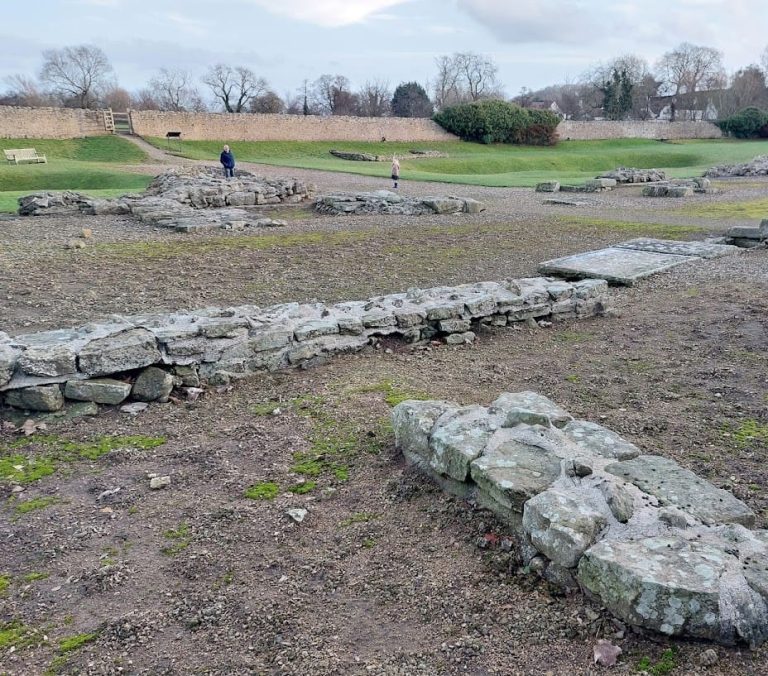
Barnard Castle occupies a rocky hill overlooking the River Tees and was built mainly of stone. Its defenses and buildings were arranged in four enclosed wards: the Outer Ward, Middle Ward, Town Ward, and Inner Ward. A deep ditch separated the Outer Ward from the other three areas, while a water-filled ditch and dam gave the Inner Ward additional protection from the Middle and Town Wards.
Outer and Town Wards
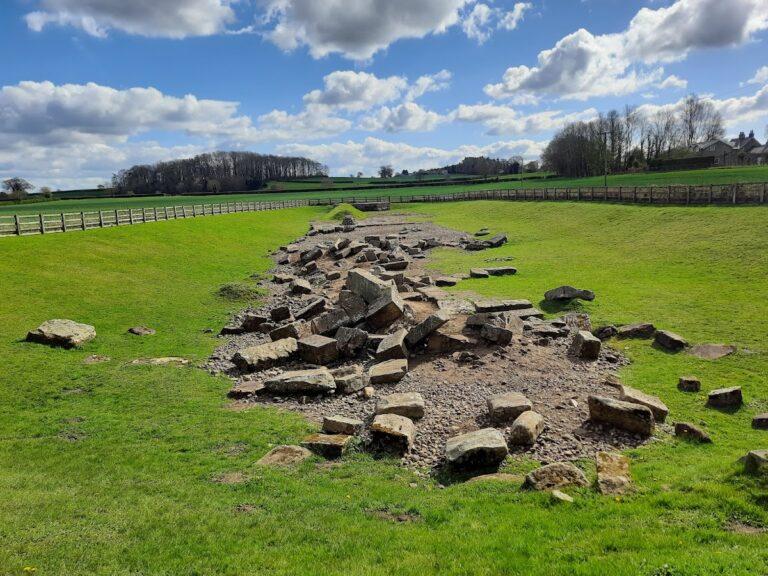
The Outer Ward contained the castle farm and the medieval chapel of St Margaret, and the original entrance was positioned on this side. Additional structures may have stood beside the curtain walls, the enclosing defensive walls, and may have strengthened the castle’s defenses. Excavation revealed the foundations of a gatehouse, together with a cobbled path leading to a pond in the Town Ward. The pond probably held fish for consumption by the castle’s inhabitants.
The Town Ward was the area used for trading with people from the settlement. Its eastern side included a sortie, a protected passage through which defenders could leave the fortification, and a postern, or smaller secondary entrance. Opposite the kitchens in the Inner Ward, excavators found the remains of a bakery.
North-eastern defenses
The northern walls included a tower with a dovecote and numerous pigeon holes built into the masonry. In the north-east, the Brackenbury Tower rose through two floors and included a latrine. It may have provided accommodation for important guests. Fortified earth embankments survive in the north-eastern corner of the complex.
Inner Ward
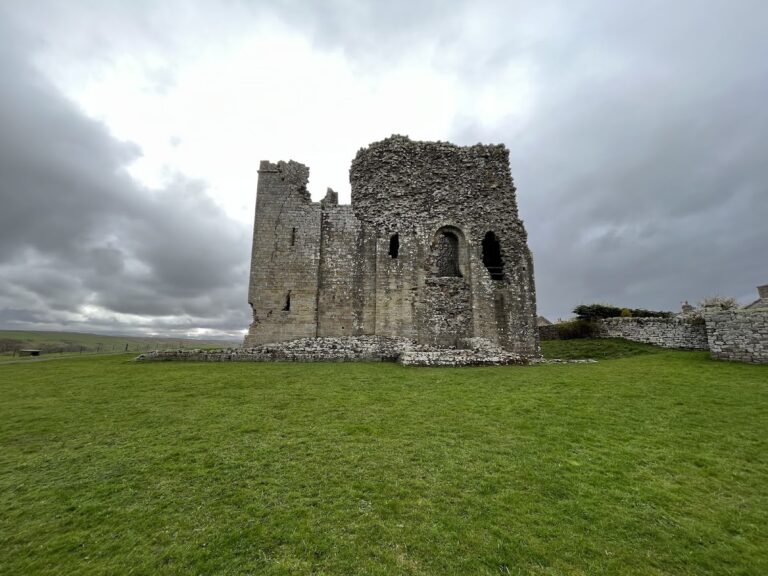
The Inner Ward contains the most substantial surviving buildings. Its principal group included the kitchens, the Great Hall, and four towers. The Great Hall served as the lord’s dining and reception space, while the hall and adjoining Great Chamber consist chiefly of fourteenth-century remains.
Lord’s apartments
The building beside the Great Hall contained the lord’s private apartments on its upper floor and a storeroom below. A carved boar, the emblem of Richard III, survives on a window lintel.
Mortham Tower
Mortham Tower was built at the western corner of the castle in the fourteenth century to extend the private apartments. It had three floors above ground, further storage rooms below ground, and arrow slits.
Round Tower
The cylindrical Round Tower stands east of the Great Hall. It also served as a private residence for the castle’s owners, and its surviving ruins are associated with the twelfth century.
Headlam Tower
Headlam Tower stood west of the kitchen beside a sortie in the outer wall. It had three floors and probably functioned as a watch post. Most of its surviving fabric dates from the fourteenth century.
Prison Tower
A further tower north of Headlam Tower and east of the kitchen is known as the Prison Tower. Its actual function is not established by evidence.