Torup Castle: A Renaissance Water Castle in Sweden


Site at a Glance
- Rating
- 4.6
- Popularity
- Low
- Country
- Sweden
- Primary era
- Early Modern
- External website
- Open
- Eras represented
- Early Modern
- Civilizations
- Danish
- Site type
- Domestic
- Remains
- Castle
On this page13 sections
History
Torup Castle is a medieval water castle in Sweden, in Svedala Municipality in Scania, whose present residence was commissioned in 1537 by the noblewoman and major landowner Görvel Fadersdotter (Sparre). The complex is regarded as one of the best-preserved sixteenth-century castles in southern Sweden, although its current Renaissance appearance was shaped principally by rebuilding between 1602 and 1630.
Medieval origins and the sixteenth century
The history of Torup reaches back to the fourteenth century, and the site is also associated with a tradition of occupation dating to around 980. A fortified estate formed the basis of the present complex. Görvel Fadersdotter built the present castle as a residence for her son, Nils Ulfstand, but he died at the age of thirteen during a journey to Germany. She retained Torup after his death and after the death of her husband, Truid Gregersen Ulfstand.
Görvel died in 1605. Her estates then passed to the Danish crown and were inherited by King Christian IV, who ruled Denmark from 1588 to 1648. Through Görvel’s third husband, the Danish nobleman and Privy Councillor Lave Brahe, Torup later became connected with the Grubbe family. The family continued the castle’s renovation and decoration during the period when its Renaissance form was taking shape.
Renaissance transformation and Danish ownership
Between 1602 and 1630, extensive restoration gave Torup the appearance associated with the early seventeenth century. During Sigvard Grubbe’s ownership, which lasted until his death in 1636, Christian IV frequently visited the castle. At the request of Kirsten Munk, the king’s wife and countess, soldiers carried out major works in the surrounding water landscape. They deepened water bodies, built canals and dams, and strengthened the banks. The lake was eventually drained in 1775.
Corfitz Ulfeldt, a member of the Danish Council of State, acquired Torup in 1647. Scania became Swedish under the Treaty of Roskilde in 1658, and the Swedish Crown confiscated the property in 1660. Ulfeldt’s grandson, J. Beck, recovered the estate for the family in 1735. The property later became associated with the Beck-Friis family.
Disaster, unrest, and restoration
Torup was the scene of a fatal accident on 21 May 1775, when a boat overturned on the lake surrounding the castle. Cornet Fredrich Trolle, his aunt Fredrika Harmens, and his sisters Brita Sofia Trolle and Elisabeth Augusta Trolle drowned. Servants attempted to rescue and revive them, but none of the four could swim.
In the 1790s, the Austrian estate administrator Franz Xaver Schober occupied the property. Four of his children were born at Torup, including the poet Franz von Schober. In 1811, approximately 1,000 to 1,500 agricultural laborers gathered at the estate to protest the designation of the French marshal Jean-Baptiste Jules Bernadotte as heir to the Swedish throne under the name Charles XIV John, and to oppose proposed compulsory military service. The protest became a peasant uprising. Parts of the estate complex were destroyed before authorities suppressed the revolt.
The property passed to the Stjernblad family and then, in 1812, to Court Marshal Baron Gustaf Julius Coyet. Coyet restored the deteriorating castle, improved the estate, and modernized its operations. Under the Coyet family, Torup became a meeting place for Sweden’s cultural and scientific elite during the late nineteenth and early twentieth centuries. Selma Lagerlöf, the Swedish writer and a friend of the owner, visited repeatedly in the 1920s.
The twentieth century and public preservation
Court Marshal Gösta Coyet owned the estate until his death in 1924. His widow, Baroness Henriette Coyet, remained its sole owner until her death in 1941. Their daughter Amelie then inherited the castle and was married to Otto von Leithner. Their son, Ernst Gustav, inherited the estate and its buildings in 1956.
Malmö Municipality acquired Torup in 1970, including the castle, surrounding buildings, parkland, beech forest, and farmland, to preserve the estate as a recreational and natural resource. The last private residents left in 2012. The castle is now used for exhibitions, concerts, festivals, and an exhibition about the history of the complex and its lands. Part of the surrounding beech forest, covering 180 hectares, has been a legally protected nature reserve since 2019.
Torup and Baroness Henriette Coyet also appear in the song “The Castle in Scania and the Baroness” by the Swedish singer Edvard Persson.
Remains
Torup is organized as a square brick-and-stone castle around a small inner courtyard. Four adjoining residential wings form the main complex, which rises three storeys and displays the Renaissance design developed chiefly in the early seventeenth century. Enormous boulders form the foundations, while the upper sections are built of red brick. Tiled roofs cover the wings and towers, and several facades end in stepped gables, roof-ends whose sides rise in successive steps.
Castle complex and defenses
Main residential complex
A tall octagonal tower is attached to the northwest corner of the castle, while a smaller round tower adjoins the southeast corner. Together with the four residential wings, these towers give the square complex its distinctive fortified form. The inner courtyard is enclosed by the adjoining wings, and the Renaissance arrangement represents the major architectural transformation undertaken between 1602 and 1630.
Entrance and water defenses
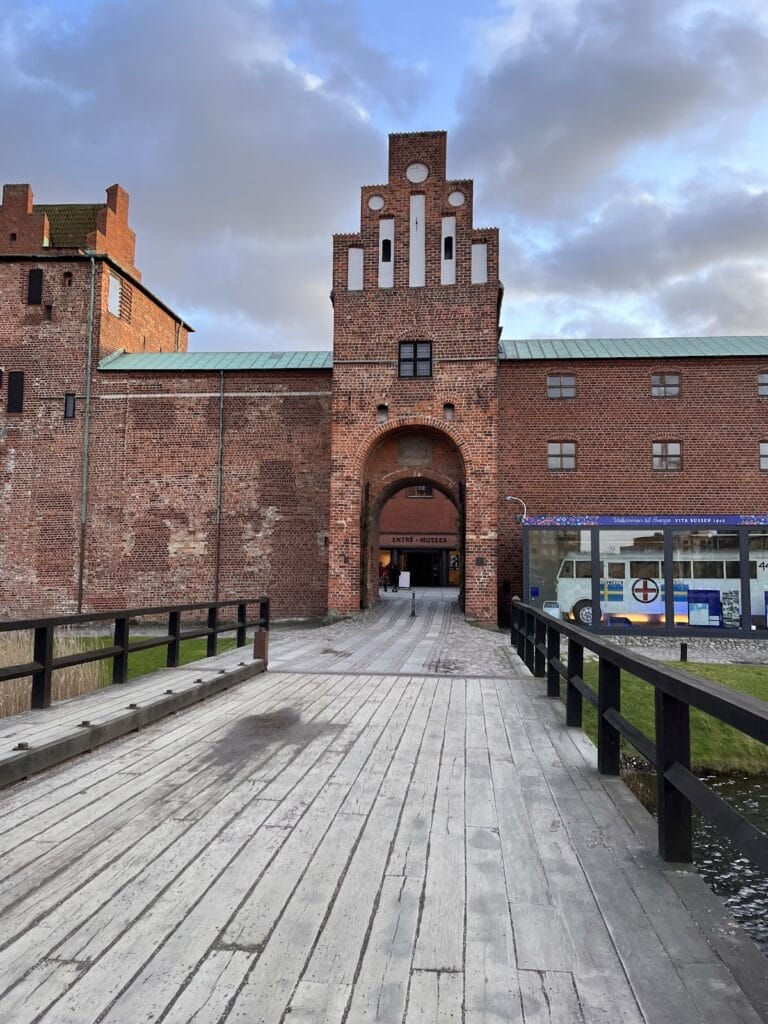
The principal entrance lies on the north side. Water-filled moats formerly encircled the castle, and access was provided by a drawbridge. A barbican, an outer defensive structure in front of a main gate, stood beyond the bridge as part of the approach defenses. The northern section of the moat was later filled with earth. An avenue runs from the former barbican toward the main complex, with a fountain on its eastern side.
Earlier fortress and surrounding grounds
Askebacken fortress
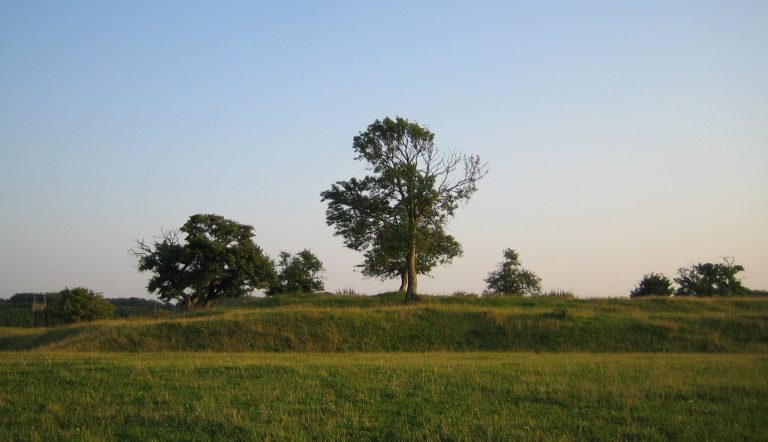
An earlier fortress stood on Askebacken, a hill immediately north of the present stables and barns. This predecessor was separate from the structure of the present castle, although the fortified estate associated with the site provided the basis for the later complex.
Park and beech forest
The castle stands within a park covering 365 hectares and beside a recreational beech-forest area of approximately 340 hectares. Beech trees, ancient trees, and abundant deadwood support diverse populations of wood-dwelling insects, bats, and ground fungi. The grounds include walking and cycling paths, riding routes, and trails ranging from approximately 2 to 10 kilometres.
Storage building
An eighteenth-century storage building in the grounds has been reused as a public meeting place with changing rooms, fitness facilities, a café, and related amenities. Its later use forms part of the continuing adaptation of the estate’s supporting buildings around the historic castle.