Moritzburg: A Fortified Archiepiscopal Residence and Museum in Halle



Site at a Glance
- Rating
- 4.5
- Popularity
- Medium
- Country
- Germany
- Primary era
- Medieval
- External website
- Open
- Eras represented
- Medieval, Early Modern, Modern
- Civilizations
- Holy Roman Empire, Kingdom of Prussia
- Site type
- Military
- Remains
- Castle
On this page18 sections
History
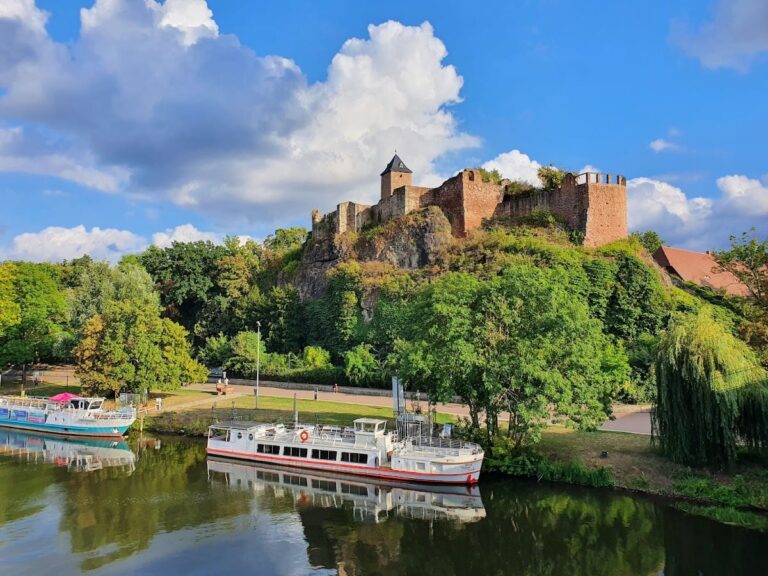
Moritzburg is a fortified castle and reconstructed castle ruin in Halle (Saale), Germany, built in the late fifteenth century as a residence and stronghold for the Archbishops of Magdeburg. Its foundation followed the loss of Halle’s political autonomy and created a base from which the archbishops could control the city. The complex combined courtly accommodation with military defence, linking late Gothic architecture to the more regular forms of the early modern period.
Foundation and Archiepiscopal Residence
In 1479, opposition among Halle’s urban guilds joined with the interests of the archbishop. Archbishop Ernst of Saxony entered the city, and the decision was taken to construct a fortress that would keep Halle obedient. Surveying began in April of that year. Poor ground conditions led the builders to choose a site northwest of the city, where the new complex incorporated part of the existing city wall and occupied land formerly associated with a Jewish settlement.
Archbishop Ernst laid the foundation stone on 25 May 1484 during a ceremonial procession. He named the residence Moritzburg after Saint Maurice, a Christian martyr traditionally associated with the Theban Legion and venerated as a military patron. Construction was initially supervised by Peter Hanschke. From 1533, Andreas Günther expanded the fortifications and probably created the low round bastions on the eastern side. The Magdalene Chapel is attributed to Ulrich von Smedeberg.
Ernst moved into Moritzburg on 25 May 1503 and called it his Arx insuperabilis, meaning “unconquerable fortress.” Much of the building work was financed through salt properties confiscated from Halle’s salt-producing aristocrats after 1479. At the state assembly of 1507, Ernst stated that construction had cost more than 150,000 gulden.
Ernst and his successor Albrecht of Brandenburg developed Moritzburg as both a residence and a fortress. Albrecht, elected archbishop in 1513, made it his preferred home and brought the castle into the religious and political conflicts of the early sixteenth century. In 1517 he summoned the Dominican preacher Johann Tetzel to Moritzburg and promoted the sale of indulgences, a practice involving remission of temporal punishment for sin within Western Christianity. The proceeds helped finance Albrecht’s collection of relics, known as the Halle Holy Treasure.
The collection was first kept in the castle chapel and later moved to the cathedral. It contained 353 reliquaries, containers made to preserve and display religious relics, holding 21,484 individual relics, including 42 complete-body relics. It was regarded as the most important collection of its kind in Germany. After the Reformation took hold in Halle, Albrecht abandoned the city and withdrew to Mainz.
War, Fire, and Decline
Moritzburg became involved in the military conflicts that affected central Germany. During the Schmalkaldic War, imperial troops occupied the fortress. After his victory at the Battle of Mühlberg, Emperor Charles V entered Halle on 10 June 1547, while his commander, the Duke of Alba, took possession of the castle.
The fortress repeatedly attracted armies during the Thirty Years’ War. Wallenstein occupied Halle and Moritzburg in October 1625. After the defeat at Breitenfeld, Count Tilly withdrew to the castle while Swedish troops pursued him. King Gustavus Adolphus of Sweden then occupied Halle and Moritzburg without a battle in September 1631.
During a renewed Swedish siege, fire broke out on 6 January 1637. The blaze destroyed the upper floors of the west and north wings as well as the chapel, and the garrison capitulated. On 19 March 1639, Saxon troops mined the foundations of the southwest bastion and blew it up. The Swedish garrison surrendered three days later.
After the surrender, August, the son of Elector John George of Saxony, became archbishop. He arranged for Saxon troops to withdraw, reducing the fortress’s strategic importance. A neutrality agreement between August and the Swedes helped keep Halle out of further fighting. Moritzburg was not rebuilt as a whole, although the chapel was partly reconstructed for worship.
Prussian Military Use and Nineteenth-Century Restoration
After August’s death in 1680, Halle passed to Brandenburg under the provisions of the Peace of Westphalia. Halle’s Huguenots received permission to worship in the gate tower chapel in 1686 and took possession of the Magdalene Chapel on 26 October 1690.
In 1717, the Prussian Anhalt Regiment, numbering about 3,500 soldiers, occupied Moritzburg. A parade ground was established outside the complex, where Prince Leopold of Anhalt-Dessau drilled the troops. The castle later served as a military hospital during the Seven Years’ War and the Wars of Liberation. Its vaults were subsequently leased to a brewery, while the chapel, which had been used by the French community until 1808, became a storage building.
The Prussian state bought the ruins back from the leaseholders between 1847 and 1852 for 24,800 thalers. Karl Friedrich Schinkel prepared plans to reconstruct Moritzburg for the University of Halle, but the project was abandoned because of its cost. By 1900, the complex had deteriorated severely.
Municipal Museum and Modern Collection
In 1897, the Prussian state transferred the east, south, and west wings to the city of Halle for its Museum of Art and Applied Arts, founded in 1885 with ten paintings. Donations from Halle residents financed the reconstruction or rebuilding of the Talamt, the southern battlements, the gate tower, and the south bastion between 1901 and 1913. A second museum location opened at Moritzburg in 1904. After the original premises at Großer Berlin had to be vacated in 1920, the collections were concentrated entirely at Moritzburg from 1921.
The museum’s holdings grew through purchases and donations. They included the Hellweg South Seas collection, acquired in 1899, and gifts from collectors such as Adolph Thiem. Max Sauerlandt directed the museum from 1908 until the First World War and greatly expanded its fine-art and applied-art collections, particularly its modern works. In 1924, under the provisional direction of Paul Thiersch, the museum acquired 24 Expressionist works from the Rosy Fischer collection.
Under director Alois Schardt, electric lighting was installed in 1929, and the painting collection was enlarged with works including a substantial group by the Russian Constructivist El Lissitzky. That year, Schardt brought the Bauhaus artist Lyonel Feininger to Halle for a commission from the city. Feininger established his studio in Moritzburg’s gate tower. The museum acquired his complete series of Halle paintings in 1931, together with works by artists including Franz Marc and Oskar Kokoschka.
The Nazi campaign against modern art placed these collections in danger. Works of classical modernism were confiscated for the “Degenerate Art” propaganda exhibition in Munich and for later sale abroad. Robert Scholz, an art journalist and NSDAP official, directed the museum from 1938 to 1945.
In July 1945, the Halle city magistrate decided to recover the former holdings. Under director Gerhard Händler, important acquisitions were made by 1949, and the museum officially reopened on 7 October 1948. The institution became the State Gallery Moritzburg in 1952, passed from municipal to state ownership in 1996, and was transferred to the Moritzburg Foundation in 2003. Since 2014, the foundation has been administered in trust by the Cultural Foundation of Saxony-Anhalt, while the museum has operated as the Kunstmuseum Moritzburg Halle.
Twentieth-Century Adaptation and Cultural Role
During the Second World War, Moritzburg’s deep vaults served as air-raid shelters for Halle’s population and the regional administration of the NSDAP. Valuable portals and architectural components were also stored in the cellars. The upper vaults of the west wing were adapted between 1951 and 1954. From 1964 to 1967, a small chamber theatre and restaurant were installed in the west wing. The Fernsehtheater Moritzburg broadcast nearly 270 live theatre productions there between 1965 and 1990.
A student club was established in the northeast bastion between 1972 and 1973, while the round hall of the southeast bastion was used for an extended period by the cabaret group Die Kiebitzensteiner. Since the 1990s, Moritzburg has been used exclusively by the Kunstmuseum Moritzburg, alongside continuing reconstruction work.
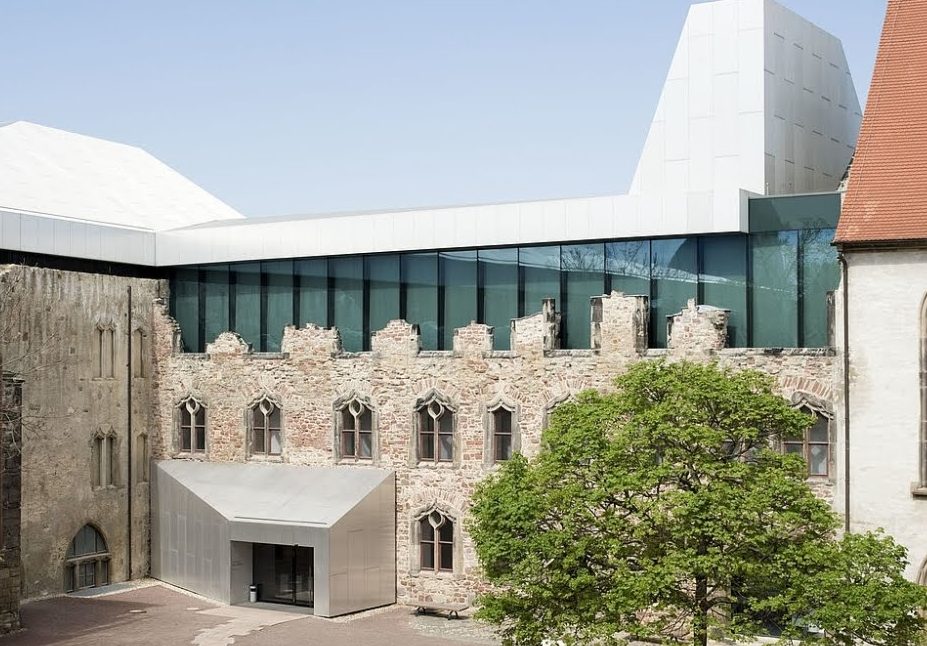
An architectural competition for new or expanded exhibition areas was held in 2003 and won by Fuensanta Nieto and Enrique Sobejano. Their redevelopment of the north wing and the former west-wing ruin was completed in 2008, and the expanded museum opened on 13 December that year. The new exhibition wing received the BDA Nike architecture prize for best atmospheric effect on 8 May 2010. The Moritzburg Foundation was included in the Blaubuch, a register of nationally important cultural institutions in eastern Germany, published in 2001. Moritzburg is also one of Halle’s three stations on the Luther Trail in Saxony-Anhalt.
Remains
Fortress Plan and Defensive Setting
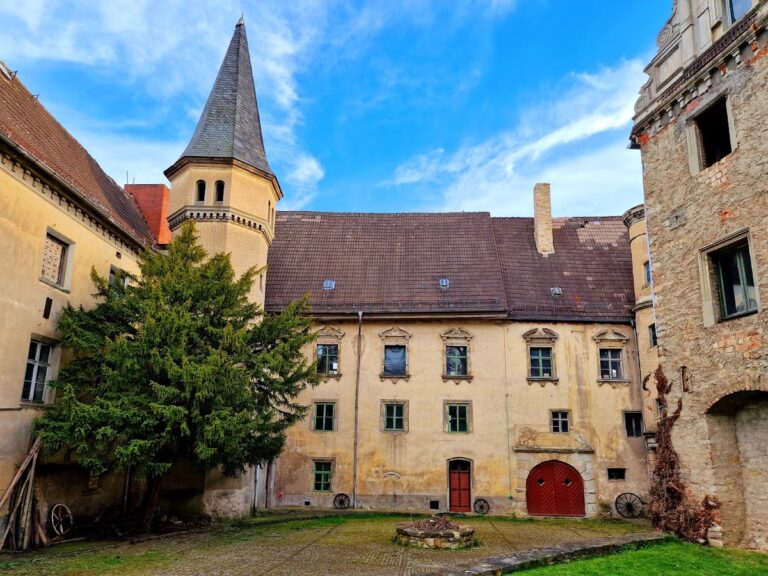
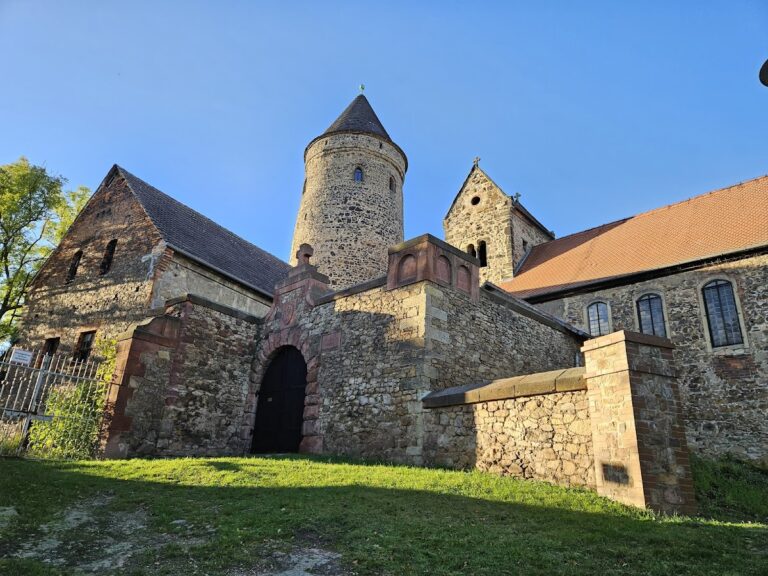
Moritzburg has an almost regular quadrangular plan measuring approximately 72 by 85 metres. Quarry stone forms the principal building material. Its late Gothic details are combined with uniform floor levels, horizontally emphasized facades, and a regular arrangement associated with early modern architecture. The courtyard was raised to the level of the surrounding city streets and was large enough for festivals, processions, and tournaments.
A moat approximately 20 to 25 metres wide and 10 metres deep surrounds the south, east, and north sides. The moat was formerly swampy. Toward the Saale, the western side was protected by a staggered system of defensive walls. A rampart known as the Jägerschanze was raised in front of the northern side between 1536 and 1538.
Wings and Towers
West Wing
The west wing formed the principal and most representative side of the castle. Its upper floors contained large ceremonial halls, while the vaulted upper basement level probably housed the garrison and is now used for museum exhibitions. Two floors above the basement contained the archbishops’ ceremonial and official rooms, which are now largely ruined. The northern part held the ruler’s living quarters and the archiepiscopal library.
The central staircase on the courtyard facade survives only in fragments. It is notable as one of the earliest staircases in the German-speaking region built into the structure rather than added externally.
North Wing
The north wing contained the original main entrance, recognizable by its coat-of-arms frieze. The entrance was abandoned and walled up in 1616. Two floors above the basement housed the officials’ chancery and an archive. In 1894, fencing and gymnastic halls were installed there for the University of Halle’s bicentenary. They remained in use for physical education until 1990.
East Wing and Gate Tower
The east side contains the town-facing gate tower, which also served as a residential tower. A chapel occupied its lowest floor. The entrance passage was built on a slight curve to prevent direct fire against the gate structure.
The original east wing was a narrow, two-storey defensive passage with open arcades and loopholes, narrow openings used by defenders to observe or fire outward. In 1777, a Baroque military hospital was built for the Prussian garrison over the old defensive foundations. The southeast bastion was adapted for museum use in 1913. The northeast tower has housed a student club since 1972 and remains an event venue.
South Side and Talamt
The south side no longer survives in its original form. It contained service buildings, the kitchen, the castle commander’s residence, and essential wells, with the stables believed to have been located there as well. The large vaulted space below the courtyard housed the archiepiscopal mint from 1582 to 1680.
The Talamt was rebuilt between 1901 and 1904 on the foundations of a half-timbered service building. Its upper floor incorporates the former Talamt’s court room and ceremonial room, which were recovered and integrated into the reconstruction. The original Talamt had stood at Hallmarkt, where it was built between 1594 and 1607 and demolished in 1881 for street widening. It had served as the residence of the salt count, the seat of the salt court, and the guildhall of the Halloren. At Moritzburg, the reconstructed building was designed for museum use.
Maria Magdalene Chapel
The Maria Magdalene Chapel occupies the eastern part of the north wing. It measures approximately 14 by 23 metres and rises 15 metres high. The building is a wall-pillar church, in which wall supports carry the vaulting while leaving the interior relatively open. Its Upper Saxon Late Gothic design includes free-standing round pillars, a three-sided eastern end, and an ambulatory, a passage running around the main body or eastern end of a church. The ambulatory resembles a gallery and rests on arcades with segmental arches.
A plaque on the north wall records the chapel’s consecration in 1514 and bears the arms of Cardinal Albrecht of Brandenburg, flanked by Saint Maurice and Saint Mary Magdalene. A chapel-specific coat of arms above the gallery on the west wall records completion for Archbishop Ernst II of Saxony in 1509. The heart of Archbishop Ernst was buried in the chapel in early August 1513. The building was first intended to serve the Halle Holy Treasure, but Albrecht later furnished it richly and planned a larger church, subsequently developing the Dominican church, now Halle Cathedral, as a collegiate church from 1519.
The chapel lost its vault in the fire of 1637. Although emergency repairs followed the Thirty Years’ War, the vault was not reconstructed until 1894 to 1899. The chapel was then restored and redecorated in historicist style and received Neo-Gothic furnishings, including a pulpit altar and an organ by Wilhelm Rühlmann in 1899. Its three choir windows were designed in the style of late Historicism, with architectural framing inspired by fourteenth-century stained-glass traditions. The replacement vault contains fifteen heraldic panels arranged in three groups of five, bearing the arms of the Hohenzollerns, the University of Halle and its faculties, and the Province of Saxony.
The original organ had two manuals and twelve stops. Its tonal structure was altered during cleaning in 1963. A completely new organ was installed and consecrated in 1990 within the historic protected case. The chapel was converted into a university church in 1898 to 1899 for the University of Halle’s bicentenary. Since 1921, it has served as a place of worship and as the home of the Evangelical Lutheran congregation of Saint Mary Magdalene.
Reconstructed Museum Areas
Exhibition Spaces
The Kunstmuseum Moritzburg occupies reconstructed and adapted parts of the castle, including the vaulted upper basement of the west wing, the rebuilt Talamt, the southern and southeastern defensive structures, and the redeveloped north and west wings. Between 2005 and 2008, a modern folded roof over the former west-wing ruin and the north wing created additional exhibition space.
Crodel Hall
The Crodel Hall contains Charles Crodel’s mural Race of Atalanta and Hippomenes, completed on 21 November 1931 in the former university gymnasium.
Museum Collections
The museum holds about 1,800 paintings, more than 37,000 graphic works, approximately 700 sculptures, and around 80,000 coins, medals, and banknotes. The collections range from late Gothic art, nineteenth-century painting, Expressionism, socially critical art, and art of the German Democratic Republic to modern German sculpture, applied art, photography, and the monetary history of Brandenburg-Prussia and central Germany.
The sculpture collection includes medieval central German carved sculpture and twentieth-century German figurative works. Applied-art holdings include glass, stoneware, faience, porcelain, and work by Halle goldsmiths. The graphic collection contains twentieth-century German Expressionist and Constructivist art, East German art, sculptors’ drawings, and broadsheets from the fifteenth to the nineteenth century.
A photographic collection was established in 1986 through the bequest of photographer Hans Finsler. It focuses on artistic photography of classical modernism and the present. In 2009, the Moritzburg Foundation donated an art chamber to Halle for paintings by Albert Ebert, and two privately acquired paintings were transferred to the new cabinet.