Castillo Venceire: A Hispano-Muslim Fortress in Luque, Spain


Site at a Glance
- Rating
- 4.5
- Popularity
- Low
- Country
- Spain
- Primary era
- Medieval
- External website
- Open
- Eras represented
- Classical, Medieval
- Civilizations
- Almohad, Roman
- Site type
- Military
- Remains
- Castle
On this page11 sections
History
Castillo Venceire is a ninth-century Hispano-Muslim fortress in Luque, Spain, built during the period of Muslim rule in al-Andalus. Also known as Castillo de Luque or Hisn Lukk, it occupies Castillo Hill above the town and reflects the military importance of Luque during the conflicts that reshaped southern Iberia.
Early settlement and the ninth-century fortress
A Muslim settlement existed at Luque soon after the Islamic conquest of the Iberian Peninsula in the eighth century. The fortress was possibly commissioned by Said ibn Mastana, a Muladi, meaning a Muslim of local Iberian or mixed Iberian and Arab ancestry. He was an ally of Umar ibn Hafsun, a prominent leader of a major revolt against the Emirate of Cordoba, the Muslim state that ruled much of al-Andalus before the establishment of the Caliphate of Cordoba.
The precise date of construction is unknown, but the fortress is thought to have followed Emir Abd Allah’s capture of Carcabuey in 892. Abd Allah later returned to Luque and brought the town under control after a prolonged siege. These events place the castle within the political and military struggles that affected the Emirate of Cordoba during the late ninth century.
Almohad destruction and rebuilding
In 1126, the castle was besieged during the campaign of Alfonso I of Aragon. Its involvement in that campaign illustrates the strategic value of its position. In 1165, forces led by Muhammad ibn Mardanis, known as the “Wolf King” and ruler of the Taifa of Murcia, a Muslim kingdom in southeastern Iberia, lost the fortress in a closely contested victory for the expanding Almohad Empire. The Almohads, a North African Islamic dynasty and empire that ruled parts of the western Mediterranean and al-Andalus, then completely destroyed the fortress and rebuilt it in their own style.
Castilian rule and frontier administration
The Castilian conquest probably took place around 1240, when Ferdinand III conquered Luque for the Castilian Crown. He granted the castle, together with those of Cabra, Baena, and Zuheros, to his half-brother Rodrigo Alfonso. The fortress later passed to Queen Joan of Ponthieu and subsequently changed hands among several holders, including the Order of Santiago, a medieval military-religious order that held territory and defended Christian frontier zones in Iberia, and Infante John, the half-brother of Sancho IV.
Although the castle was held by different lords, it remained directly dependent on Cordoba for most of its history. After Alfonso XI defeated the Marinids at the Battle of Salado, he stationed soldiers in frontier towns bordering the Nasrid Kingdom of Granada, the last major Muslim kingdom in the Iberian Peninsula, which survived until 1492. Luque was included among these frontier settlements.
The Venegas lordship and decline
In 1374, Egas Venegas received the lordship of Luque after supporting Henry II during the first Castilian civil war. The Venegas family acquired comital rank in 1624 through a grant from Philip IV. Their connection with Luque continued until the castle was abandoned during the eighteenth century, after which the fortress deteriorated into ruin.
Protection and restoration
In 1973, the Spanish Government registered the castle in its own name and unsuccessfully offered it at auction several times. Ownership was transferred to Luque Town Council in 1997. The castle is protected as an Asset of Cultural Interest.
Modern restoration began with work on the Almohad Tower and the Keep Tower. The first phase ran from September 2018 to January 2019, followed by a second phase later in 2019. A third phase in July 2020 addressed the exterior faces and the crowning of the walls. The final comprehensive restoration began in December 2021 and concluded in July 2023, addressing the principal surviving elements of the ruined fortress.
Remains
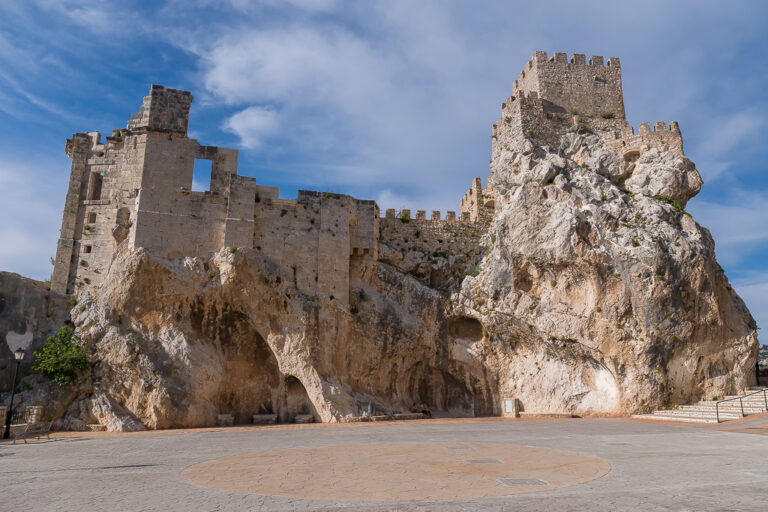
Castillo Venceire occupies a rocky height known as Castillo Hill, overlooking the entire town of Luque and lying very close to the Rosario Hermitage. The surviving fortress is organized around two principal towers linked by several sections of curtain wall, meaning defensive wall segments that connect towers or other fortified structures. The present complex combines the remains of the Almohad rebuilding with extensive modern restoration.
Towers and defensive walls
Almohad Tower
The Almohad Tower is one of the principal surviving elements of the fortress. It belongs to the rebuilding carried out after the destruction of 1165, when the Almohads reconstructed the castle in their characteristic style. Restoration work repaired the tower and formed part of the wider effort to stabilize and recover the fortress.
Keep Tower
The Keep Tower, the principal or strongest tower of a medieval castle, is the second major tower in the surviving complex. It is connected to the other defensive elements by sections of curtain wall. Earlier restoration repaired the tower, while the comprehensive work completed between 2021 and 2023 addressed the wider structure around it.
Archaeological remains
Excavations inside the castle have revealed evidence from several periods of occupation. The earliest remains date from the fourth century BC. A Roman mill dated to the second century was also found within the fortress, providing physical evidence of activity at the site long before the construction of the Hispano-Muslim castle.
These archaeological layers place the medieval fortress within a much longer history of occupation on Castillo Hill. Together with the surviving towers and linked walls, they show how the site developed from earlier activity into a fortified settlement associated with the Muslim and Christian political struggles of medieval southern Iberia.