New Navarino Fortress: An Ottoman Stronghold at Pylos


Site at a Glance
- Rating
- 4.7
- Popularity
- Medium
- Country
- Greece
- Primary era
- Early Modern
- External website
- Open
- Eras represented
- Early Modern, Modern
- Civilizations
- French, Ottoman, Venetian
- Site type
- Military
- Remains
- Fort
On this page16 sections
History
New Navarino Fortress, also known as Niokastro or Neokastro, is an Ottoman fortress at Pylos in southwestern Greece. Built in 1572–1573 by Kilic Ali Pasha, the chief admiral of the Ottoman fleet, it belongs to the gunpowder-era history of Ottoman military architecture and guarded the southern entrance of Navarino Bay. The medieval Old Navarino Fortress controlled the northern entrance, but silting had made its harbor and the northwestern approach to the bay increasingly difficult to use.
Ottoman Foundation and Naval Role
New Navarino was established shortly after the Battle of Lepanto in 1571 as the principal military position at the bay’s southern entrance. Together, the two fortresses controlled the maritime zone from the island of Proti to the Messenian islands of Sapientza, Schiza, Agia Mariani, and Venetiko. The newer stronghold also protected a commercial sea route linking the eastern and western seas.
Before the new fortress was built, the Ottomans had used Old Navarino as a naval base for raids and fleet operations in the Ionian and Adriatic seas. New Navarino later served as the base for the Ottoman invasion of Crete in 1645, at the beginning of the Cretan War. Venetian forces recaptured the fortress during the same conflict in the 1650s.
The Ottoman traveler and chronicler Evliya Celebi described Niokastro in 1668 as a substantially developed settlement. He mentioned a mufti, a deputy judge, military and municipal officials, a garrison, a city commander, twelve aghas, markets, religious institutions, an inn, a bathhouse, fountains, and a slave market supplied by corsair ships from Tunis, Algiers, and Tripoli. Outside the fortress, a Greek quarter contained 200 houses, gardens, an inn, and fifteen shops, and was inhabited exclusively by Greeks.
Venetian Conquest and Ottoman Restoration
During the Morean War, the Venetian-Ottoman conflict of 1684–1699, Venetian forces commanded by Francesco Morosini captured both Navarino fortresses in 1686. New Navarino, defended by Mustafa Pasha, endured a siege and bombardment. After Otto Wilhelm von Königsmarck defeated an Ottoman relief force, the fortress surrendered on 6 June 1686. Some defenders rejected the capitulation and detonated a powder store.
Navarino then became an administrative center of the Venetian Kingdom of the Morea. A Venetian census in 1689 counted 101 inhabitants in Navarino and 1,413 people in the wider province. Twenty years later, the provincial population had risen to 1,797.
The Ottomans reconquered the Peloponnese between June and September 1715. New Navarino returned to Ottoman rule and remained there until the Greek Revolution of 1821. It again functioned as a district center, or kaza, within the Ottoman administrative system. From 1789 to 1807, the fortress district was a fief of Beyhan Sultan, the daughter of Sultan Mustafa III and sister of Sultan Selim III. In 1816, the district included 600 Turks in 142 families, while 130 Greeks in seventeen families lived outside the walls.
Russian Attack and the Greek Revolution
Russian forces captured New Navarino on 10 April 1770 after a six-day siege during the Russo-Turkish War and the Orlov Revolt, a Greek uprising supported by Russian forces against Ottoman rule. The Ottoman garrison was allowed to evacuate to Crete. Russian control was brief, however. The Russian fleet left on 1 June 1770 after partially damaging Navarino, and the Ottomans recovered the fortress.
During the Greek Revolution, local Greek forces led by Georgakis, Giannis, and Nikolaos Oikonomidis besieged New Navarino from 25 March to 9 August 1821. The Ottoman garrison surrendered after receiving assurances of safe passage, but the surrender was followed by the Massacre of Navarino.
Egyptian Recapture and the Creation of Pylos
Ibrahim Pasha of Egypt recaptured New Navarino on 11 May 1825. His forces first took Sphacteria, killing approximately 200 of its defenders, and then besieged the fortress. They cut its aqueduct and bombarded it for three days. The Greek defenders, among them Ioannis Makriyannis and Dimitrios Kallergis, capitulated because food and ammunition were running short and expected reinforcements did not arrive.
On 8 October 1827, the allied British, French, and Russian fleet destroyed the Ottoman-Egyptian fleet at the Battle of Navarino. The battle forced Ibrahim Pasha to leave the Peloponnese, although the Ottoman-Egyptian garrison remained in the fortress until its evacuation under the supervision of General Nicolas Joseph Maison and the French Morea Expedition. French forces occupied New Navarino on 30 August 1828, and the Egyptian withdrawal was completed on 4 October 1828.
A new settlement developed beside the fortress after the battle. Engineers of the French Morea Expedition prepared its street plan in 1829, and the settlement expanded mainly after 1830. It was initially also called Neokastro or New Navarino, but a royal decree officially named it Pylos in 1833.
Later Use and Conservation
As the modern settlement developed outside the walls, the fortress ceased to function as a residential settlement. German and Italian forces used it as a base or headquarters during the Second World War. After the war, the citadel temporarily served as a prison. In 1953, the fortress was transferred to the Greek Archaeological Service.
New Navarino and the associated Pylos aqueduct are protected as archaeological and historic monuments. Formal protection includes an undeveloped protected Zone A around the fortress and the medieval aqueduct. Restoration and adaptive reuse have progressively turned the complex into a cultural center containing the Archaeological Museum of Pylos, the Museum of the Ephorate of Underwater Antiquities, exhibitions, and cultural activities.
Remains
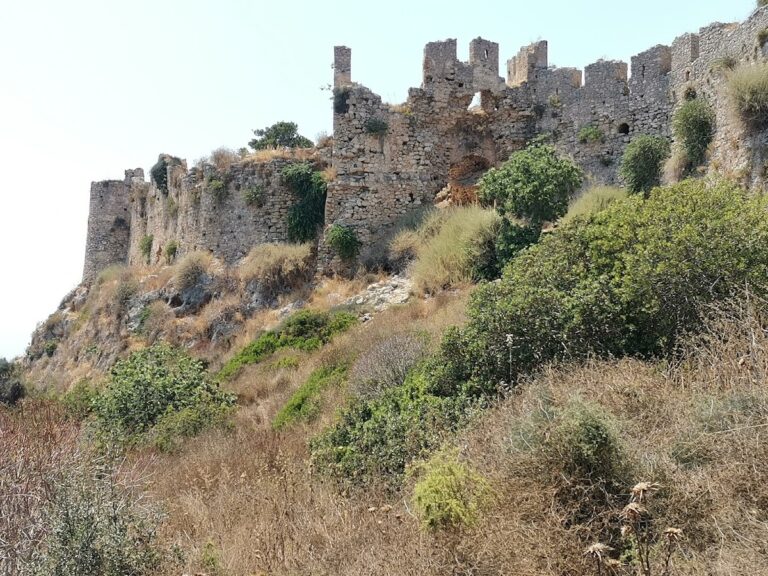
New Navarino occupies a strategic height west of Pylos, opposite the southern end of Sphacteria Island and beside the entrance to Pylos harbor. The complex consists of a larger Lower Castle, covering approximately 80 stremmata, and an Upper Castle or citadel, the most strongly fortified part of the larger fortress. Its Ottoman gunpowder-era defenses use thick, low, sloping walls designed to withstand cannon fire and lessen the force of projectiles. The walls are approximately 2.5–3 meters thick and reach up to 8.5 meters in height. They are built mainly from roughly worked limestone and alabaster.
Citadel and Defensive Works
Upper Castle
The Upper Castle contains a roughly hexagonal citadel built at the highest and most vulnerable point of the fortress during the Venetian occupation. A dry moat, meaning a moat without standing water, protected it externally. Six pentagonal bastions projected from the defenses, and nearly sixty guns were mounted on the ramparts.
Outer Enclosure and Seaward Bastions
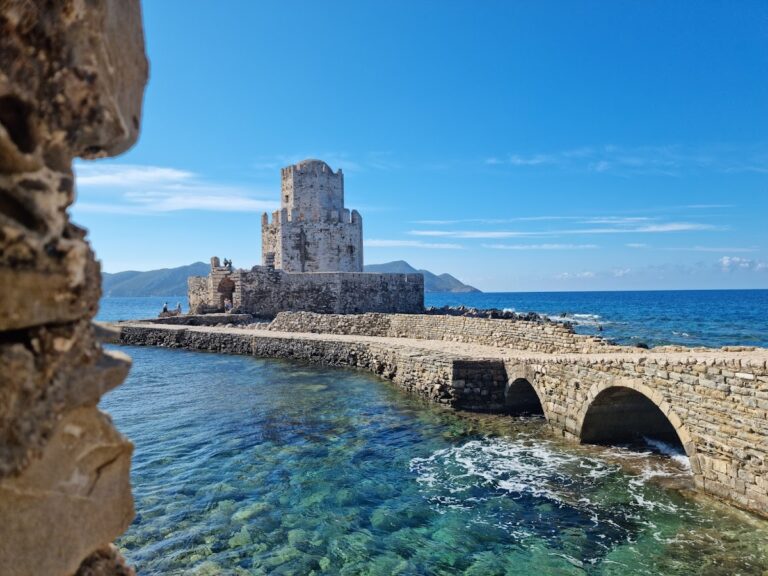
The outer fortified enclosure includes a perimeter wall, four cylindrical towers, and two major seaward bastions defending the entrance and harbor. The western bastion, known as the Seventh Bastion, predates much of the remaining fortification and chiefly controls the entrance to Navarino Bay. The northern bastion is known as the Bastion of Jafer Pasha, Santa Maura, or Santa Maria, and chiefly controls the port of Pylos.
A long southern wall links the citadel with the Seventh Bastion. The southern part of the fortress was damaged when ammunition detonated during bombing in 1944. Most residential and public buildings inside the walls survive only as ruins, reflecting alterations, additions, and other interventions made during successive Venetian and Ottoman occupations.
Zematistra Gate
The principal entrance lies on the southeastern side, through the imposing Zematistra Gate. Openings above the entrance allowed defenders to pour heated oil or boiling water onto attackers.
Religious and Civil Buildings
Church of the Transfiguration of the Savior
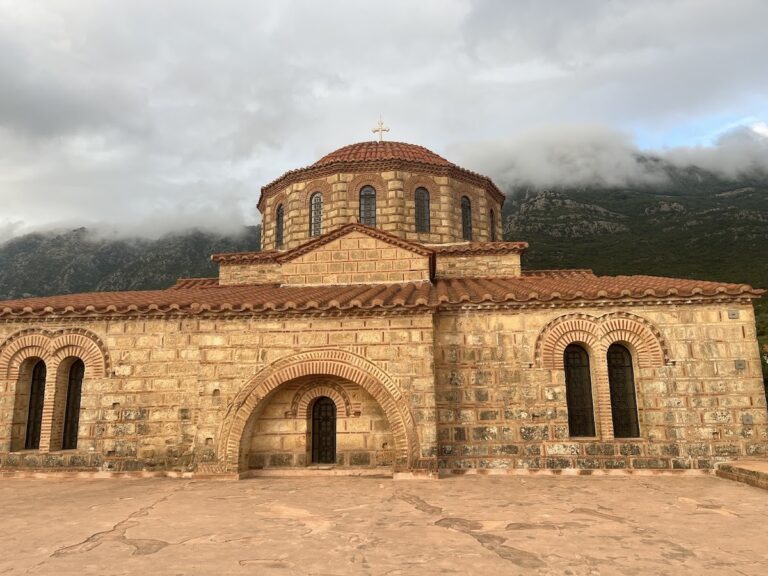
The Church of the Transfiguration of the Savior stands near the center of the fortress. It was built between 1573 and 1595 as an Ottoman mosque during the reign of Sultan Murad III. During the second Venetian occupation, it became a Catholic church, then returned to use as a mosque under Ottoman rule. After the liberation of the region, it was converted into an Orthodox church.
The building is a surviving Gothic-style structure. It underwent comprehensive restoration during the 2007–2013 restoration program.
Maison Building
The Maison Building stands to the left of the entrance, opposite the prison building. Constructed as barracks for the French Morea Expedition between 1827 and 1830, it is a long, two-storey stone structure with a pitched gable roof and numerous openings. It later housed a library and now contains the Archaeological Museum of Pylos.
Pasha Building
The Pasha Building stands within the outer fortified enclosure, in the area formerly occupied by the fortress settlement. This elongated, two-part stone hall has substantial masonry and a wooden roof and dates from the seventeenth or eighteenth century. It was renovated and now houses the Museum of the Ephorate of Underwater Antiquities.
During the German and Italian occupation, the building was used as a prison. After 1953, it became a storage building for the Ephorate of Underwater Antiquities, and in 2008 it contained carpentry, painting, and blacksmith workshops supporting restoration work at the fortress. Following renovation in 2010, the Pasha Museum began operating there in 2012. Its permanent exhibition, Sunken Journeys, Human Explorations: Significant Traces in the Seas of the Peloponnese, covers the building, the Peloponnese and its seas, maritime routes, underwater excavations, conservation of recovered objects, shipwreck causes, and underwater looting.
Pylos Aqueduct
The Pylos aqueduct supplied New Navarino with water through several systems. The older arrangement began at Paleonero, southeast of the fortress, and conveyed water through a clay pipeline. A later system brought water from the Koumbe springs, approximately 15 kilometers northeast of the fortress near Chandrinos, through a built channel to the Kamares area near Pylos. Underground connections then carried water to sources inside the fortress.
Several sections of the aqueduct survive. These include the structure known as the Kamares and additional remains at Vrachos outside Pylos.
Nearby sites