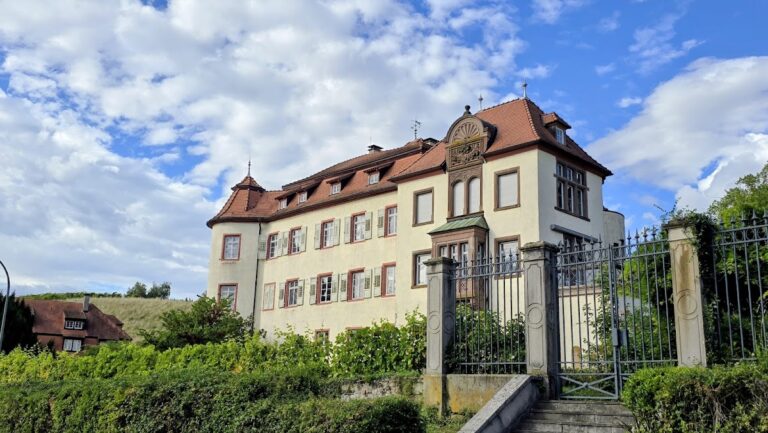
Hohenbaden Castle: The Former Seat of the Margraves of Baden


Site at a Glance
- Rating
- 4.7
- Popularity
- Medium
- Country
- Germany
- Primary era
- Medieval
- Eras represented
- Medieval
- Civilizations
- Holy Roman Empire
- Site type
- Military
- Remains
- Castle
On this page12 sections
History
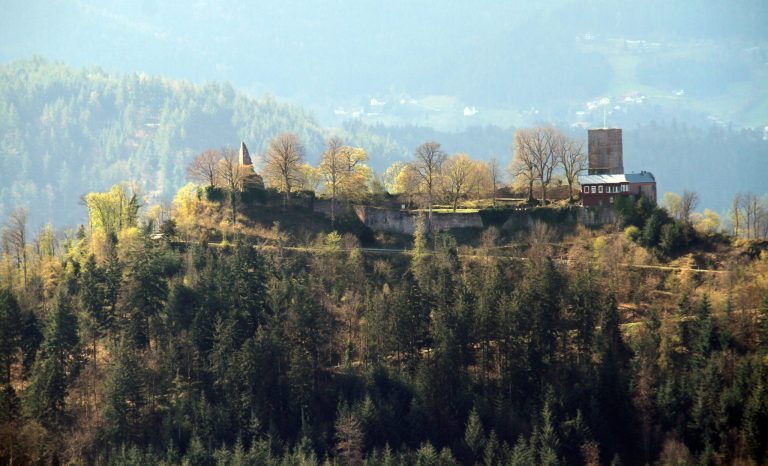
Hohenbaden Castle is a medieval hillside fortification above Baden-Baden, Germany, whose upper castle began around 1100 on the western slope of the rocky Battert. It became the first seat of the margraves, medieval territorial rulers, after the ruling family transferred its authority to the Upper Rhine. The castle later gave its name to the state of Baden.
The Upper Castle and the Baden Name
Construction of the upper castle, known as the Hermannsbau, is associated with Margrave Hermann II, who lived from 1074 to 1130. From 1112, the margraves adopted the name “of Baden,” linking their new designation to the castle and the settlement below it, which was then called Baden.
Expansion into a Margravial Residence
The Gothic lower castle developed under Margrave Bernhard I of Baden, who ruled from 1372 to 1431. Margrave Jakob I, who ruled from 1431 to 1453, expanded it into a representative center of the margraviate, the territory governed by a margrave. At its height, the castle contained 100 rooms.
Margrave Christoph I enlarged the New Castle in the town of Baden, where construction had begun in 1370. The ruling residence moved there in 1479. After that transfer, Hohenbaden served as a residence for widows of the ruling family.
Fire, Ruin, and Commemoration
A fire destroyed the Old Castle in 1599. The ruins were not structurally secured until after 1830. Today, the State Palaces and Gardens of Baden-Württemberg, the state institution responsible for preserving historic palaces, castles, gardens, and related monuments, cares for Hohenbaden.
A Staufer stele erected near the car park below the ruins in 2014 commemorates cooperation between the margraves of Baden and the Staufers, a prominent medieval German ruling dynasty whose members included several Holy Roman Emperors. The castle also entered modern cultural memory through Luise Adolpha Le Beau’s symphonic poem Hohenbaden, Op. 43, composed in 1896 and premiered in Baden-Baden on 25 February 1898. During the nineteenth century, artists including Hans Thoma often depicted the view from Ritterplatte, a rock east of the castle.
Remains
Hohenbaden survives as a ruined hillside fortress on the western slope of Battert. Its principal divisions are the upper castle, including the Hermannsbau, and the Gothic lower castle. The surviving complex also includes a former Knights’ Hall, a castle courtyard, a fortress wall, and a tower.
Upper and Lower Castle
Hermannsbau
The Hermannsbau forms part of the upper castle, whose construction began around 1100. Its position within the upper section reflects the early phase of Hohenbaden as a margravial seat on the Battert slope.
Bernhardsbau
The Bernhardsbau, dating from around 1400, is the most important component of the lower castle. On its ground floor, a column decorated with a coat of arms held by angels formerly supported a powerful vault.
Courtyard and Defensive Features
Knights’ Hall
The ruined Knights’ Hall forms part of the castle’s surviving interior spaces. A large wind harp installed there in 1999 rises 4.10 metres and carries 120 nylon strings. Air currents activate the strings, producing the fundamental tones C and G. Regional musician and harp maker Rüdiger Oppermann designed and built the instrument and described it as Europe’s largest wind harp. A smaller wind harp stood in the Knights’ Hall from 1851 to 1920.
Fortress Wall and Tower
The castle courtyard is accompanied by a surviving fortress wall and tower, which preserve elements of the site’s defensive arrangement. The tower provides views over Baden-Baden, the Rhine Plain, and the Vosges.
Present Structures
The site includes a restaurant and a small hotel containing three rooms and two suites, incorporated among the surviving castle structures.