Schlossberg Castle: A Historic Fortress in Forbach, France


Site at a Glance
- Rating
- 4.4
- Popularity
- Medium
- Country
- France
- Primary era
- Medieval
- External website
- Open
- Eras represented
- Medieval, Early Modern, Modern
- Civilizations
- Duchy of Lorraine, German, Holy Roman Empire
- Site type
- Military
- Remains
- Castle
On this page12 sections
History
Schlossberg Castle is a historic fortress in Forbach, France, built by medieval lords on the 134-metre Schlossberg hill. Its origins may reach back to the eleventh or twelfth century, while architectural evidence places construction in the late twelfth or early thirteenth century. The hill overlooks Forbach, the Warndt basin, the routes between Metz and the German cities, and the ancient road from Metz to Worms.
Medieval foundation and expansion
The castle is first mentioned in 1257, in the writings of Thédoric de Werde. By the middle of the thirteenth century, it consisted of a palace surrounded by an enceinte, a fortified enclosing wall, with a square keep at its centre. The original entrance lay through an opening later identified as the fourth gate.
After 1431, Arnold VI of Sierck the Elder acquired the castle and undertook a major programme of strengthening and enlargement. He had become a trusted associate of René of Anjou after the Battle of Bulgnéville, and reinforced Schlossberg to protect the northeastern marches of the Duchy of Lorraine, a political territory between the French and German spheres whose frontier zones required military protection. He extended the defensive perimeter, created a new entrance corresponding to the present third gate, built a tower on the site of the current tower, and added stables.
Renaissance residence and military conflict
During the middle of the sixteenth century, the lords of Hohenfels-Reipoltskirchen and Daun-Falkenstein transformed the medieval stronghold into a fortified Renaissance palace. Their additions included a corner tower and a bastion, a projecting fortification designed to strengthen defensive fire and protect the surrounding walls.
In 1591, troops commanded by Christian I of Anhalt-Bernburg looted the castle. The German Protestant prince and military commander had come to support Henry IV during the difficult succession to the French throne, in opposition to Charles III, Duke of Lorraine.
The counts of Leiningen-Westerburg and Eberstein restored Schlossberg and strengthened it again in 1607, adding another bastion. Excavations in the nineteenth century indicated that the complex then possessed at least six towers. Its military history ended during the Thirty Years’ War, the major European conflict fought from 1618 to 1648. On 14 December 1634, Louis XIII ordered the castle’s destruction through Marshal de La Force as part of a campaign against castles regarded as threats to the French presence in Lorraine. By early 1635, the hill was reduced to ruins and again became known as the “green mound.”
Revolutionary reuse and later commemorations
During the French Revolution, stones from the remaining ruins were reused after the hill was renamed the “Mountain of Fraternity” and transferred to Pierre Ney. The property later passed through several families. Gustave Adt, a local industrialist associated with the Adt family’s paper and papier-mâché enterprises, eventually acquired it and began historical excavations.
The present tower formed part of a programme of architectural embellishment undertaken during the period of German annexation at the initiative of the Adt family. Gustave Adt planned a 20-metre square tower dedicated to Otto von Bismarck, the Prussian statesman and first chancellor of the German Empire, whom he greatly admired. That project was not realized. Around 1895, however, Adt placed a large Bismarck medallion between two cannons from the Franco-Prussian War of 1870 on the medieval ruins. The area below the tower was already known as Bismarckplatz.
The Bismarck medallion was later replaced by one depicting Jean Nicolas Houchard, a Forbach-born French Revolutionary general. Houchard was executed during the Reign of Terror, the period of intensified revolutionary repression in France from 1793 to 1794. The former Bismarckplatz at Schlossberg was distinct from another commemorative space dedicated to Bismarck in the park of Adt’s Castle, the residence of the local papier-mâché manufacturers.
Twentieth-century changes
The surrounding park became municipal property in 1919 after incorporating part of the land belonging to the Adts’ farm. Combat during the Second World War damaged the tower. Exposure to the weather then led to restoration in the 1950s, followed by further restoration campaigns that preserved the surviving structure.
Remains
Hilltop fortress
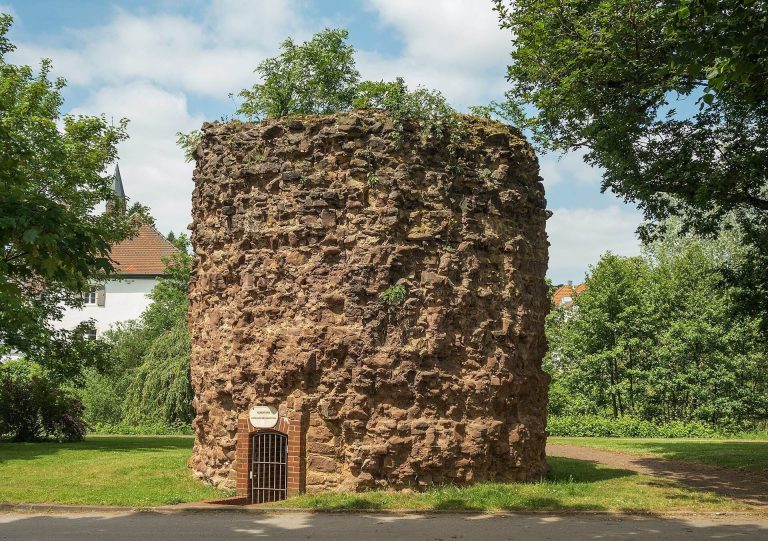
Schlossberg Castle occupied a hill in front of the Gaubiving plateau, an advanced part of the Lorraine Plateau. This isolated hill, or butte, provided views towards the Saar and controlled the ancient route from Metz to Worms. The medieval complex combined a palace, enclosing defenses, gates, a central square keep, towers, stables, and later bastions.
Medieval keep and defenses
The square keep was the principal strong tower of the medieval castle. Erected after 1436, it was massive, with walls measuring about 2.90 metres thick on the western side and 4.30 metres on the southern side. The earlier entrance passed through what became the fourth gate, while Arnold VI of Sierck’s later entrance corresponds to the present third gate. By 1607, the defensive complex included at least six towers, along with the palace, stables, and bastions added or enlarged over successive phases.
Schlossberg Tower and park
Schlossberg Tower
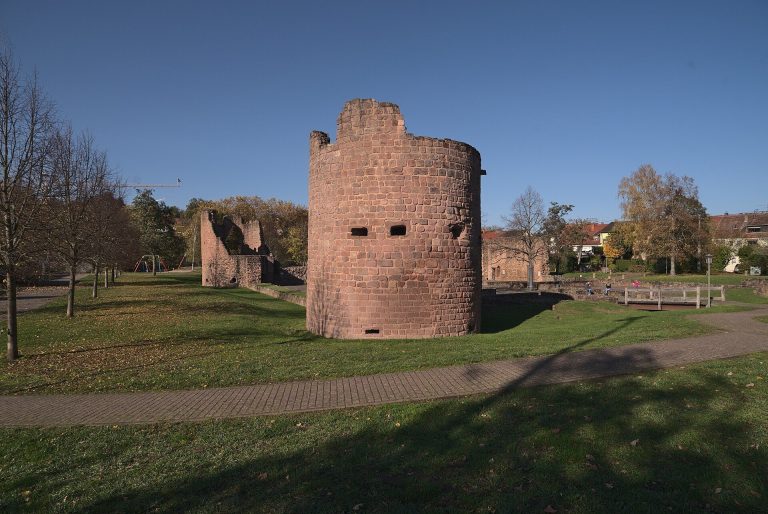
The current Schlossberg Tower is an almost 28-metre-high octagonal structure built in 1891 by the German architect Paul Tornow on the castle remains. It occupies the site of a former round corner tower known as the Red Tower rather than the site of the medieval keep. Because the earlier tower overlooked the Saar, the present structure is also sometimes called the Saareck Tower. War damage and weathering led to restoration in the 1950s, with additional campaigns following later.
Park and Burghof
The park formerly contained a windmill, a Swiss chalet, water basins dating from the German period, and a rose garden. After the Second World War, these features were replaced by green spaces, and the park was redesigned repeatedly. The former forest keeper’s house survives below the hill. The Burghof is a farm complex built in several stages around 1900. After restoration and enlargement, it housed an open-air school in 1919 and later became a restaurant. A congress hall was built beside it after fire destroyed part of the complex, using an architectural style associated with the Adt buildings of the same period.
Commemorative remains
The former commemorative installation at the foot of the tower consisted of a large medallion set between two cannons dating from the Franco-Prussian War of 1870. The medallion now depicts Jean Nicolas Houchard rather than Otto von Bismarck, preserving a later layer of political and local memory within the castle site.