Werk Strino: An Austro-Hungarian Fort at the Tonale Pass



Site at a Glance
- Rating
- 4.4
- Popularity
- Medium
- Country
- Italy
- Primary era
- Modern
- External website
- Open
- Eras represented
- Modern
- Civilizations
- Austrian Empire, Habsburg
- Site type
- Military
- Remains
- Fort
On this page7 sections
History
Werk Strino is an Austro-Hungarian fort in Italy, built between 1860 and 1862 near the Tonale Pass in the municipality of Vermiglio. It was the first fort constructed in the upper Vermiglio valley and formed part of Subrayon II, the Austro-Hungarian fortified frontier subdivision controlling the Tonale barrier.
Construction and Strategic Role
The fort was built to defend the final section of the road to the Tonale Pass and to block movement through Val di Vermiglio toward Val di Sole. Its construction followed the improvement of the former cart track into a substantial road in 1859, an initiative associated with Field Marshal Radetzky, an Austrian commander and senior Habsburg field marshal. The improved route increased concern about an Italian advance over the pass and the possible danger to the Fortress of Trento.
Werk Strino stood within a chain of fortifications guarding the area. Forte Presanella lay to the south, while Forte Mero and Forte Saccarana, also known as Forte Tonale, stood to the north. In 1891, a smaller close-combat fortification called Forte Velon in Italian and Vermigliohang in German was built below Werk Strino and below the road. It was subordinate to the main fort rather than an independent fortification, and was linked with Werk Strino and a roadside guardhouse.
Military Use and the First World War
The fort’s command was subordinate to the IX Battalion of Innsbruck. Its garrison included light infantry from Rovereto and Pergine Valsugana. Another organizational record lists a detachment of the Bolzano No. II Landesschützen Regiment and the 2nd Company of Fortress Artillery Battalion 7.
By the outbreak of the First World War, Werk Strino no longer met contemporary military requirements. In 1915 it was regarded as only marginally protected against shellfire and insufficiently resistant to assault, while its guns offered inadequate protection for the valley floor. The front remained at the Tonale Pass, about eight kilometres away in a straight line, so the fort served mainly as accommodation and a relay station. Italian artillery firing from Ponte di Legno caused some damage.
Postwar Damage and Restoration
After the war, inhabitants returning to Val di Vermiglio quarried the fort for stone to rebuild houses destroyed during the conflict. Its partial destruction therefore resulted mainly from the later removal of stone and iron rather than from direct wartime destruction.
The municipality of Vermiglio and the Autonomous Province of Trento later promoted restoration as the fort deteriorated. The work consolidated the structures, removed rubble, and cleared dense vegetation. A subsequent campaign sought to return the building as far as possible to its original condition, with the principal structural damage considered external and repairable.
After restoration, the Comitato Forte Strino di Vermiglio was established in 1997 to create and promote an exhibition space. A similar association replaced the committee in 2008 and provided guided visits during the summer. Werk Strino now houses an exhibition devoted to the First World War and another devoted to contemporary art, and forms part of the Trentino Great War network.
Remains
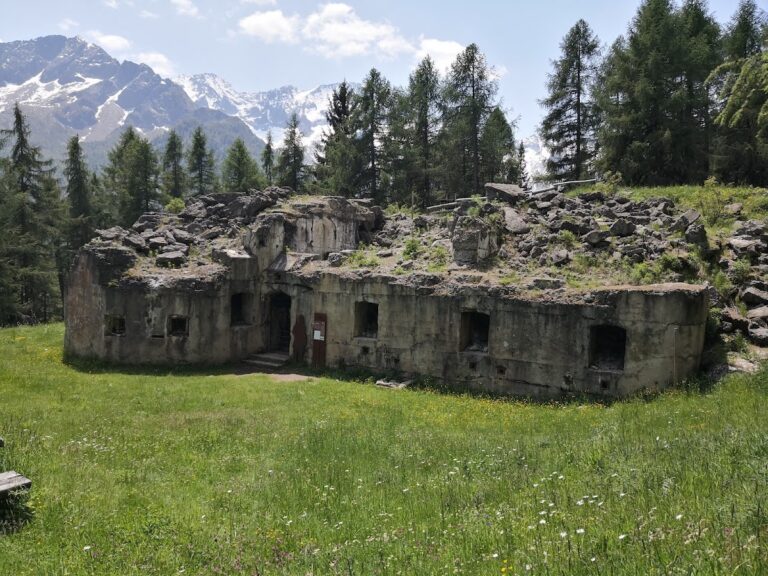
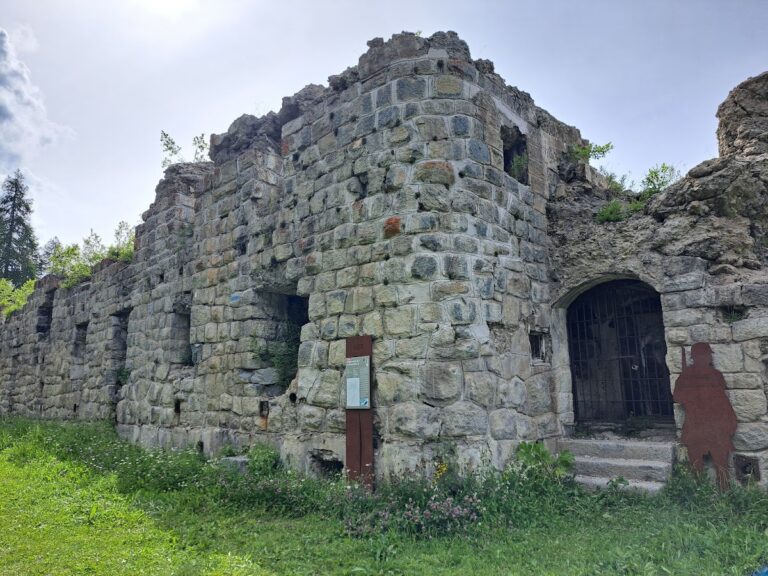
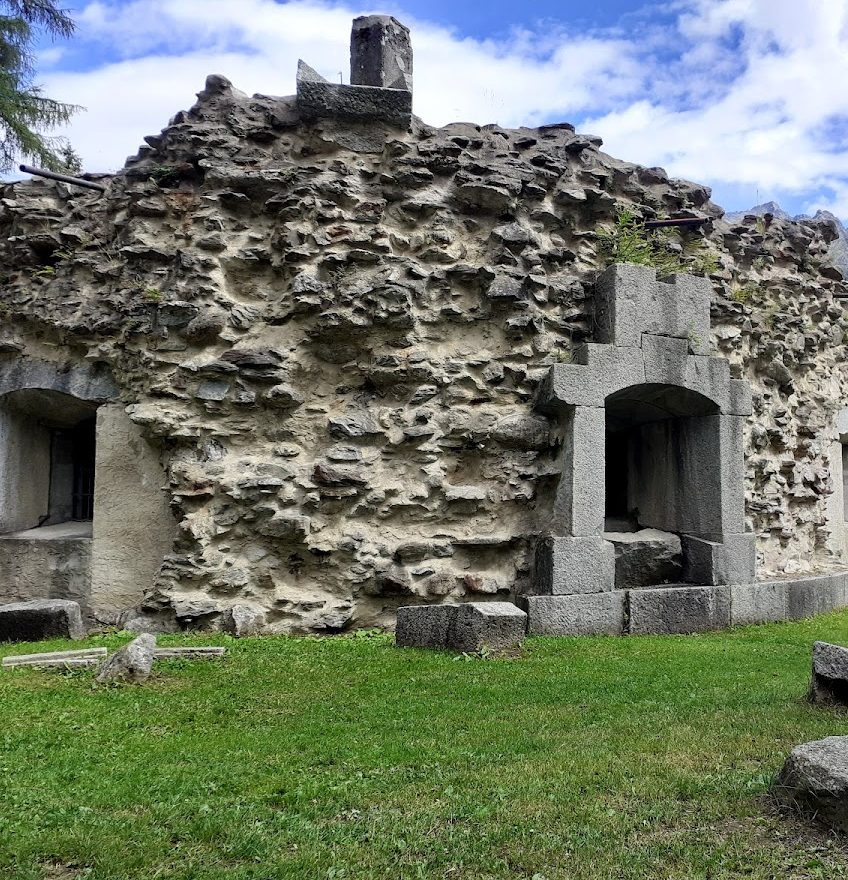
Werk Strino stands directly beside the Tonale road at approximately 1,500 to 1,538 metres above sea level. Its principal structure is a two-level, semicircular granite-masonry block with a rounded front and recessed flanks. The lower part also served as a barrier across the road, though that section was partly demolished to allow the modern road to pass.
Main Fort
The first level contained three gun positions and the second four, directed toward the Tonale Pass road and Val di Vermiglio. Protected chambers called casemates housed four 12-centimetre M 61 guns on depression mountings and four 9-centimetre M 75/96 guns. Loopholes supported close defense. The original roofs were about one metre thick and covered by as much as two metres of earth, providing protection against artillery shells of the period.
Werk Strino was designed as a self-sufficient installation. Its facilities included a drinking-water supply, bread oven, infirmary, electric generator, optical signaling equipment, and a telephone connecting it with the other forts, forward positions, and the central station at Male. A dovecote was also provided for keeping the bodies of the dead. The structure itself remains substantially intact despite heavy external damage, and restoration removed accumulated rubble and overgrown vegetation.
Vermigliohang and the Covered Connection
The lower Vermigliohang facility was a modest fortification positioned beneath Werk Strino and beneath the road. It was classified as shellproof and resistant to assault. Its armament consisted of two 8-centimetre M 98 minimal-embrasure guns, two M 07/12 machine guns, and seven rifle mountings.
A concrete postern, a protected passage through a fortification, connected Vermigliohang with the roadside guardhouse. A steep, vaulted covered stairway approximately 140 metres long connected it with the main fort. This passage was known as a caponier, a covered defensive route used for access and close-range protection.
Nearby sites