Forte Presanella: An Austro-Hungarian Border Fort in Italy


Site at a Glance
- Rating
- 4
- Popularity
- Very Low
- Country
- Italy
- Primary era
- Modern
- Eras represented
- Modern
- Civilizations
- Habsburg
- Site type
- Military
- Remains
- Fort
On this page6 sections
History
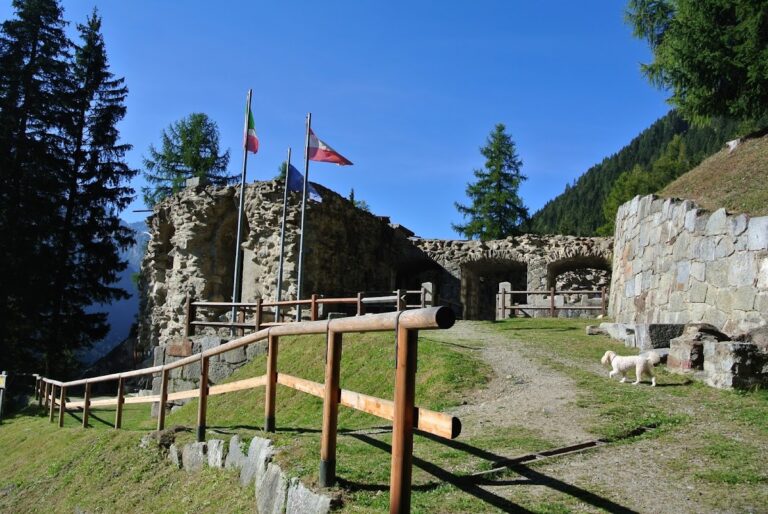
Forte Presanella is a former Austro-Hungarian fort in Italy, near Vermiglio, completed in 1912 as part of the fortified border system built against Italy. It belonged to the Tonale barrier in Subrayon II, a subdivision of a larger military defensive district, and helped block the route from Tonale Pass through Val di Vermiglio and Val di Sole toward the Adige Valley.
Construction and defensive role
The fort was constructed for the Imperial and Royal Army of Austria-Hungary together with the facing Forte Saccarana. Along with the forts Tonale, Mero, and Strino, it controlled the route across the Tonale sector. This defensive network protected the rear of the Trento fortress and the approach toward Bolzano.
Forte Presanella was also known as Forte dei Pozzi-Alti, Forte Pozzi Alti, and Forte Stavel. Italian official maps now identify it as “Ex Forte Presanella.” Its design followed the model of the forts Verle and Lusern on the Altopiano dei Sette Comuni, a high plateau in northeastern Italy. By the time construction ended, however, advances in fortress artillery had made the design technologically outdated.
First World War damage and later military use
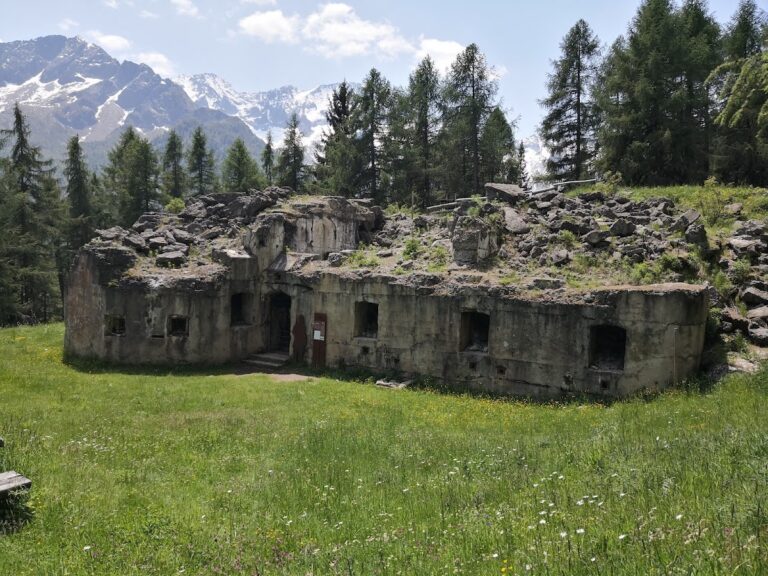
During the Alpine campaign of the First World War, Italian batteries near Ponte di Legno and in Valle Seria shelled the fort throughout the fighting. The 149 mm field guns used until mid-August 1915 produced almost no effect on their own. From 23 August, Italian forces also employed 30.5 cm howitzers, which caused severe damage despite scoring only a few hits.
Approximately 450 shells of medium and heavy calibers struck the fort, with a hit rate of about four percent. The damage was nevertheless severe because the installation stood exposed on a mountain projection. Its guns were removed from the complex from the end of August 1915 and reused in field positions, while the fort itself remained occupied. In June 1918, during Operation Lawine, it became the headquarters of the 1st Infantry Division.
Forte Presanella is now in Italy and has undergone restoration in recent years. These later interventions followed its earlier role as an Austro-Hungarian military installation on the imperial frontier.
Remains
Mountain setting and defensive layout
The fort stands at approximately 1,880 metres on a mountain ridge north of Croz di Stavel, which rises to 2,635 metres, and Cima die Pozzi, which reaches 2,890 metres. It occupies the eastern, or right-hand, side of the valley. A steel-grid fence surrounded the complex, while a large wall above the fort provided protection from possible avalanches.
The rectangular building was set with its long axis aimed almost directly toward Tonale Pass, the strategic point of the barrier. Its narrow front facade was backed by a wedge-shaped earth embankment that provided additional protection. The fort also maintained line-of-sight connections with the other installations of the Tonale barrier.
Artillery and observation structures
Three 100 mm M09 howitzers formed the main armament. Each was a turret howitzer, a short-barreled artillery piece mounted in a rotating armored cupola, and the three turrets were designated TH2, TH3, and TH4. They were arranged one behind another along the fort’s axis, with 16.8 metres between neighboring turrets. This placement meant that an attack from Tonale Pass could prevent direct fire in that direction because the guns would obstruct one another.
Two 80 mm M05 guns were installed in armored casemates, protected chambers that fired through openings in their armor, and were designated KP5 and KP6. The fort also carried fifteen 8 mm Schwarzlose M07/12 machine guns. The Schwarzlose was a standardized machine-gun design used widely by the Austro-Hungarian armed forces. An armored observation cupola completed the fort’s principal defensive equipment.
Nearby sites