Heimburg Castle: A Medieval Hill Fortress in Germany


Site at a Glance
- Rating
- 4.4
- Popularity
- Low
- Country
- Germany
- Primary era
- Medieval
- External website
- Open
- Eras represented
- Medieval
- Civilizations
- Holy Roman Empire
- Site type
- Military
- Remains
- Castle
On this page8 sections
History
Heimburg Castle is a medieval German hill fortress in Germany, probably built around 1070 by King Henry IV as a stronghold against Saxon princes and to protect the Harz mining region and the route to Bodfeld, an imperial hunting base in the central Harz.
Foundation and early destruction
The castle was first recorded in 1073 as a possession of Emperor Henry IV, a medieval German king and Holy Roman Emperor. Its early destruction remains uncertain. Saxon forces may have destroyed it in 1073 or 1074 during the Saxon War, Henry’s conflict with rebellious Saxon nobles, or it may have fallen after the Battle of Welserholz in 1123.
Rebuilding and noble control
By 1143, the castle had probably been rebuilt. In that year Henry the Lion, a powerful twelfth-century German duke, entrusted it to Anno of Heimburg, a ministerialis, meaning a service-dependent noble or official who carried out administrative or military duties for a higher lord.
The lords of Heimburg later fought a feud lasting several generations with the counts of Regenstein. The Heimburg side eventually surrendered the castle to Count Ulrich I of Regenstein. One branch of the Regenstein family then adopted the designation Regenstein-Heimburg.
Decline and archaeological work
During the sixteenth century, the castle was repeatedly pledged or granted as a fief. When the Regenstein line died out in 1599, the fief returned to its feudal lord, the Duke of Brunswick. The castle was destroyed during the Thirty Years’ War, the major European conflict fought from 1618 to 1648, and it was not rebuilt. Its ruins later became a source of building stone.
Excavations took place from 1891 to 1894, and the site was refurbished in 1990. The ruins are also included as checkpoint 84 in the Harzer Wandernadel, a hiking badge network that marks designated points along trails in the Harz region.
Remains
Hilltop complex
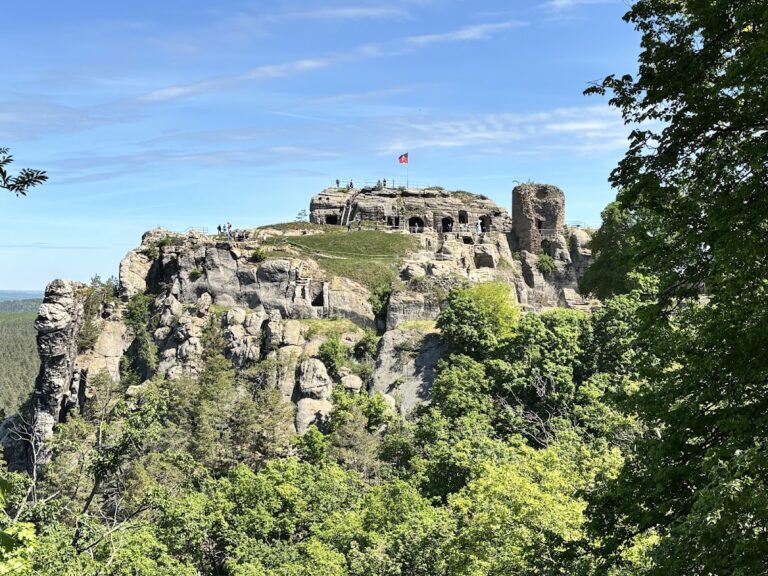
Heimburg Castle occupies the oval Altenburg hill above Heimburg, in the northern Harz foothills within the Harz Nature Park. The lightly wooded hill rises to 280.9 metres above sea level. The oval castle complex had an inner ward measuring approximately 35 by 60 metres and was enclosed by several wall lines, ditches, and ramparts.
Walls and tower
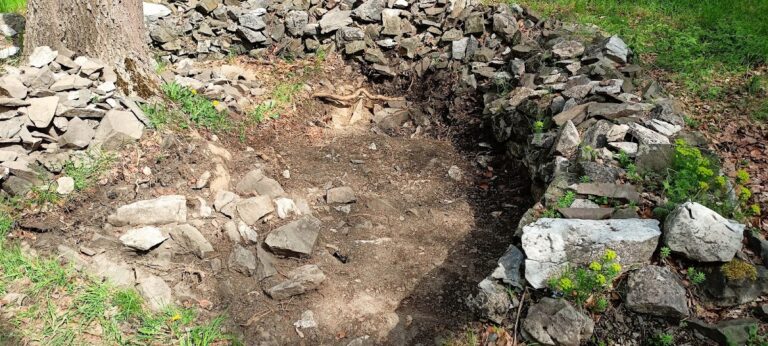
Surviving remains include a curtain wall that once stood up to 10 metres high. The complex also retains the remains of a round bergfried, the principal tower of a medieval German castle, which served mainly for defense and as a strong refuge rather than as the lord’s primary residence.
Former Altenburg site
A viewing pavilion now occupies the site of the former Altenburg. It forms part of the present arrangement of the hilltop ruins, whose surviving walls and earthworks reflect the castle’s defensive layout.