Regenstein Castle: A Medieval Rock Castle and Prussian Fortress in Germany


Site at a Glance
- Rating
- 4.6
- Popularity
- Medium
- Country
- Germany
- Primary era
- Early Modern
- External website
- Open
- Eras represented
- Medieval, Early Modern
- Civilizations
- Brandenburg-Prussia, French, Holy Roman Empire
- Site type
- Military
- Remains
- Castle
On this page12 sections
History
Regenstein Castle is a medieval rock castle near Blankenburg in Germany, first recorded in 1162 during the rule of the House of Reginbodonen, a medieval noble family to which Count Poppo I of Blankenburg belonged. Built on the sandstone Regenstein massif, it later became a fortress and remained a military position until the eighteenth century. The surviving ruins reflect this change from a medieval comital residence to a major early modern military installation.
The Counts of Regenstein
In 1162, Conrad, the son of Count Poppo I of Blankenburg, was named Count of Regenstein. The castle became especially associated with Count Albert II of Regenstein, whose disputes during the 1330s involved the rulers of nearby towns, the Bishop of Halberstadt, and the Abbess of Quedlinburg. These conflicts later provided the setting for Gottfried August Bürger’s ballad The Robber Count, which was set to music by Johann Philipp Kirnberger, and for Julius Wolff’s novel of the same name.
During the fifteenth century, the counts moved their official residence to Blankenburg Castle. Regenstein then declined and became a ruin. The male line of the family ended in 1599 with the death of Count John Ernest of Regenstein.
Transfer to the Tattenbach family
After several changes of ownership, Regenstein was granted in 1643 by Archduke Leopold William of Austria, who also held the position of Bishop of Halberstadt and exercised territorial political authority, to the Lower Bavarian Count William of Tattenbach. The family adopted the title Count of Reinstein-Tattenbach, and the castle’s name was sometimes written as Rheinstein or Reinstein.
In 1671, Count John Erasmus of Reinstein-Tattenbach was beheaded in Austria for taking part in the Magnate Conspiracy, a plot by prominent Croatian and Hungarian nobles against Habsburg rule. The Elector Frederick William of Brandenburg then confiscated the county.
Prussian fortress and destruction
From 1671, Prussian forces enlarged the medieval castle into a modern fortress according to contemporary military-engineering principles. It became a Prussian garrison in 1677, and its military role continued until the position was made unusable in 1758.
Lightning struck the powder tower in 1736, causing an explosion and severe damage. Reconstruction followed, and by 1742 the enclosing wall had been extended to 1,200 metres. French forces occupied the fortress on 12 September 1757 and continued its structural expansion. Prussian forces recaptured it on 12 February 1758, but they lacked the resources to restore the works and the soldiers needed to garrison them. They therefore demolished the fortifications by blowing up the powder magazine. Regenstein was not rebuilt after 1758.
Later history and interpretation
After the fortress period, the surrounding pastures and forests came under Prussian administration in Westerhausen. Following Westphalian rule from 1807 to 1813, Regenstein belonged from 1815 to 1945 to the Prussian district of Halberstadt as its smallest exclave, meaning a territory separated from the main part of the state that governed it. It is now part of Blankenburg.
A restaurant opened at the rock in 1812, beginning Regenstein’s later role as a tourist attraction. Johann Wolfgang von Goethe and the painter Georg Melchior Kraus visited the site on 11 September 1784 during Goethe’s third journey through the Harz. They came to conduct geological studies, and two drawings and a rock sample in Goethe’s rock collection commemorate the visit.
Remains
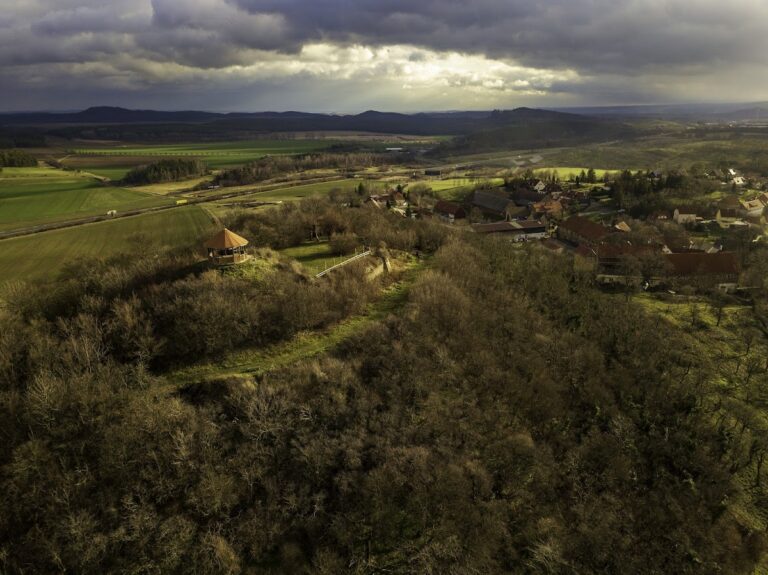
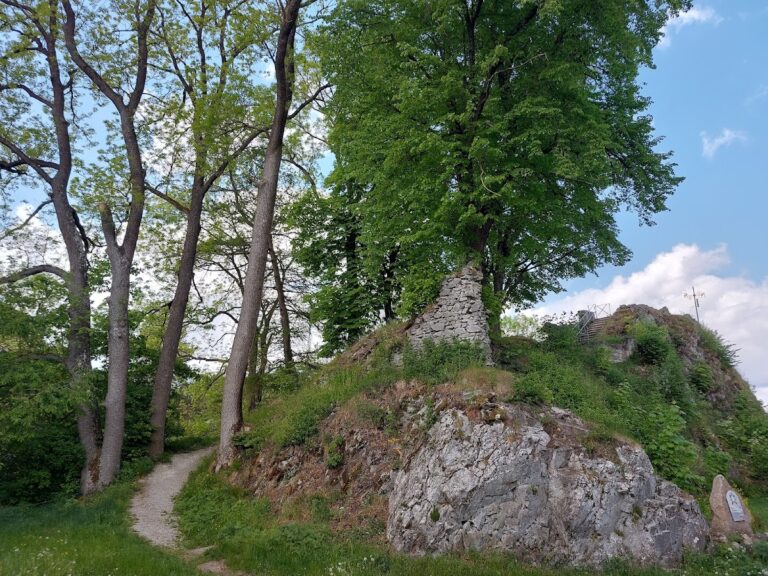
Regenstein occupies the northwestern highest point of the sandstone massif. The rock rises sharply from the Harz foreland and falls steeply on three sides. The site is approximately 294 metres above sea level, while a surveying point at the former castle position is recorded at 289.4 metres. The medieval castle used only a small part of the much larger area later enclosed by the fortress. Surviving features include medieval and military ruins, earthworks, casemates, and many chambers and installations cut directly into the sandstone.
Medieval castle and rock-cut rooms
Keep and carved chambers
The medieval keep, the principal fortified tower of the castle, survives in ruined form within the later fortress area. Regenstein’s most distinctive spaces are its cavernous rooms carved from the natural rock. These chambers included stables, and one surviving room contains an exhibition of archaeological finds from the castle area. The rock-cut installations preserve the close relationship between the medieval stronghold and the sandstone outcrop on which it was built.
Prussian fortress remains
Defensive works and casemates
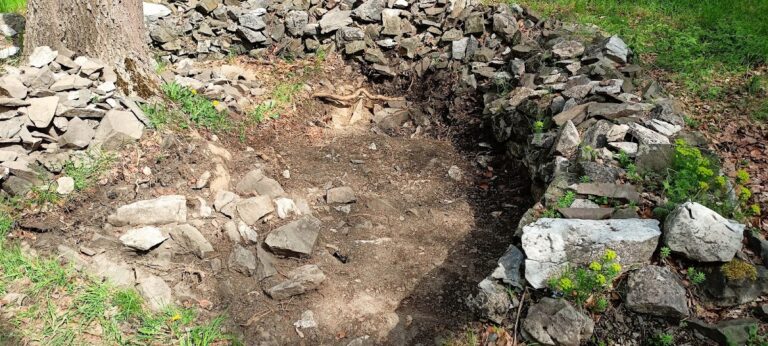
The later fortress survives through earthworks, redoubts, bastions, casemates, and other defensive structures associated with Prussian, French, and local territorial control. A redoubt was a fortified defensive work, while a bastion was a projecting structure intended to strengthen a fortification against artillery. A casemate, a vaulted fortified chamber, served purposes such as protecting soldiers, storing supplies, or sheltering artillery. The entrance gate has been partly restored, and sections of the eighteenth-century enclosing wall remain as part of the fortress layout.
The castle well
The castle well was cut in 1671 during the early fortress period. More than 197 metres deep, it required a wheel operated by three men to raise water. The wheel’s shaft was about 3.5 feet in diameter, and raising a bucket holding 40 measures of water took almost a quarter of an hour.
The demolition of the fortress damaged the well. Rubble and debris progressively filled the shaft, which had reached a recorded depth of only 62 feet by 1855. The shaft was completely filled in 1885.
Landscape and associated features
The ruins stand on sandstone outcrops within the forested Heers area. Below them are the former Regenstein Mill and the Sand Caves. The mill formerly supplied the castle with water, linking the lower landscape to the needs of the fortified settlement above.