Burg Hals: A Medieval Hilltop Castle in Germany


Site at a Glance
- Rating
- 4.2
- Popularity
- Low
- Country
- Germany
- Primary era
- Medieval
- Eras represented
- Medieval
- Civilizations
- Holy Roman Empire
- Site type
- Military
- Remains
- Castle
On this page7 sections
History
Burg Hals is a medieval hilltop spur castle in Passau, Germany, positioned above the village of Hals in a narrow bend of the Ilz River. The Lords of Hals were first mentioned in 1072, and the castle was recorded in 1112 as belonging to the Palsenze family of Eferding. Its name refers to its position at the river’s “neck,” or narrow bend.
Rise of the Lords of Hals
In 1190, the nobles of Kamm from Ortenburg took control of the castle lordship. The new lords became involved in conflicts with the Counts of Bogen and the bishops of Passau. During one dispute, the emperor imposed the imperial ban, a formal outlawry that removed legal protection and could permit the seizure of property.
Rudolf of Habsburg, the thirteenth-century German king who began the Habsburg dynasty’s major political rise, elevated Albert of Kamm to the rank of count in 1280. The Counts of Hals then extended their territory toward the Bohemian border. Their possessions included Osterhofen, Haidenburg, Schönberg, Aidenbach, Aiterhofen, Rathmannsdorf, and Fürstenstein. They also secured trade routes to Bohemia, including the Golden Trail, a historic route linking Bavaria with Bohemia. Timber floating from the Bavarian Forest and pearl fishing provided important income.
Leuchtenberg Rule and Financial Decline
When the Kamm-Hals line became extinct, the castle passed in 1375 to Johann of Leuchtenberg, a count from the Upper Palatinate. His close relationship with Charles IV, Holy Roman Emperor and King of Bohemia, secured the right to mint coins for the lords of Hals. Burg Hals produced the so-called Bösen Halser coins during the Schinderling period, which was associated with the circulation and minting of debased silver coinage.
After Charles IV died, Johann supported Charles’s son, Wenceslas, the succeeding King of Bohemia. Johann consequently ended up on the losing side in the conflicts that followed. The county accumulated debt and lost much of its territory. In 1399, Johann abducted the Bishop of Bamberg near Hals and demanded a ransom, but the act did not solve his financial difficulties.
Wittelsbach Administration and Destruction
The remaining territory passed to the noble families of Aichperg and later Degenberg. The Wittelsbachs, a major Bavarian ruling dynasty, purchased the lordship in 1517. A fire damaged the castle in 1622. After 1663, ducal castle administrators lived in a newly built administrative building in Hals, while the castle was used only for storage.
During the War of the Austrian Succession, a conflict over the Habsburg inheritance and control of European territories, the castle was dismantled in 1741 to prevent its military use by the enemy. The standing walls collapsed in 1810. The ruins then deteriorated further and were used as a source of building stone.
Burg Hals is privately owned. Its ruins and archaeological remains are protected in Bavaria as both an archaeological monument and a listed architectural monument. The archaeological designation includes buried medieval and early-modern features and finds in the area of the ruins.
Remains
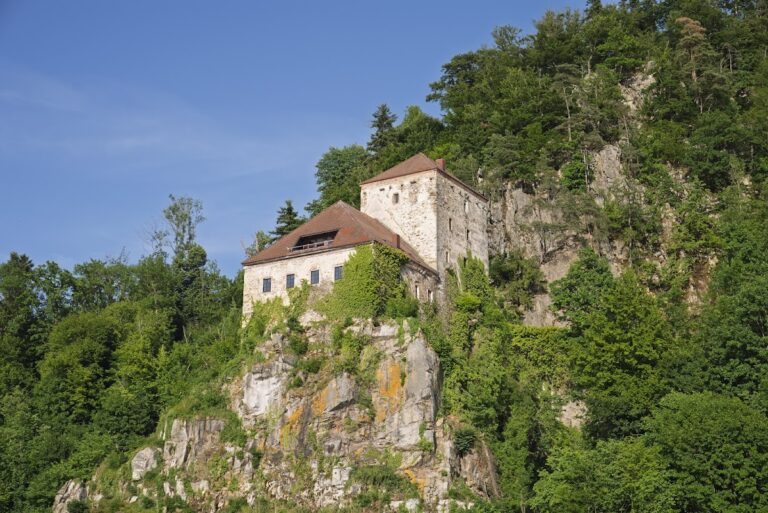
Burg Hals occupies a narrow rocky ridge above Hals, within a tight bend of the Ilz. This projecting ridge formed the natural defensive setting of the spur castle, whose surviving fabric consists of ruins on the castle rock. The former castle was later used as a source of building stone, while buried medieval and early-modern remains survive within the area.
Castle Rock
The castle rock contains the remaining walls and archaeological remains of Burg Hals. A rare elder iris, Iris sambucina, grows on the rock and forms part of the site’s recorded natural setting.
Burg Reschenstein
Burg Reschenstein lies approximately 750 metres northwest of Burg Hals. It is identified as the castle’s outwork, a detached defensive position intended to support the main castle’s defense.