Portuguese Castle (Qeshm): A Portuguese Fort in Iran


Site at a Glance
- Rating
- 3.7
- Popularity
- Low
- Country
- Iran
- Primary era
- Early Modern
- Eras represented
- Early Modern
- Civilizations
- Portuguese, Safavid
- Site type
- Military
- Remains
- Fort
On this page9 sections
History
Portuguese Castle (Qeshm) is a Portuguese fort built in 1621 on Qeshm Island, Iran, in the architectural traditions of Portuguese colonial and Safavid Persia. Constructed under the naval commander Ruy Freire de Andrade, it supported Portuguese economic activity in the region, especially on neighboring Hormuz Island, and preserves evidence of Portugal’s presence in the Persian Gulf during the sixteenth and seventeenth centuries.
Qeshm and the Kingdom of Hormuz
From 1301, Qeshm formed an important protected territory of the Kingdom of Hormuz, a maritime kingdom centered on Hormuz Island. Qeshm supplied drinking water to Hormuz and, from 1417, became the kingdom’s principal commercial center. This role made control of the island valuable to powers competing for trade in the Strait of Hormuz.
Portuguese conquest and construction
In 1507, Portuguese forces commanded by Afonso de Albuquerque and Vasco da Gama conquered several Persian Gulf islands, including Hormuz and Qeshm. Persia was then ruled by the Safavid dynasty, which governed the country from 1501 to 1722 and established a powerful centralized state.
In May 1621, 2,000 Portuguese soldiers and troops from Hormuz landed on Qeshm. They built the fort over the following five and a half months under Ruy Freire de Andrade, a Portuguese naval commander active in the Persian Gulf and nearby waters.
The siege of 1621–1622
During the winter of 1621–1622, the Shirazi commander Emam-qoli Khan blockaded the Portuguese garrison for nine months. An English East India Company squadron, an armed English trading fleet operating in the Persian Gulf and Indian Ocean, arrived at Bandar-e Jask in 1621 to collect silk for export. It joined the effort against the Portuguese in return for expanded trading privileges and control of the fort on Hormuz. The English had already defeated a Portuguese squadron under Ruy Freire near Jask in December 1620.
Negotiations with Ruy Freire failed, and the English bombarded the Qeshm fort in early February 1622. The garrison surrendered, Ruy Freire was captured, and Persian forces took control of Qeshm. The fort on Hormuz fell in April of the same year.
Later struggles for control
A Portuguese attack during the winter of 1629–1630 helped revive Portuguese trade. Following this success, the Portuguese obtained payments from the Persians for the permanent use of Qeshm. The death of Shah Abbas I, a Safavid shah, and the execution of Emam-qoli Khan ended those payments. In 1645, the Dutch attacked the Persian garrison on Qeshm. They failed to capture the fort but pressured the shah and strengthened their position in regional trade. The Portuguese continued to demand payments for use of the island until 1673, although Qeshm later came under Dutch control again.
Nadir Shah ordered the fort renovated in 1741 during his conflict with Oman. Oman attacked Qeshm again in 1806 after forming an alliance with the English. Despite an agreement, Omani forces arrested the local sheikh Mollah Hossein, and the English East India Company sent the ship Alert to seize the island. A counterattack led by Sheikh Soltan Saqr retook the fort in 1807 and repelled the British attack.
Excavation and preservation
Archaeologists led by Ehsan Yaghmayi excavated three of the fort’s four walls in 1999 and 2000. A major earthquake on 27 November 2005 destroyed part of the fort before the investigations were complete. Portuguese Castle has been listed as an Iranian national monument since 1998 and is also identified with Portuguese-influenced heritage.
Remains
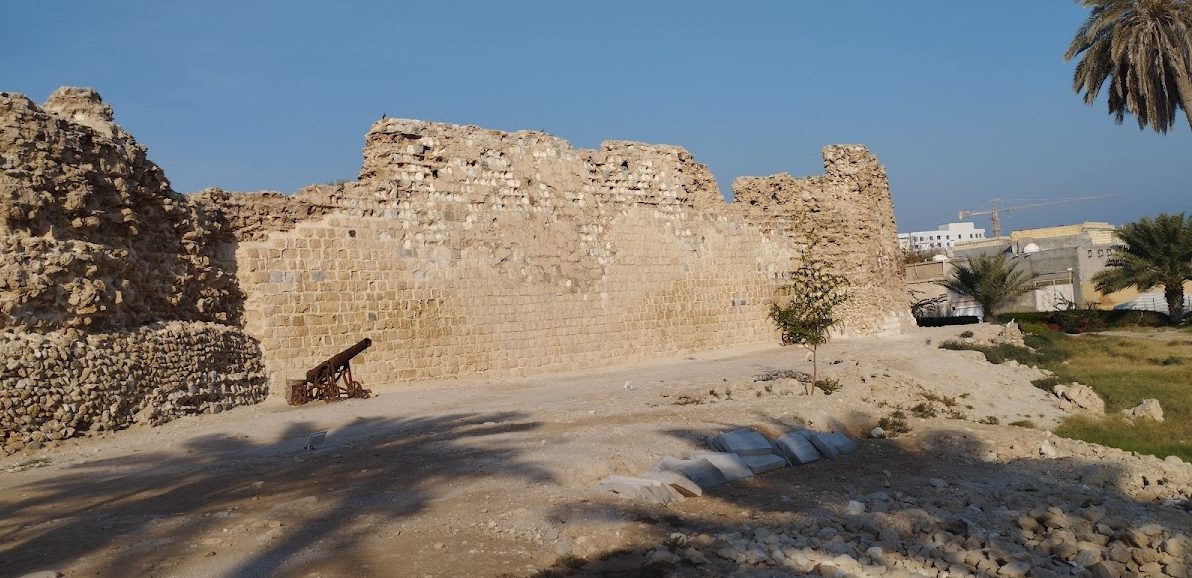
The ruins stand on Qeshm Island in the Strait of Hormuz, within the Persian Gulf. The surviving fortifications include two visible defensive walls and two towers, while several old cannons remain within the ruins. Archaeological work exposed three of the original four walls before the earthquake of 2005 destroyed part of the fortifications.
Construction and surviving fortifications
The fort was built with stone, wood, sarooj mortar, and plaster. Sarooj is a traditional waterproof mortar used in Iranian and Persian Gulf construction. The surviving walls and towers represent a military complex shaped by Portuguese colonial building traditions and the architectural context of Safavid Persia. The cannons within the ruins reflect the fort’s defensive function.
Excavated objects
Excavations recovered Chinese porcelain and Venetian glass. These objects connect the fort’s material remains with the wider commercial networks that crossed the Persian Gulf and linked the island to maritime trade beyond the region.