Weidelsburg: A Ruined Hilltop Castle in Germany


Site at a Glance
- Rating
- 4.7
- Popularity
- Low
- Country
- Germany
- Primary era
- Medieval
- External website
- Open
- Eras represented
- Medieval
- Civilizations
- Holy Roman Empire
- Site type
- Military
- Remains
- Castle
On this page13 sections
History
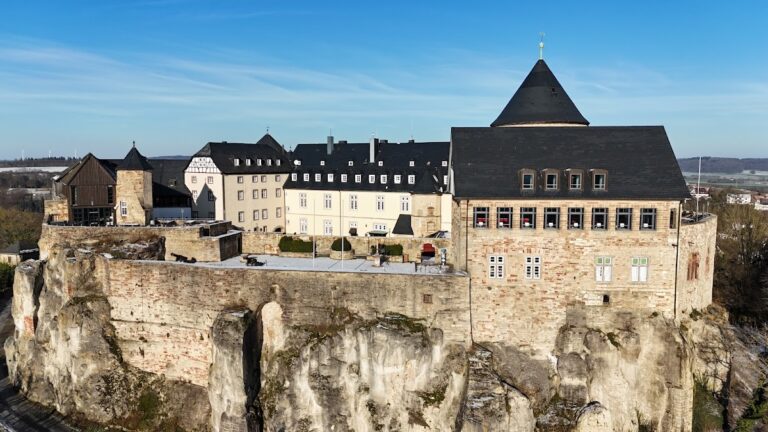
Weidelsburg is a ruined hilltop castle in Germany near Ippinghausen in Hesse. It became a defensive stronghold on the Ludovingian frontier, protecting important roads and standing in a contested borderland between Hesse, Waldeck, and Mainz. The castle is regarded as the largest castle ruin in North Hesse and remains a landmark of the Wolfhager Land.
Early fortress and frontier stronghold
A predecessor fortress, probably the castrum Alstat, appears in records dating from 1111 to 1121. These references occur within a list of donations to Mainz Cathedral compiled between 1111 and 1137. The date when Weidelsburg itself was built, and the identity of its builder, are uncertain. The castle is first mentioned by name in 1235.
Its position gave it a defensive role in a politically divided region. Weidelsburg stood in the former tripoint between the Landgraviate of Hesse, the County of Waldeck, and the Mainz enclave of Naumburg. It also occupied an old boundary between Franconian and Saxon territories. The Ludovingians, a medieval ruling dynasty that governed central German territories including Hesse for a period, used this frontier environment as part of their territorial power.
Transfer, destruction, and rebuilding
In 1266, Wittekind of Naumburg, a nobleman and canon in Magdeburg and Halberstadt, sold Weidelsburg, Naumburg Castle, and the court of Elben to Archbishop Werner of Mainz. The properties had been pledged to the Naumburgers by the Hessian landgraves, and Wittekind made the sale with the consent of his nephews. A proposed sale to Landgrave Henry I of Hesse for 1,500 marks of silver, made the year before, had not been completed.
The transfer intensified the conflict between Mainz and Hesse. In 1273, during the struggle between Archbishop Werner and Landgrave Henry I, Henry destroyed Weidelsburg. Most of the surviving fabric belongs to a later rebuilding phase that began roughly a century afterward.
Landgrave Hermann II of Hesse and Count Henry VI of Waldeck began reconstructing the castle in 1380. The work stopped in 1382 when Archbishop Adolf I of Nassau asserted older rights to Weidelsburg. In 1389, Adolf ordered the Lords of Hertingshausen to resume the reconstruction. The castle therefore became both a defensive installation and a material expression of competing territorial claims.
Sieges and the end of strategic importance
The feud between Mainz and Hesse continued into the fifteenth century. Landgrave Hermann II besieged Weidelsburg in 1402 and 1403, partly destroying the castle. In 1431, Archbishop Conrad III of Dhaun appointed Reinhard of Dalwigk as Mainz’s official administrator there. Dalwigk was regarded as a violator of the public peace, meaning that he was seen as breaching efforts by territorial rulers to suppress private feuds and maintain public order.
Hessian troops and the forces of Archbishop Dietrich Schenk of Erbach besieged Weidelsburg in 1443 and again in 1448. These campaigns compelled Dalwigk to submit and punished him. The second campaign ended with his permanent expulsion from the castle.
This expulsion is associated with the local version of the Hessian Women’s Loyalty tradition, a story also connected with other women of the period. In the Weidelsburg version, the castle’s mistress carried her husband out on her back after receiving a promise of safe conduct and permission to take as many possessions as she could carry.
Weidelsburg soon lost its strategic importance as the Hessian land-peace policy reduced the military role of many local fortresses. This policy was a medieval effort by territorial rulers and the Empire to restrict private warfare and enforce public order. Weidelsburg had been abandoned by no later than the end of the sixteenth century and later became a ruin, probably after a fire.
Restoration and preservation
Major restoration campaigns took place from 1930 to 1935, from 1979 to 1987, and from 2008 to 2011. The first campaign removed approximately 8,000 cubic metres of rubble. Later work restored sections of masonry and helped preserve the surviving walls, towers, gateways, and residential buildings. The ruin lies within the Habichtswald Nature Park and continues to define the historical landscape of the surrounding Wolfhager Land.
Remains
Weidelsburg occupies the summit of the wooded Weidelsberg at an elevation of 492.3 metres above sea level, in the western part of the Habichtswald Nature Park within the Waldecker Wald. The surviving complex combines high defensive walls, residential buildings, towers, arched gateways, and substantial portions of an outer defensive area known as a zwinger. This space between the main wall and an additional outer enclosure made an assault more difficult.
Residential and defensive buildings
Eastern and western palaces
The castle contains an eastern palas and a western palas. A palas was the principal residential and representative building of a medieval castle, providing important living and reception spaces. The eastern palas includes an observation platform at approximately 500 metres above sea level, while views from this part of the complex extend toward the inner courtyard. Sections of the masonry have been restored, and the surviving buildings form part of the castle’s reconstructed and ruinous fabric.
Courtyard and towers
A tower remains in the inner courtyard, and a separate fortification tower survives elsewhere in the complex. Together with the high wall sections, these towers express the defensive organization of the hilltop site. Their surviving masonry is integrated with the gateways and the substantial remains of the zwinger.
Gateways and local tradition
Arched gateways
Several arched gateways survive within the castle ruin. They form part of the fortified circulation between the outer defenses and the interior buildings. Their preserved arches, set among restored and fragmentary masonry, help convey the arrangement of the castle’s entrances.
Relief of Hessian Women’s Loyalty
A relief at the north gate shows the castle’s mistress carrying her husband on her back. It commemorates the local form of the Hessian Women’s Loyalty tradition, including the promise of safe conduct and the restriction that she could take only what she was able to carry. The relief links a surviving physical feature with the story associated with Weidelsburg’s fifteenth-century conflict.
Hilltop setting
From the summit of the Weidelsberg, the castle’s setting encompasses the Waldecker Wald, the Habichtswald uplands, and the surrounding West Hessian mountain-and-basin landscape. The wider view includes the regions around Wolfhagen, Naumburg, and the Edersee. The elevated position explains the castle’s role as a frontier stronghold and contributes to its visibility across the surrounding landscape.
Nearby sites