Schloss Landau: A Historic Castle Complex in Germany


Site at a Glance
- Rating
- 4.6
- Popularity
- Low
- Country
- Germany
- Primary era
- Early Modern
- External website
- Open
- Eras represented
- Medieval, Early Modern
- Civilizations
- Holy Roman Empire
- Site type
- Domestic
- Remains
- Castle
On this page11 sections
History
Schloss Landau is a historic castle complex in Bad Arolsen, Germany, developed from a thirteenth-century castle on the site. Around 1330, Count Heinrich IV of Waldeck converted the earlier complex into a castle, which was first recorded in 1339. Its long history reflects the changing residential, religious, educational, and institutional uses of the Waldeck estate.
Medieval Waldeck residence
From 1366, Heinrich IV’s grandson Heinrich VI used the castle intermittently as a residence. The Waldeck-Landau comital lines, families belonging to the rank of counts, were based there during three periods: 1397–1495, 1539–1597, and 1638–1668. Toward the end of the fourteenth century, a chapel was added over an earlier crypt, a chamber used for burials or religious purposes. It served as the burial chapel of the Waldeck comital family before later becoming the Landau town church.
Sixteenth-century rebuilding
Extensive rebuilding began in 1549. The work affected sections of the east and north wings, the large stair tower on the courtyard side, and the east portal leading into the courtyard. These surviving elements form an important part of the castle’s later appearance while retaining fabric connected with its medieval development.
Expansion under Christian Ludwig
The castle was expanded and remodelled between 1679 and 1683 in connection with the 1680 marriage of its lord, Christian Ludwig of Waldeck, to his second wife. The alterations also accommodated his fourteen children from his first marriage and eleven children from his second marriage.
Collapse, fire, and rebuilding
Part of the east wing collapsed in 1744 and was demolished by about 1750. After a fire in the town, further rebuilding took place between 1749 and 1763. Major maintenance work on the remaining buildings followed in 1818.
Nineteenth- and twentieth-century uses
After Prince Ferdinand Ludwig Hubert of Waldeck died in 1828, the castle was first leased to the estate owner Wilhelm von Hadel and later to his successor. A member of the Waldeck princely family, the higher-ranking branch of the ruling Waldeck house, was again recorded as living there in 1849.
From 1933 to 1944, Schloss Landau housed an agricultural college. In 1948, it became a residential and nursing home known as “Schloss Landau,” operated as a branch of the Protestant Gesundbrunnen elderly-care organization in Hofgeismar. The home remained in operation until 2012.
Conversion after 2014
Following two years of vacancy, the Waldeck domain administration sold the property to a private hotel operator in 2014. Extensive renovation and conversion began in spring 2015, creating private rooms, guest and seminar facilities, and a representative event hall within the castle.
Remains
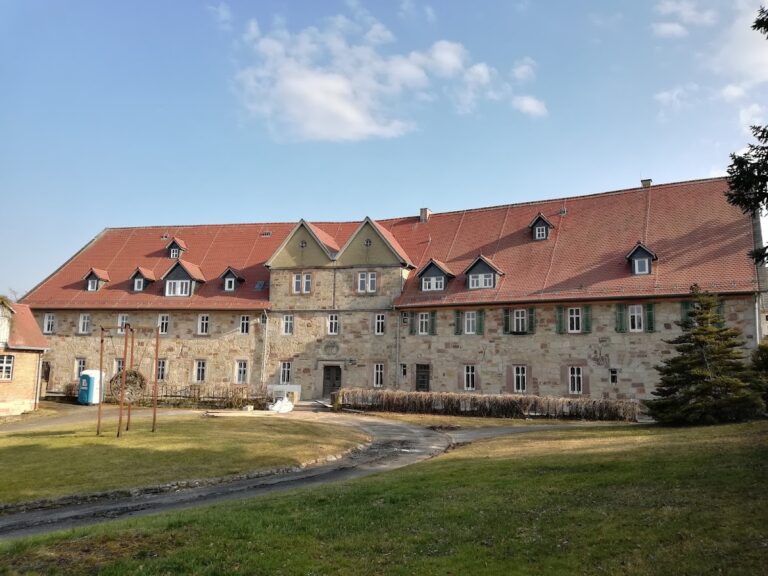
Schloss Landau stands in the northern part of Landau, now a district of Bad Arolsen, at the edge of the historic town centre. The former burial chapel, now the Protestant Landau town church, occupies the highest point of the castle hill in the middle of the historic centre. The complex incorporates remains dating partly from the fourteenth century and preserves the successive development of the earlier castle site.
Castle wings and courtyard entrance
The surviving sixteenth-century fabric includes parts of the east and north wings, the large stair tower facing the courtyard, and the east-side portal leading into it. The east wing was damaged by collapse in 1744 and completely demolished by about 1750. The present gate arch and the passage above it, which connects the north and south wings, belong to the rebuilding carried out from 1749 to 1763.
Former chapel and town church
The former burial chapel stands at the highest point of the hill and developed from an original Romanesque crypt. The chapel was later completed in Gothic style. It now serves as the Landau town church for the Protestant congregation, retaining its connection with the religious history of the castle complex.
Garden and associated buildings
The castle garden contains a historic stone well that was incorporated into a therapy garden during the building’s use as a residential and nursing home. An old orchard includes apple and plum trees, together with raspberries, gooseberries, and currants. Associated ancillary buildings form part of the complex and were included in the renovation and conversion works begun after 2015.
Nearby sites