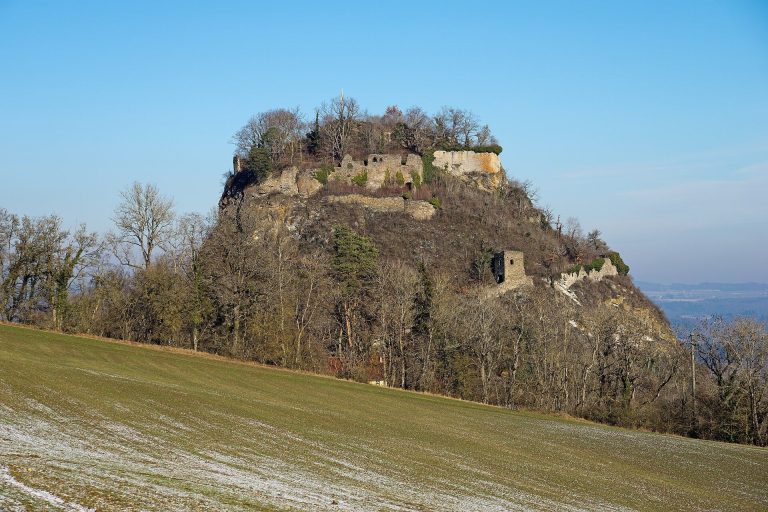
Homburg (Stahringen): A Medieval Hilltop Castle in Germany


Site at a Glance
- Rating
- 4.6
- Popularity
- Low
- Country
- Germany
- Primary era
- Medieval
- Eras represented
- Medieval, Early Modern
- Civilizations
- Holy Roman Empire
- Site type
- Military
- Remains
- Castle
On this page8 sections
History
Homburg (Stahringen) is the ruin of a high-medieval hilltop castle in Germany above Stahringen, now a district of Radolfzell am Bodensee. The Lords of Homburg commissioned its first ring-wall complex during the eleventh century, and the castle became their long-term seat. They were ministerials of the Bishop of Constance, medieval dependent nobles who served higher-ranking lords or ecclesiastical institutions in military and administrative roles while exercising local power.
Origins and the Lords of Homburg
The castle was established around 1000–1100 on a glacial gravel deposit above the settlement. Stahringen subsequently appeared for a long period in documentary records as a village belonging to the knightly estate. The fortified residence therefore formed the centre of a local lordship associated with the Lords of Homburg.
Destruction and rebuilding
During the Swiss War of 1499, the castle was looted, its inhabitants were deprived of their possessions, and the complex was burned. Reconstruction and enlargement followed in 1502.
In 1565, Wolf von Homburg sold his lordship to his son-in-law, Hans Konrad von Bodman. Wolf died in Radolfzell in 1566 without eligible heirs, and a bronze epitaph commemorating him remains in the minster there. The Lords of Bodman held Stahringen for only about fifty years before the territory passed to the Benedictine Abbey of Saint Gall in 1614. The abbey was a major monastic and territorial institution around Lake Constance.
War, abandonment, and territorial change
During the Thirty Years’ War, the European conflict of 1618–1648 shaped by religious, dynastic, and territorial struggles, ownership changed several times. Protestant and Catholic troops occupied the castle at different stages. In 1642, Konrad Widerholt, commandant of the Hohentwiel fortress in the Hegau, attacked Homburg and burned it again.
After the war, the ruined castle became a quarry, and pieces of its masonry were reused in farmsteads below the ruin. In 1749, the castle and its remaining lordship passed to the Bishop of Constance. Between 1803 and 1808, Habsburg and Württemberg on one side and Baden on the other disputed possession of Stahringen-Homburg. After two years under the Kingdom of Württemberg, the 1810 border treaty between Württemberg and Baden assigned the territory to the Grand Duchy of Baden, where it became part of the Baden Lake District.
Remains
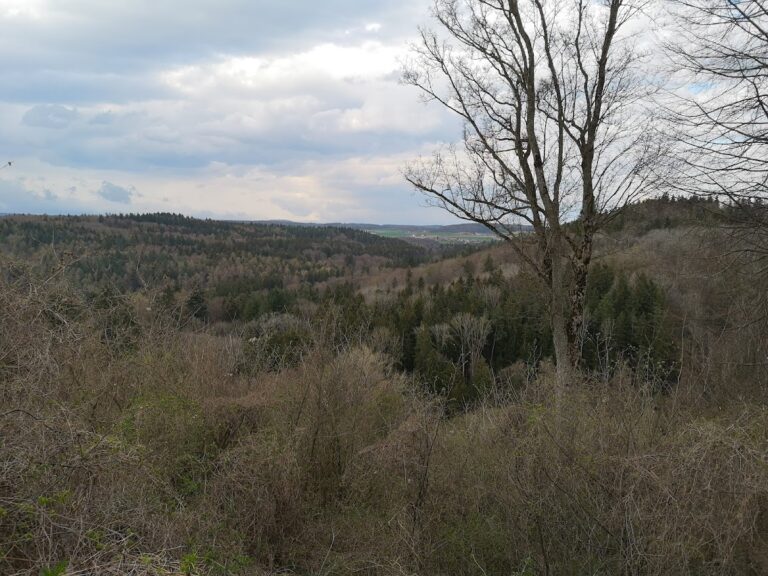
Homburg occupies a spur approximately 635.3 metres above sea level. The ground drops steeply toward Stahringen, while the western approach rises more gently and was consequently easier to attack. The castle was organized around a ring wall and developed as a fortified residential complex. Repeated destruction and later stone reuse have left an incomplete group of walls, including a structure more than 11 metres high and a massive defensive wall that conveys the former scale of the complex.
Fortifications and interior
Shield wall and entrance
The shield wall guarded the side most exposed to attack. Over time, it was faced with large bossaged blocks of Nagelfluh, a naturally cemented conglomerate of rounded gravel and stone fragments, and reached almost 3 metres in thickness. An entrance portal survives within the wall, together with substantial adjoining masonry. The wall structure rises more than 11 metres in places and remains the strongest surviving element of the ruin.
Courtyard and wall ascent
Inside the fortified enclosure, the remains include an interior courtyard and an ascent onto the wall. The surviving fabric does not permit a reliable full reconstruction of the former arrangement. An eighteenth-century painting nevertheless depicts a round tower belonging to the castle, providing evidence for an element of the complex that is no longer fully preserved.