Vushtrri Castle: A Medieval Urban Fortification in Kosovo


Site at a Glance
- Rating
- 4.6
- Popularity
- Low
- Country
- Kosovo
- Primary era
- Medieval
- External website
- Open
- Eras represented
- Medieval, Early Modern
- Civilizations
- Ottoman, Serbian
- Site type
- Military
- Remains
- Castle
On this page6 sections
History
Origins and uncertain attribution
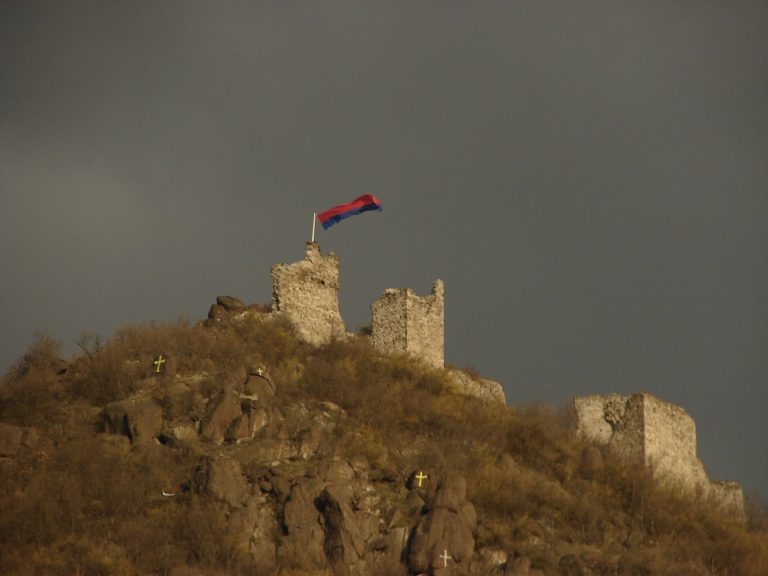
Vushtrri Castle is a medieval urban fortification in Vushtrri, Kosovo, associated with Serbian rule and generally dated by its architecture to the late fourteenth or early fifteenth century. Its construction is traditionally attributed to the Vojinović brothers, who are also credited in tradition with building the nearby Stone Bridge. Later accounts connected the fortress with the reign of Emperor Stefan Dušan, a fourteenth-century Serbian ruler who became emperor, and have sometimes considered him a possible founder. The evidence does not establish a single certain builder or date.
The Vojinović family was a noble lineage active during the first half of the fourteenth century. Epic poetry describes the brothers as nephews of Stefan Dušan, but the family’s documented sphere of control lay outside Vushtrri. Vojislav Vojinović held influence toward nearby Zvečan around 1355 to 1363, followed by Nikola Altomanović from 1366 to 1373. The Vojinović and Branković families were related through Ratoslava, the sister of Branko Mladenović and aunt of Vuk Branković, who married Altoman Vojinović, Nikola’s father.
The Branković and Ottoman periods
A Branković court existed at Vushtrri in the early fifteenth century. The fortress later served as the seat or residence of Đurađ Branković, a Serbian despot who ruled from 1427 to 1456 and administered Kosovo. Much of the former capital associated with his rule disappeared during the Ottoman period, when the fortress became a government seat and the residence of the administrative bey, an Ottoman official who could govern a district. Its ground floor was converted into a storehouse for barley, corn, and wheat collected as taxes for the bey.
This change of function also altered the fortress entrances. The former gateway in the north wall was closed and walled up, and a replacement entrance was opened through the eastern wall. The northern gateway had a semicircular form and stood approximately one metre from the tower. Vojinović Tower was declared a Monument of Culture of Exceptional Importance in 1990 and placed under the protection of the Republic of Serbia.
Remains
The donjon
The surviving fortress is centered on a donjon, the principal fortified tower of a medieval castle, with parts of the surrounding walls enclosing a square courtyard. Built of stone, the tower has walls approximately three metres thick. Its defensive features include remains of machicolations, projecting structures with openings used to attack people below, together with putlog holes that held scaffolding or timber supports and traces of hoardings, projecting wooden fighting galleries.
The tower contained an enclosed ground floor and another floor above it. Its uppermost level was open and surrounded by battlements. Unlike many donjons, whose entrances were commonly placed at basement level, this tower was entered from the southern side at the upper floor. Wooden stairs led to the entrance and could be removed quickly during an emergency. The ground floor’s later use as a grain store reflects the Ottoman administrative reuse of the structure.
Courtyard enclosure and gateways
Sections of the walls surrounding the square courtyard remain standing. They generally reach four to five metres in height, while the southern wall facing the main street at the foot of the slope rises six to seven metres. A lower part of that wall is approximately 1.2 to 1.5 metres high and projects about 0.35 to 0.4 metres.
The former northern gateway stood beside the tower and had a semicircular shape. After it was blocked, access was moved to an opening through the eastern wall. The surviving tower and the walls enclosing the square courtyard are the identified remains of the former fortress.