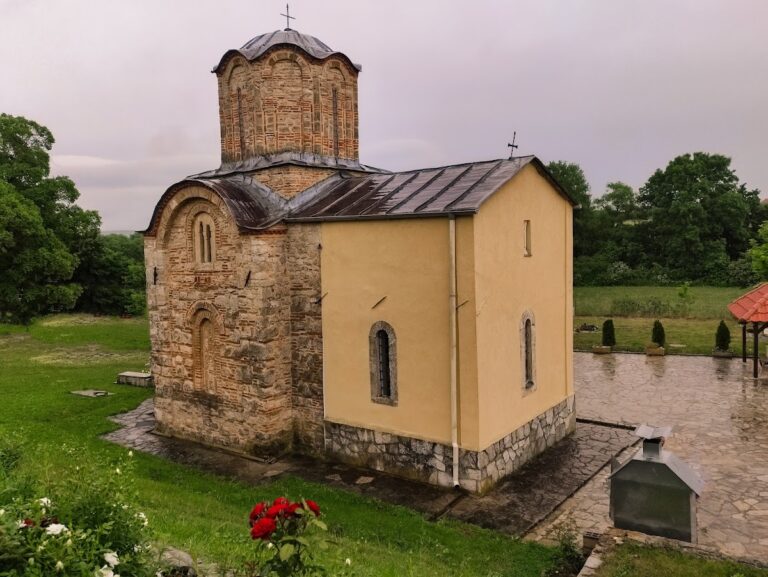
Monastery Devič: A Serbian Orthodox Monastic Heritage Site in Serbia


Site at a Glance
- Rating
- 4.8
- Popularity
- Very Low
- Country
- Serbia
- Primary era
- Medieval
- External website
- Open
- Eras represented
- Medieval, Early Modern, Modern
- Civilizations
- Ottoman, Serbian
- Site type
- Religious
- Remains
- Monastery
On this page12 sections
History
Monastery Devič is a Serbian Orthodox women’s monastery in Serbia, located in the Drenica forest about 5 km south of Srbica. Despot Đurađ Branković, a high-ranking ruler of the medieval Serbian state, founded it around 1434 in the fifteenth-century religious tradition associated with Saint Joanikije of Devič.
Foundation and Ottoman-era reconstruction
Saint Joanikije had come from Crna Reka and lived as an ascetic in a hollow beech tree. He was buried at the site in 1430, four years before the monastery’s foundation. Tradition connects Đurađ Branković’s decision to establish the monastery with gratitude for the recovery of his virgin daughter. The name Devič is associated with this story and means “maiden” or “virgin.”
The monastery was entered in the Ottoman census of 1455 as the Church of the Theotokos, dedicated to the Entry of the Most Holy Theotokos into the Temple. This Eastern Orthodox feast commemorates the presentation of the Virgin Mary in the Temple. During the Ottoman conquest, the monastery was severely damaged or destroyed, after which the church and the place containing Joanikije’s grave were rebuilt.
A later restoration was carried out in 1578 through the efforts of Abbot Pahomije and Hieromonk Longin. An inscription in the frescoes records their work. The monastic complex came to include churches dedicated to the Entry of the Mother of God, Saint Joanikije, and Saint George.
Religious and educational life
During the nineteenth century, Devič continued to support religious and communal activities. A Serbian primary school operated at the monastery in 1897 for orphaned children from different regions. The children received accommodation, heating, food, clothing, footwear, and school supplies. Jerotije Elezovic first taught at the school, followed from 1899 by Dimitrije Dimitrijevic, a trained theologian. Priest Anđelko Pesic served as its guardian.
Religious life also included services and gatherings connected with major feast days. In 1900, water-blessing took place at the Spring of Saint Joanikije during the Feast of the Ascension. Serbian communities traditionally gathered around the church on Saint Peter’s Day, linking the monastery with the wider religious life of the surrounding population.
War, destruction, and rebuilding
The monastery was repeatedly looted and restored. Austro-Hungarian forces looted it in 1915 after the retreat of the Serbian army through Albania during the First World War. Before the later wartime destruction, the treasury held a substantial collection of manuscript and printed books dating from the nineteenth and twentieth centuries.
In 1941, during the Second World War, Albanian fascist forces looted and burned the monastery after the occupation of Kosovo by Albanian and Italian forces. The hermitage of Saint Joanikije on the northern slope and the spring below the monastery were destroyed, and Prior Damaskin Boskovic was killed. Italian troops removed the monastery’s two large bells in 1942. The complex was rebuilt in 1947 and underwent further restoration afterward.
Devič was attacked and looted again during the Kosovo War in 1999. Food and two cars were stolen, the marble tomb of Saint Joanikije was desecrated, the slab of his reliquary was broken, and icons were defaced. From 12 to 14 June, the nuns and their confessor, Father Serafim, were subjected to physical and psychological abuse.
Russian troops of the 14th Tactical Group guarded the monastery from 1999 until their withdrawal in 2001. French KFOR troops then provided protection until 2012, when responsibility passed to the Kosovo Police. During the unrest of 18 March 2004, Danish KFOR troops evacuated the nuns. The monastery was subsequently looted, desecrated, and burned.
Monastery Devič is an immovable cultural monument of exceptional importance. Its monastic property includes more than 60 hectares of land and approximately 250 hectares of forest, together with vineyards, houses, and other associated properties. Abbess Anastasia Biljic has led the sisterhood since 1993; she first came to the monastery at the age of thirteen.
Remains
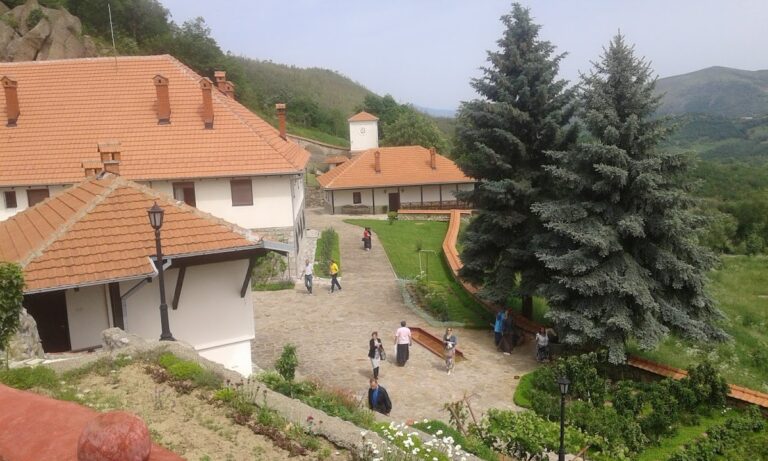
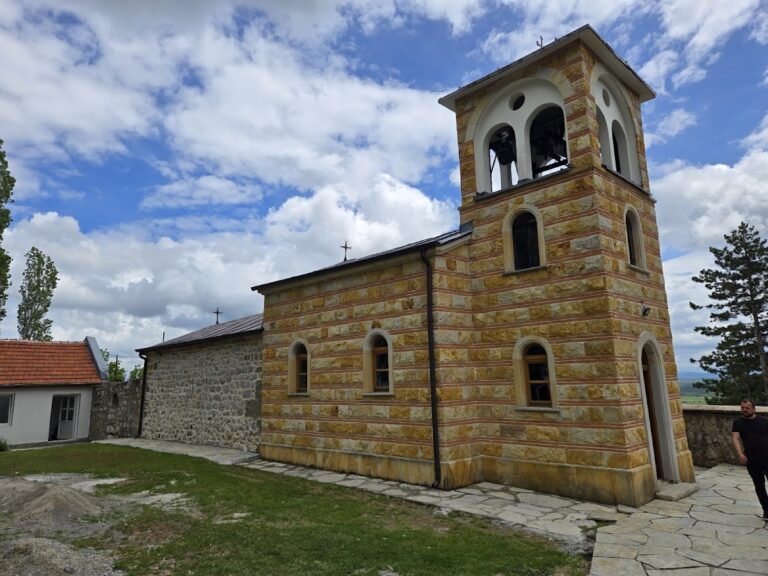
The complex lies beneath the main ridge of Mount Devič in the Drenica forest. Its principal church is a single-nave structure with a longitudinal barrel vault and an altar ending in a three-sided exterior apse. An enlargement on the northern side created access to a small chapel adjoining the eastern wall, where the grave of Saint Joanikije is located. The complex was rebuilt after the destruction of 1941 and has received additional restorations.
Church and chapel
Principal church
The church is dedicated to the Entry of the Mother of God into the Temple. Its single nave is covered by a long barrel vault, while the altar projects into a three-sided apse on the exterior. Fragments of wall paintings survive in the apse, preserving part of the church’s painted interior through the successive changes to the complex.
Chapel and tomb of Saint Joanikije
The northern extension of the church leads to a small separate chapel attached to its eastern wall. The chapel contains the grave of Saint Joanikije, whose devotional importance shaped the foundation and identity of Devič. Fragments of paintings remain above the grave, including a depiction of his Dormition that is noted for the inventiveness of its painter.
Frescoes and monastic landscape
Painted layers
The surviving frescoes belong to several periods. The fifteenth-century layer portrays Saint Joanikije in the habit of a great-schema monk, an Orthodox monk who has received the highest monastic degree. An inscription identifies him as the first ktitor, meaning the founder or principal patron of the monastery. This layer also includes Saint Acacius, the Wedding at Cana in Galilee, and the Healing of the Paralytic. A second layer dates from the sixteenth century, while a third was painted in the nineteenth century.
Spring and hermitage
The Spring of Saint Joanikije lay in a hollow below the monastery, and the saint’s hermitage stood on the northern slope. Both places were connected with the physical and devotional history of the complex until they were destroyed in 1941.
Associated properties
The monastery’s wider property included vineyards at Velika Hoca, several houses at Vucitrn, and parcels of land around Bica, Lausa, Lepina, and Ludovici. These holdings formed part of a larger estate of farmland and forest, alongside the buildings and land immediately connected with the monastery.
Nearby sites