Burgruine Velburg: A Medieval Hilltop Castle in Germany


Site at a Glance
- Rating
- 4.7
- Popularity
- Low
- Country
- Germany
- Primary era
- Medieval
- External website
- Open
- Eras represented
- Medieval
- Civilizations
- Duchy of Bavaria, Holy Roman Empire
- Site type
- Military
- Remains
- Castle
On this page7 sections
History
Burgruine Velburg is the ruin of a high-medieval to early-modern hilltop castle in Germany, probably founded around 1100 on the Schlossberg above the Frauenbach valley in Bavaria. Its origins lay near an area of imperial property along the Black Laaber, and the fortress later became an administrative seat under the Wittelsbach dynasty.
Origins and the Lords of Velburg
The surrounding imperial property passed into the hands of the ecclesiastical advocates of the Bishopric of Bamberg after 1009. Kuno, a free nobleman and the first recorded lord of the castle, made a donation to Obermünster Abbey in Regensburg around 1110–1117, during the tenure of Abbess Hadamut. The castle itself appears in written records in 1129.
Gerhard and Hermann of Velburg were recorded as Counts of Velburg in 1156, and the castle remained associated with their family throughout the twelfth and early thirteenth centuries. Hermann married Adelheid of Klamm, an Austrian noblewoman, and increasingly directed the family’s activities toward Austria. The Velburg family became harder to trace in the Upper Palatinate, although a count of Velburg is documented as late as 1231. Tradition places the end of the Velburg line in 1217 with Count Ulrich, after which the inheritance passed to the Duke of Bavaria. An Austrian comital family, the Clamm, is also said to have inherited the castle in 1188.
In 1190, Otto of Velburg joined Emperor Frederick Barbarossa on the Third Crusade, the campaign of 1189–1192 launched by major European rulers after the Muslim reconquest of Jerusalem.
Wittelsbach Administration and Destruction
After the castle passed to the Wittelsbachs, the dynasty that ruled Bavaria and related branches of the Palatinate, Velburg served as an administrative centre. Administrators from Upper Bavaria and the Palatinate occupied the post alternately. Around 1450, the castle was almost completely burned, but it was rebuilt.
Following the Landshut War of Succession, the conflict over the Bavarian succession fought from 1503 to 1505, the castle was transferred in 1505 to the newly established Duchy of Palatinate-Neuburg, a principality created for a Wittelsbach branch. Swedish troops destroyed it during the Thirty Years’ War, the European conflict of 1618–1648 that brought widespread military destruction and political upheaval to the German lands. In 1790, its surviving stone was quarried for the construction of Velburg’s parish church.
Archaeological Protection
The surviving fabric was secured during the 1980s. Burgruine Velburg is protected as both a listed architectural monument and an archaeological monument. The protected archaeological evidence includes settlement activity from the Urnfield period, a later Bronze Age cultural period associated with cremation burials, and the Early La Tène period, a later Iron Age phase linked with Celtic cultural developments in central Europe, as well as remains within the medieval castle area. The ruin and its surroundings also lie within a 350-hectare landscape-protection area and a 160-hectare European habitat-protection area covering the Schlossberg, Wolfgangshöhle, and Hohllochberg group.
Remains
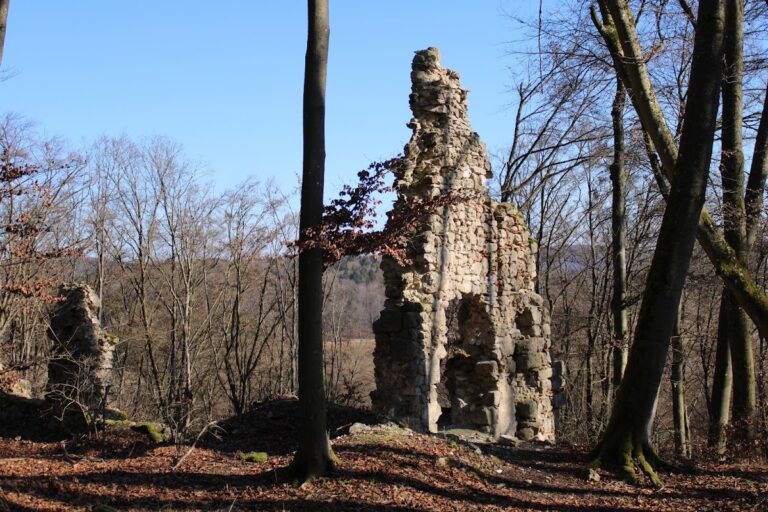
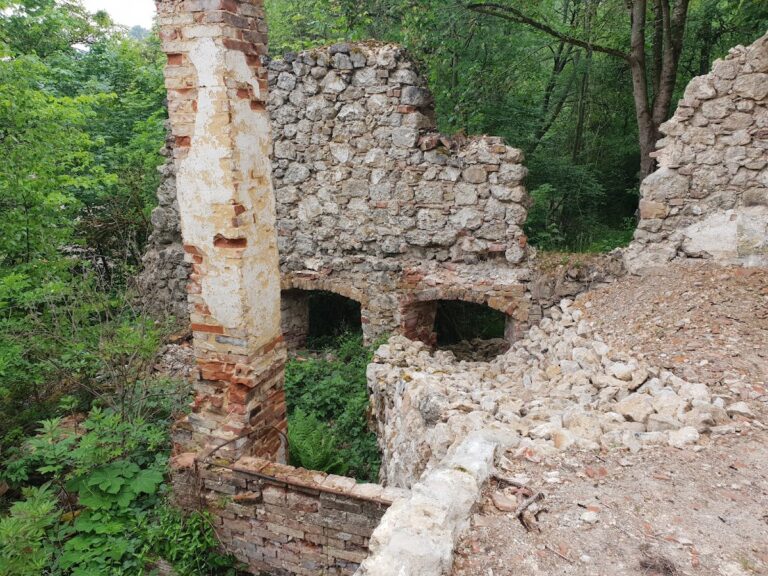
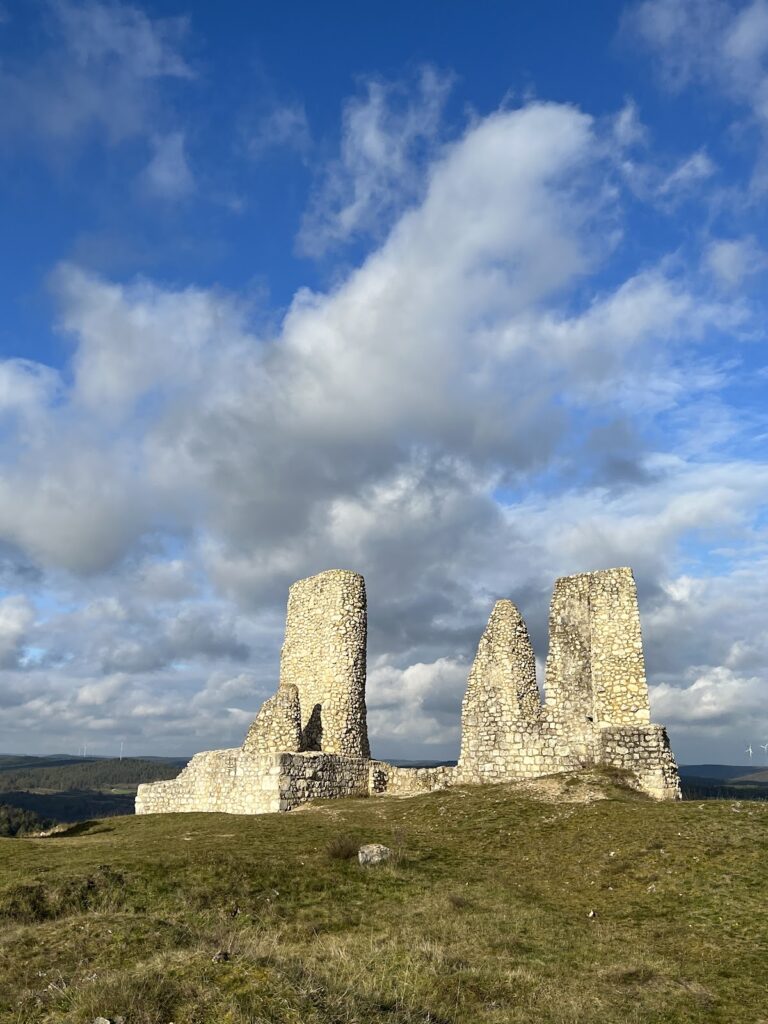
The castle occupied the rocky summit of the Schlossberg at 621.8 metres above sea level. Its former complex had a triangular ground plan, and the surviving remains consist mainly of parts of the reconstructed keep and fragments of the castle walls. The site stands in a Jurassic landscape shaped by limestone formations, dry grassland, and beech woodland.
Keep and Castle Walls
The reconstructed bergfried, or principal fortified tower of a medieval German castle, occupies an approximately 8-by-8-metre ground plan. It has been made accessible to a height of 12 metres and is used as a viewpoint. Fragments of the surrounding castle walls survive around it, preserving portions of the former triangular fortification.
Schlossberg Landscape
An old avenue of linden trees follows switchbacks up the Schlossberg toward the ruin. The wider landscape associated with the site includes the Three Stone Maidens, Hohllochberg, Osterberg, Bockenberg, and the König Otto dripstone cave. These limestone formations, wooded areas, and dry grasslands form the physical setting of the castle remains.
Nearby sites