Burgruine Wolfstein: A Medieval Hilltop Castle in Bavaria


Site at a Glance
- Rating
- 4.6
- Popularity
- Medium
- Country
- Germany
- Primary era
- Medieval
- External website
- Open
- Eras represented
- Medieval
- Civilizations
- Holy Roman Empire
- Site type
- Military
- Remains
- Castle
On this page13 sections
History
Burgruine Wolfstein is a medieval hilltop castle in Bavaria, Germany, associated with the Wolfstein district of Neumarkt in der Oberpfalz. Its stone buildings were erected around 1150, although the castle’s earliest connection with the Wolfstein noble family remains uncertain. Ulrich of Wolfstein is said to have been its lord around 1120, but no direct evidence confirms this early association.
Origins and the Wolfstein family
The castle is securely known from 1283, when the knight Gottfried of Sulzbürg adopted the name Wolfstein, settled in the existing castle, and established the Wolfstein noble family. By the middle of the fourteenth century, the family had greatly expanded its possessions and influence, controlling large parts of the Neumarkt region.
Emperor Charles IV, a fourteenth-century Holy Roman Emperor and King of Bohemia, granted the Wolfstein lordship of Sulzbürg-Pyrbaum permission to establish a town below the castle with the same privileges as nearby Neumarkt. The plan was never carried out. In 1434, Emperor Sigismund, also Holy Roman Emperor and King of Bohemia, placed the castle legally on the same status as the city of Neumarkt.
Conflict and territorial takeover
Wolfstein’s elevated legal position brought it into serious conflict with the Wittelsbach count palatines who ruled in Neumarkt. The Wittelsbachs were a major Bavarian ruling dynasty whose branches sought to absorb the castle and its lands into their own territories.
Before that takeover, Count Palatine Otto I increased pressure on the Wolfsteins. They responded by accepting the King of Bohemia as their protector and pledging the castle to him. When Hans of Wolfstein died without children in 1462, the Bohemian king seized Wolfstein and granted it to Vizthum of Neuschönenberg. Count Palatine Otto II then purchased the castle and its associated lands from Vizthum, incorporating them into the princely domain.
Administrative decline and abandonment
Wolfstein became the Neumarkt administrative office and was governed by a special representative until the sixteenth century. It gradually lost its importance as an administrative center and subsequently declined.
During the War of the Landshut Succession in 1504, a conflict over the inheritance of the Duchy of Bavaria-Landshut, the castle suffered severe damage. Its fortifications were then comprehensively repaired. By 1670, the abandoned complex had essentially fallen into ruin. A proposed renovation was not carried out, and the remains continued to deteriorate.
Reuse and conservation
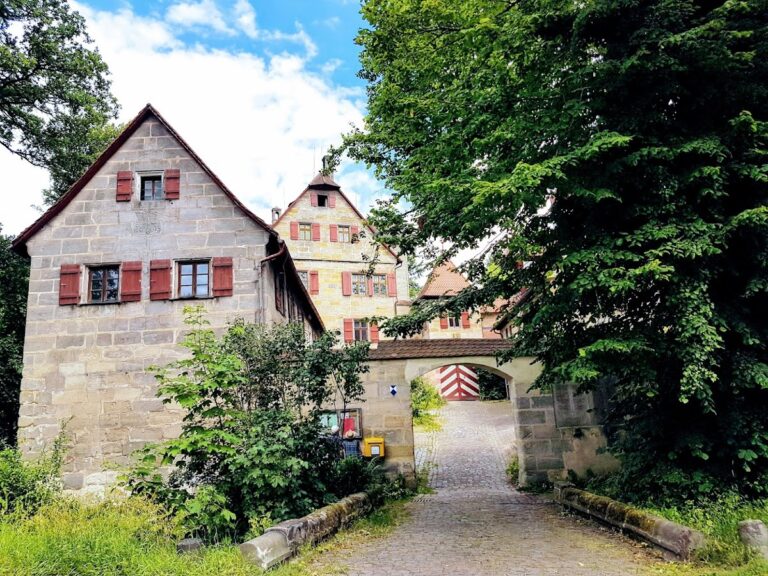
About the middle of the nineteenth century, local farming families settled in the former outer bailey. Two residential houses still stand there, and stones from the former curtain wall were reused as building material.
Since the mid-1990s, the Wolfstein Friends Association has carried out extensive excavation, renovation, and conservation work, particularly in the main castle. These efforts brought buried areas and structures back to view and placed parts of the complex in good condition. Burgruine Wolfstein is municipally owned and protected as both an architectural monument and an archaeological monument. The archaeological protection also covers evidence of a prehistoric hilltop settlement.
Remains
Wolfstein occupies the highest point of Wolfsteinberg in the central Franconian Alb, at 588.8 metres above sea level. The ridge rises northeast of the Neumarkt valley, with Schafhof to the southwest and Labersricht to the north. The castle was built as a hilltop spur castle, with an extensive outer bailey in front of the main fortified enclosure.
Defensive layout
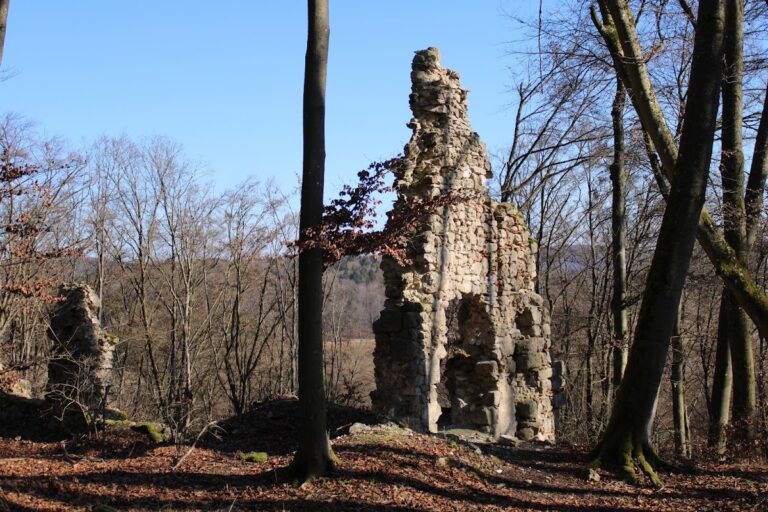
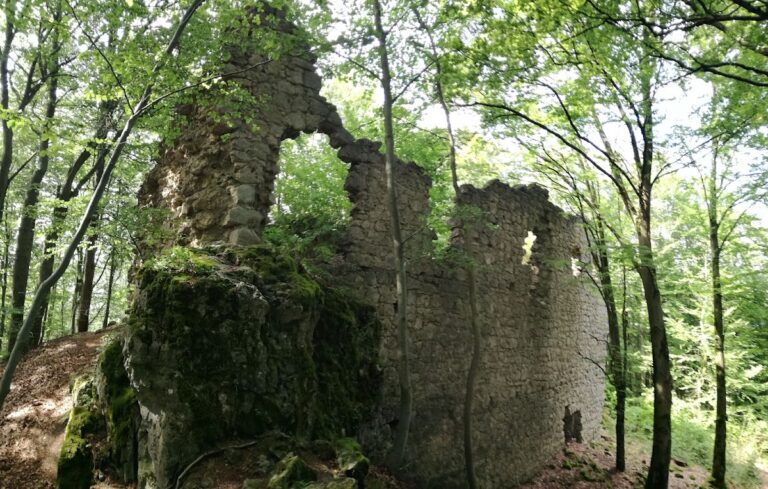
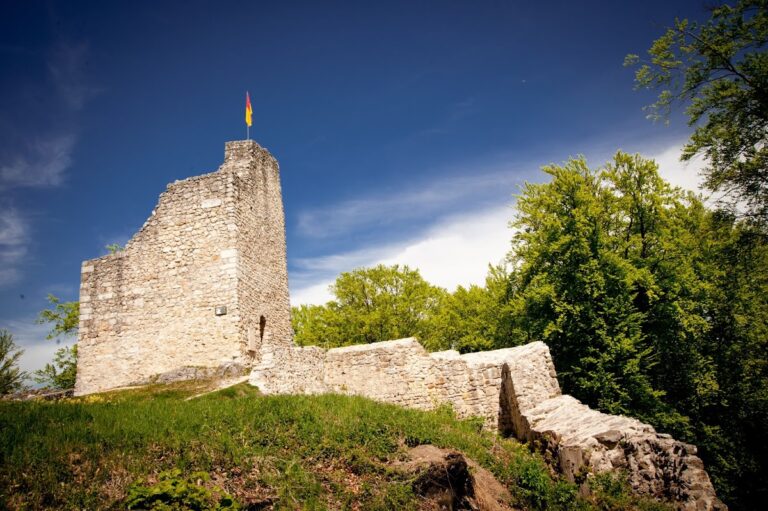
Entry to the upper castle lay on the southern side, where a drawbridge crossed a deep ditch. Almost precipitous rocks protected the site to the north and west. A ring of stone walls enclosed the main castle, while numerous sections of the main walls, the principal tower, and limited parts of the outer bailey survive.
Main castle
Bergfried
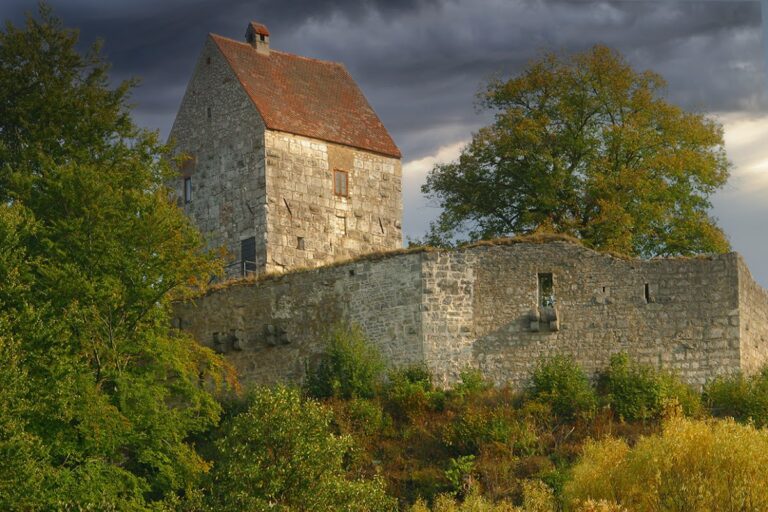
The 22-metre-high bergfried, the principal tower of a medieval German castle and a defensive refuge rather than normally a permanent residence, remains standing. An observation platform occupies its top.
Lordly residence
The former three-storey residence of the castle lords formed part of the main castle. Conservation work exposed its ground floor, allowing the surviving remains to be understood within the ring of enclosing walls.
Chapel and interior features
A well, several interior vaults, and the former castle chapel dedicated to Mary were uncovered or brought back into view during the archaeological and conservation work. Utility and service buildings also occupied the main castle, whose surviving walls preserve part of the original internal arrangement.
Outer bailey
The outer bailey, the area outside the main fortified enclosure that commonly contained service buildings, storage, and additional residences, extended in front of the upper castle. Two residential houses remain there from the nineteenth-century farming settlement. The surviving wall remains of this area were not included in the later conservation work and remain in their existing condition.
Geology and landscape setting
The ruins stand on Jurassic limestone strata whose colours correspond to the White, Brown, and Black Jurassic formations. The summit consists of massive to thick-bedded dolomite and fossil-bearing limestone belonging to the Franconian Alb formation.
Above the Brown Jurassic iron sandstone formation lie the White Jurassic strata. The fine- to medium-grained Brown Jurassic sandstone contains iron and isolated iron-ore seams, while fragments of iron ore also occur in the white strata. Beneath these layers is grey, disturbed marlstone from the Jurensis Marl formation of the Black Jurassic group. A small occurrence of the colourless mineral aragonite was found in the castle ditch of the former lordly seat.
Conservation work removed dense woodland around the ruins. This increased light around the masonry and reduced moisture-related damage, while also making the castle visible from the valley.
Nearby sites