Snežnik Castle: A Medieval Fortress and Aristocratic Residence in Slovenia


Site at a Glance
- Rating
- 4.7
- Popularity
- Medium
- Country
- Slovenia
- Primary era
- Medieval
- External website
- Open
- Eras represented
- Medieval, Early Modern, Modern
- Civilizations
- Habsburg, Holy Roman Empire
- Site type
- Domestic
- Remains
- Castle
On this page12 sections
History
Snežnik Castle is a medieval castle in Slovenia, in the southwest part of the Lož Valley in historic Inner Carniola. Its construction date is uncertain, but the fortress is first mentioned in 1269 through its owner, Meinhard von Schneberg. Earlier fortifications may have existed in antiquity, when Roman-subject Illyrian peoples inhabited the area, although no reliable evidence connects an ancient settlement or Roman fort with the castle site. The hilltop position allowed the stronghold to control mountain passes, trade routes, and the valley.
The Schnebergs and Lambergs
The name Snežnik comes from the noble family name Schneberg and is not derived from the Slovene word for “snow.” Meinhard von Schneberg was the earliest documented lord. The region then belonged to the Patriarchate of Aquileia, an ecclesiastical principality centered on the patriarchal see of Aquileia. The Schnebergs held Snežnik as ministeriales, dependent nobles or military servants who performed administrative and military duties for a higher lord.
The Schneberg family divided the estate among several heirs, leaving the castle and surrounding lands in multiple hands by the late fourteenth century. In 1393, William II von Lamberg acquired a quarter of the fortress and several neighboring farms. His descendants gradually purchased the remaining shares and lands during the fifteenth century. The Lambergs then rebuilt and enlarged the earlier fortress, adding a substantial residential building and giving the complex much of its Renaissance character. The Renaissance was a European cultural and architectural period associated with renewed classical influence and expanded residential design alongside older defensive forms.
Seventeenth- and eighteenth-century lordships
After the Lamberg line ended, Snežnik passed through the Scheyer and Pranckh families. In the first third of the seventeenth century, it came to the barons Rambschissl, who sold it to Prince Eggenberg, the Imperial governor of Carniola. Eggenberg also acquired the lordship of Lož and moved its administrative center from the difficult-to-reach Lož Castle to the more accessible Snežnik estate.
In 1669, Janez Vajkard Eggenberg sold the Lož-Snežnik lordship to Prince Janez Vajkard Auersperg, Count of Gottschee. The Auerspergs repaired and enlarged the castle. Count Jurij Gotfrid Lichtenberg acquired the estate in 1707 and permanently united the Lož and Snežnik lordships in 1718. The Lichtenberg family retained the estate for about 140 years, during a period when the region formed part of the Habsburg Empire, the Central European dynastic state ruled by the Habsburgs.
The Schönburg-Waldenburg estate
By the early nineteenth century, the Lichtenbergs were deeply indebted. A court-ordered appraisal was made in 1816, and in 1832 the family organized a lottery offering the Snežnik estate or 250,000 florins as the prize. The winning Hungarian blacksmith selected the money. The Lichtenbergs nevertheless sold the estate in 1847 to a Viennese couple named Karis. After the buyers became bankrupt, Snežnik was auctioned in 1853 and purchased for 800,000 florins by the German Prince Oton Viktor Schönburg-Waldenburg.
Prince Jurij Schönburg-Waldenburg, Oton Viktor’s third son, inherited the castle in 1859. He extensively remodeled it as a summer residence and hunting lodge, established an English-style landscape park, and created a fideicommiss, a legally restricted hereditary estate intended to keep property undivided within a designated family succession. He stocked the forests with deer and the ponds with trout, laid paths through the woodland, and employed specialists to manage the surrounding wilderness.
Jurij also supported the first Slovene forestry school, which opened at the castle in 1869. It closed in 1875 because instruction in German created a language barrier for local Slovene speakers. His installation of a steam sawmill helped initiate industrial development in the Lož Valley.
Twentieth-century changes
In 1902, Jurij was succeeded by his eldest son, Herman Schönburg-Waldenburg, a diplomat of Austria-Hungary. After the First World War, the Treaty of Rapallo, the 1920 agreement settling territorial relations between Italy and the new Kingdom of Serbs, Croats and Slovenes, divided the estate between those two kingdoms.
Herman died in 1943 at the family castle of Hermsdorf near Dresden. During the Second World War, the castle caretaker resisted attempts to loot the building and helped preserve the Schönburg family’s interior furnishings. In 1945, the castle and estate were nationalized and converted into a hunting estate reserved for important state officials. The castle became a museum in 1983, was designated a cultural monument of national importance in 1999, and underwent restoration in the early 2000s. The National Museum of Slovenia administers the museum, whose principal exhibition concerns aristocratic hunting and noble domestic life. The complex also serves as a protocol residence of the Republic of Slovenia.
Remains
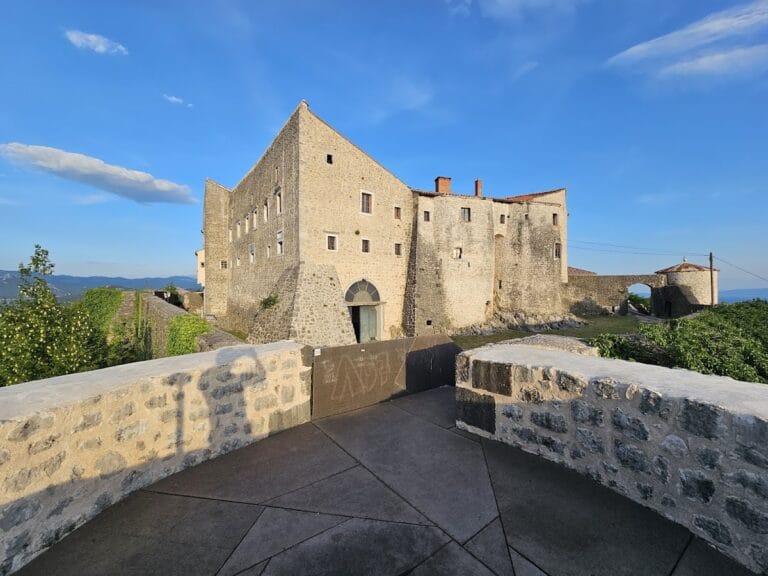
Snežnik Castle is arranged around a massive rectangular, multi-storey main building enclosed by a Renaissance defensive wall. The complex combines stone and brick construction with later alterations to its entrance defenses, interiors, and surrounding landscape. A ditch lies before the southern entrance, while the castle’s other principal elements include a northern stair tower, a fortified forecourt, and a nineteenth-century park.
Castle buildings and defenses
Main building
The central building is plastered and painted white, with walls made of stone and brick. A circular stair tower adjoins its north side, while the only entrance is on the south. Grave markers taken from the ruins of an ancient Roman settlement or outpost at Šmarata were incorporated into the main facade. These reused stones belong to the material history of the building, rather than proving the existence of an ancient settlement at Snežnik itself.
Entrance defenses
The entrance was once approached by a drawbridge, later replaced by a permanent stone bridge. The present approach crosses the defensive ditch on a twin-arched stone bridge. A high wall with two corner towers stands in front of the entrance. The towers are circular and diagonally square in plan, although their current form belongs to later rebuilding rather than to the medieval period.
The castle is enclosed by a Renaissance defensive wall. An engraving published in 1689 by Janez Vajkard Valvasor, a Carniolan nobleman and author of The Glory of the Duchy of Carniola, shows the earlier entrance defenses as smaller square wooden watchtowers. It also depicts the ditch without water and a simple wooden bridge. The engraving presents the complex’s general layout as broadly similar to the present arrangement, although the main building then had fewer storeys and the gate towers were lower and constructed of wood.
Interiors and landscape park
Nineteenth-century interiors
The interior was extensively remodeled during the second half of the nineteenth century. Most surviving furnishings date from this period and include elaborate furniture, paintings, and stucco decoration. The arrangement was preserved through the Second World War, when the caretaker’s resistance to looting helped protect the furnishings.
Park and water features
The surrounding park was laid out and improved during the nineteenth century. It contains several meadows connected by riding and walking paths, rows of chestnut and linden trees, and two small artificial lakes supplied by the Obrh and Brezno streams. The park formed part of the estate landscape developed alongside the castle’s use as a summer residence and hunting lodge.
Nearby sites