Colț Fortress: A Medieval Refuge and Castle in Romania


Site at a Glance
- Rating
- 4.6
- Popularity
- Low
- Country
- Romania
- Primary era
- Medieval
- Eras represented
- Medieval, Early Modern
- Civilizations
- Hungarian
- Site type
- Military
- Remains
- Castle
On this page10 sections
History
Colț Fortress is a medieval fortress in Romania, built by the Transylvanian noble Kende family for protection during the first half of the fourteenth century. It was first recorded in 1359, and its position above the entrance to the Râușor Gorge gave it a defensible setting. The family later became known as Kendeffy after converting to Catholicism and changing its surname.
From residence to fortified castle
The fortress developed around a residential tower that already stood in the second half of the fourteenth century. By 1519, the complex was described in a medieval record as a castrum, a fortified place or castle, showing that the original tower had been expanded into a larger stronghold.
Despite its defensive purpose, Colț Fortress was probably too small to resist a large army. It may instead have provided a refuge during conflicts among local princes, known as cnezi, who held authority in medieval Transylvania and nearby regions.
Ottoman capture and later decline
During the Ottoman conquest, the fortress was captured. The husband of Ilona Kendeffy was taken prisoner and died in captivity. A local tradition later linked Ilona to the fortress through a story in which she spun flax from a castle window until the thread reached the turbulent Strei River. She was said to believe that her husband would return only when this happened.
The Ottoman traveler and writer Evliya Çelebi visited Colț Fortress in 1661, and a guard was still stationed there in 1671. By the end of the seventeenth century, the fortress and its estates had returned to the Kendeffy family. From the eighteenth century onward, the complex fell into ruin, while parts of its walls collapsed into the valley.
Colț Fortress has also been identified as a possible inspiration for The Castle in the Carpathians, an adventure novel by the nineteenth-century French writer Jules Verne. The municipality of Râu de Mori has sought funding to restore the ruins.
Remains
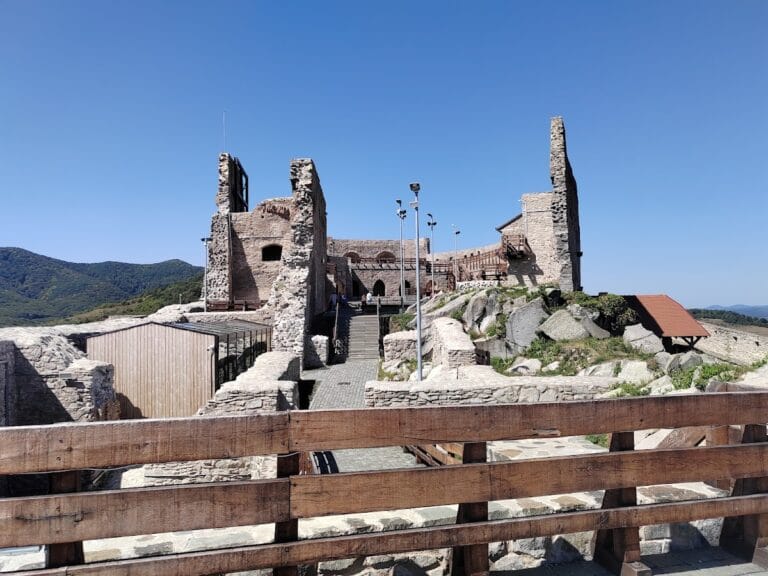
The fortress occupies the summit of a rocky hill 726 meters above sea level, at the entrance to the Râușor Gorge beneath the northern foothills of the Retezat Mountains and at the southern edge of the Hațeg Basin. Its irregular plan follows the shape of the terrain. A ravine protected the southern side, while a surrounding castle wall enclosed the other sides.
Central tower and enclosing defenses
Square residential tower
The core of Colț Fortress is a square residential tower. Three levels survive, although the tower may originally have been taller. Its role as the fortress’s central building reflects the site’s development from a defended residence into a more extensive castle complex.
Castle wall and southern towers
During the sixteenth and seventeenth centuries, the tower was enclosed by a powerful wall with an approximately triangular form. Two polygonal towers were added on the southern side, and a drawbridge provided access to the fortified enclosure. Sections of the wall and the polygonal towers remain among the principal surviving structures.
Later additions and associated remains
Northwestern wing and bastions
A building wing was attached to the northwestern part of the enclosing wall during the sixteenth or seventeenth century. Small bastions, projecting defensive structures, were also added. Their remains can still be seen within the substantially ruined complex.
Chapel below the fortress
Below the fortress are the ruins of a thirteenth-century Greek Orthodox chapel. The chapel predates the recorded fourteenth-century fortress and forms a separate archaeological element within the site’s wider remains.
Nearby sites