Sevnica Castle: A Late Renaissance Castle in Slovenia


Site at a Glance
- Rating
- 4.7
- Popularity
- Medium
- Country
- Slovenia
- Primary era
- Early Modern
- External website
- Open
- Eras represented
- Medieval, Early Modern, Modern
- Civilizations
- Holy Roman Empire
- Site type
- Military
- Remains
- Castle
On this page9 sections
History
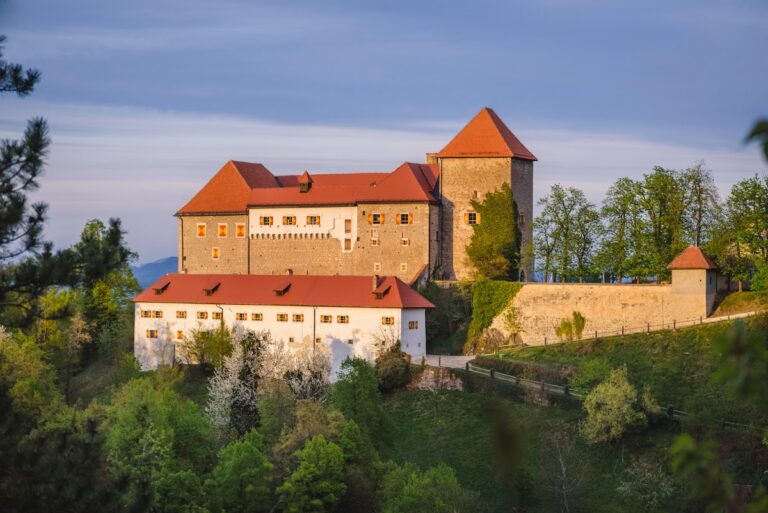
Sevnica Castle is a historic castle in Slovenia, standing above the old town of Sevnica and overlooking the surrounding countryside. Its present form was created chiefly by a Late Renaissance rebuilding between 1595 and 1597, although the site was first recorded in 1309 as Castellum Lichtenwald. The castle developed within estates held by the Archdiocese of Salzburg, the Catholic ecclesiastical authority that exercised territorial power in the region.
Medieval origins and Salzburg rule
The Archdiocese of Salzburg held estates in the area from 1043. The precise origin of the castle is unknown, but its construction was probably connected with the episcopate of Archbishop Konrad I von Abensberg, who ruled Salzburg from 1106 to 1147. It may have formed part of the rebuilding and colonization of an area damaged by Hungarian invasions. Surviving medieval fabric indicates that the early stronghold included a substantial tower incorporated into a residential wing, probably on the eastern side.
In 1479, Archbishop Bernard II von Rohr became involved in a conflict with Emperor Frederick III. During the war, Bernard allied himself with Matthias Hunyady Corvinus, the fifteenth-century king of Hungary and Croatia, and surrendered Sevnica Castle, its manor, and other castles to him. The Peace of Bratislava ended the conflict in 1491, after which the castle and manor passed to the emperor. Emperor Maximilian I returned them to the Archdiocese of Salzburg in 1494.
Reformation and the sixteenth-century rebellion
The Lutheran Reformation, a sixteenth-century movement that challenged Catholic doctrine and church administration, spread through Sevnica and the surrounding region. A Lutheran chapel was probably established in the castle grounds during this period. Oswald Geriacher, the manor administrator, may have built it. His tombstone shows him and his wife kneeling before a crucifix, and he was probably a Protestant. The stone records his death on June 2, 1575.
Primož Trubar, a leading Slovenian Protestant, served as a Catholic parish priest at nearby Loka near Zidani Most from 1530 to 1542. Jurij Dalmatin, a native of Krško and the first translator of the Bible into Slovene, may have visited the Lutheran chapel. Worship there was probably conducted in both Slovene and German, linking the building to the region’s changing religious culture.
Sevnica also became involved in the Croatian-Slovenian peasant rebellion of 1573, an uprising against the conditions imposed on peasants by the ruling order. On February 5, approximately 600 insurgents led by Ilija Gregorić reached the town. Baron Bolthazar von Lamberg, then tenant of the manor, invited them into the castle and offered them a feast. They soon continued toward Lisca. Lamberg’s earlier good relations with his own peasants also helped prevent the immediate danger from escalating.
Rebuilding and changing tenure
In 1595, Innocenz Moscon acquired the castle, though ownership was disputed in prolonged litigation. Between 1595 and 1597, he rebuilt the complex in the Late Renaissance style, giving it essentially the form seen today. The dispute ended in 1637, when the Archdiocese of Salzburg retained ownership and the Moscon family received hereditary tenure.
The castle remained Salzburg property until 1803. Hereditary tenure passed to the Auersperg family in 1675, the Drašković family in 1688, the Auerspergs again in 1725, and the Keglević family in 1769. A private chapel in the southwest tower received an altar dated 1637 and dedicated to Saint George, a Christian martyr widely venerated as a military patron.
The castle suffered damage during the eighteenth and early nineteenth centuries. A fresco in Saint Lawrence’s Church at Žabjek depicts lightning striking the western watchtower during a thunderstorm in 1778. The medieval tower was probably levelled with the eastern residential wing soon afterward. On June 26, 1801, a severe hailstorm and windstorm broke all the castle’s windowpanes, removed the roofs from two corner towers and another adjacent building, and caused two deaths.
From February 2 to May 7, 1801, the so-called German Infantry Regiment was stationed at Sevnica. Sergeant Johann Michael Fischer was tried in the castle for homicide and shot there on March 12 in the presence of the regiment. On June 1, 1803, Count Johann Händl von Rebenburg became proprietor. He lowered the battlements, filled in the moats, planted trees in the park, and created a terraced vineyard on the southern side of Castle Hill. Local traditions remembered his generosity and the park arranged in a Renaissance-Baroque manner.
Nineteenth- and twentieth-century changes
The castle and its associated properties continued to change during the nineteenth century. Dr. Karel Ausserer bought the castle in 1880 and built an approach road on the northern side of Castle Hill. Countess Matilda Arco Zinneberg owned it from 1910 to 1945. She used the Lutheran Cellar as a burial place for her husband, Arthur Tränkel, and their daughter, Kitty. During the Second World War, she left the castle and its valuables in the care of an administrator and moved to Italy.
After the war, the castle was nationalized. Its remaining furniture disappeared, and poor families were housed in the building. The park and vineyard declined, while the wine cellar beside the Lutheran Cellar was eventually removed. From the 1960s, residential occupants were gradually cleared from the castle and the building acquired new functions. Frescoes in the Lutheran Cellar were restored between 1963 and 1973. Baroque frescoes in the southeast tower were discovered around the same period and restored between 1977 and 1979; the art historian Ivan Komelj dated them to the seventeenth century.
A 1966 proposal to restore the park to its 1825 arrangement was never carried out. In 2005, the southern side of Castle Hill was cleared and its terraces were planted with fruit trees. The castle now accommodates exhibitions, a school museum, a fire-fighting museum, an exile museum, and the Ornamental Arts Gallery of Ivan Razboršek.
A claim made in 1938 connected Sevnica Castle with Lower Castle in Sevnica through a tunnel that townspeople supposedly used as a refuge during Ottoman invasions. That tradition remains undocumented and does not establish the tunnel’s existence.
Remains
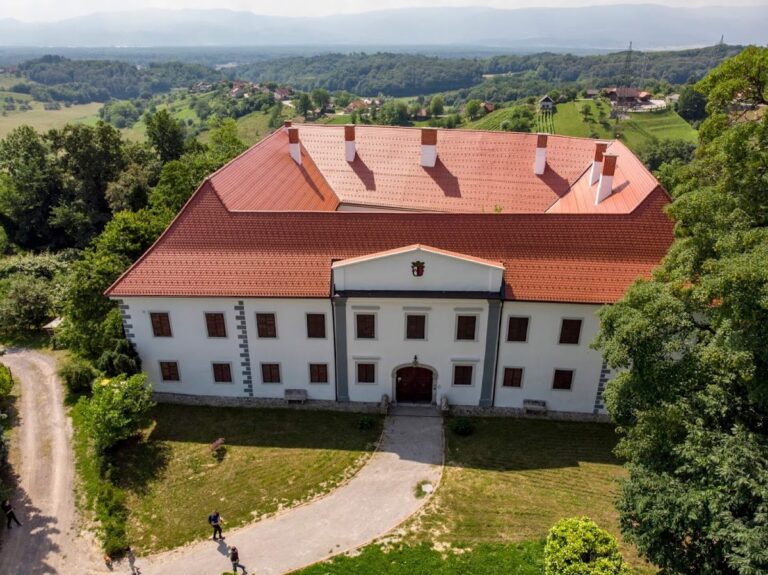
Sevnica Castle occupies a hill above the old town. The complex combines residential wings, corner towers, a courtyard, and defensive elements that were later altered when the battlements were lowered and the moats filled. The castle park surrounds the building, while former vineyard terraces extend along the southern side of Castle Hill. Some vines planted by Count Händl were still growing in the 1970s, although the park is now in poor condition.
Medieval tower and castle entrance
The earliest surviving fabric belongs to a medieval tower incorporated into a residential wing, probably the east wing. Its walls are approximately 2.6 metres thick, indicating that the tower may originally have risen four or five storeys. It probably formed part of a larger building rather than standing independently. Late Romanesque cornerstones survive below the outer eastern castle wall and provide physical evidence of the castle’s earliest medieval phase.
The entrance preserves two notable reused elements. Above it, an inscription in German translates as “Patience overcomes everything.” Innocenz Moscon added the words during his legal struggle over ownership. Built into the wall to the right is a Roman tombstone, a funerary monument from the Roman period, showing a couple within a rounded medallion. Count Johann Händl von Rebenburg brought the stone to the castle from Ajdovski Gradec.
Lutheran Cellar
On the southeast side of Castle Hill stands the Lutheran Cellar. Although its exterior resembles a plain farm building, it was designed as a concealed Lutheran chapel. Its interior contains frescoes from the second half of the sixteenth century, regarded as among the finest surviving paintings from that period in Slovenia. Stone supports on the facade probably carried a pergola. During the nineteenth century, a wine cellar with a roof supported by these elements was built in the courtyard and was later removed.
The building was also reused as a family burial place. Its acoustics have made the Lutheran Cellar suitable for concerts and other performances, while its restored frescoes preserve the clearest surviving expression of the castle’s Protestant phase.
Residential wings and towers
The second floor of the south wing contains mainly nineteenth-century Neo-Renaissance furnishings, together with a conference hall and a wedding hall. Neo-Renaissance design revived Renaissance architectural and decorative features during the nineteenth century. The surviving furnishings therefore belong to a later period than the castle’s principal Late Renaissance rebuilding.
The southeast tower contains Baroque frescoes on its second floor, with motifs representing the four seasons. In the southwest tower, the first floor contains a Renaissance-Baroque private chapel. Its altar, dated 1637, is dedicated to Saint George. Together, the towers and residential wings preserve the layered domestic, religious, and representational uses that shaped the castle after its medieval beginnings.