Felsburg: A Medieval Hill Castle in Hesse, Germany


Site at a Glance
- Rating
- 4.4
- Popularity
- Low
- Country
- Germany
- Primary era
- Medieval
- External website
- Open
- Eras represented
- Medieval
- Civilizations
- Holy Roman Empire
- Site type
- Military
- Remains
- Castle
On this page11 sections
History
Felsburg is a partial hill-castle ruin in Germany, associated with Felsberg on the Eder River in North Hesse. Its origins reach back to a wooden defensive structure probably established on the basalt summit during Chatti times, around AD 300 to 600. The medieval castle occupied a strategic position above the valley and helped protect an old salt-trade route that crossed the Eder by a ford.
Early Lords of Felsburg
The castle and the vice-counts of Felsberg were first recorded in 1060 under the name Velisberc, while the settlement below was mentioned in 1090. The ruling family belonged to the Megin lineage and lived at Felsburg from at least 1090 until 1253. During this period, Heiligenberg Castle was built within sight of Felsburg as a counterfort. The Archbishops and Electors of Mainz used Heiligenberg to press their territorial claims against the Landgraves of Thuringia and, later, Hesse. This rivalry developed into a prolonged conflict that continued until 1427, giving Felsburg an important strategic role.
The Felsberg rulers gradually withdrew from the Eder lowlands. In 1238, they ceded the castle and town to the Landgraviate of Thuringia, a territory governed by a landgrave, a high-ranking territorial prince. In 1253, Berthold of Felsberg gave most of his estates to Breitenau Monastery. After 1286, the Felsberg vice-counts retained possessions mainly around Hessisch Lichtenau, and the family soon became extinct.
Hessian Stronghold
After the division of Hesse and Thuringia that followed the death of Henry Raspe, a thirteenth-century Landgrave of Thuringia, Felsburg came under the Landgraviate of Hesse. It then served as the seat of successive landgravial officials. From 1333, Landgrave Henry II, known as “the Iron,” expanded the castle, and its defenses were strengthened again in 1387, 1388, and 1392.
Felsburg remained involved in regional military politics. In 1367, Hessian knights led by Konrad Spiegel zum Desenberg defeated the forces of Hersfeld Abbot Berthold II of Völkershausen in the Eder lowlands near Altenburg. Friedrich von Felsberg, a landgravial ministerialis, meaning a medieval military or administrative official serving a prince, lived at the castle in 1375. The Landgrave had pledged him Felsberg’s tax revenues in 1373.
The castle played a direct part in the Mainz-Hessian War of 1427. Landgrave Louis I of Hesse led his forces from Felsburg against Mainz commander Gottfried von Leiningen. His force of 600 cavalry had devastated the areas around Gudensberg, Felsberg, and Melsungen from a base at Fritzlar. Louis defeated him at the Großenengliser Platte and again near Fulda, despite the intervention of Mainz Archbishop Conrad III of Dhaun. These victories compelled Kurmainz, the territorial state governed by the Archbishops and Electors of Mainz, to accept the Peace of Frankfurt.
Changing Uses and Decline
From 1455 to 1458, the alchemist Klaus von Urbach lived at Felsburg after Landgrave Louis I brought him there in the hope that he would produce gold. When the experiments failed, Klaus von Urbach was banished from the land.
Beginning in 1511, Landgravine Anna, the mother of Philip the Magnanimous, a sixteenth-century Landgrave of Hesse, used Felsburg for several years as her widow’s residence. From there, she contested the guardianship of her children and control of the land, although she spent most of her time at an estate in Felsberg that still survives and remains in use. Felsburg subsequently ceased to be a center of Hessian state politics and never again served as a landgrave’s residence.
From 1550, parts of the castle were gradually dismantled to provide materials for the hunting lodge at Melsungen. Landgrave Maurice of Hesse-Kassel held his last state assembly at Felsburg in 1626 before abdicating. The castle survived the Thirty Years’ War almost unscathed, but it then deteriorated gradually. During the Seven Years’ War, Hessian troops under Major von Linsingen captured it in 1762. French troops subsequently destroyed the castle.
Preservation and Memory
The State of Hesse owns Felsburg, and the Administration of State Palaces and Gardens of Hesse oversees it. The Burgverein Felsberg 1885 e.V., which originally leased the castle from the Prussian state, continues to be responsible for its preservation and upkeep. Its lease was renewed and clarified with the State of Hesse in 1952.
Conservation and repair began in 1950. Extensive restoration started in 1987 and continued for 18 years because of financial difficulties. A museum was established in the chapel, while the restored cellar is used for civil and church weddings during the summer. A carillon funded by donations was installed above the chapel entrance in 2006. The North Hessian poet Georg Mohr, who lived from 1870 to 1928, also preserved the castle in a Romantic-era song whose melody uses Friedrich Glück’s setting of Joseph von Eichendorff’s poem In einem kühlen Grunde.
Remains
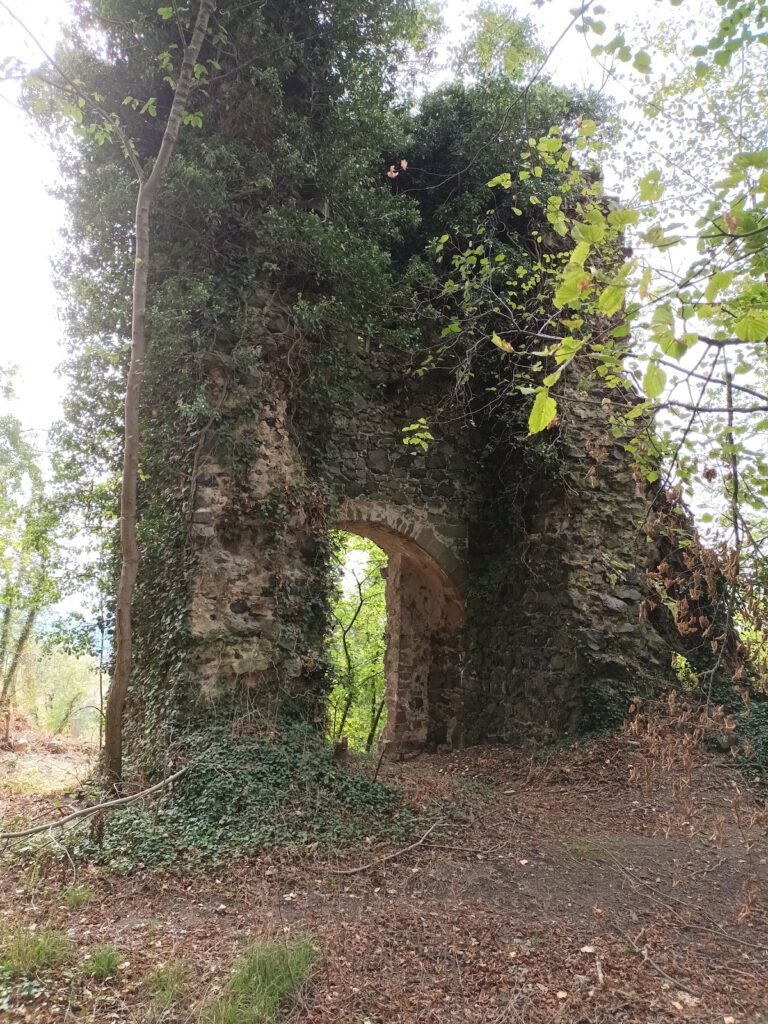
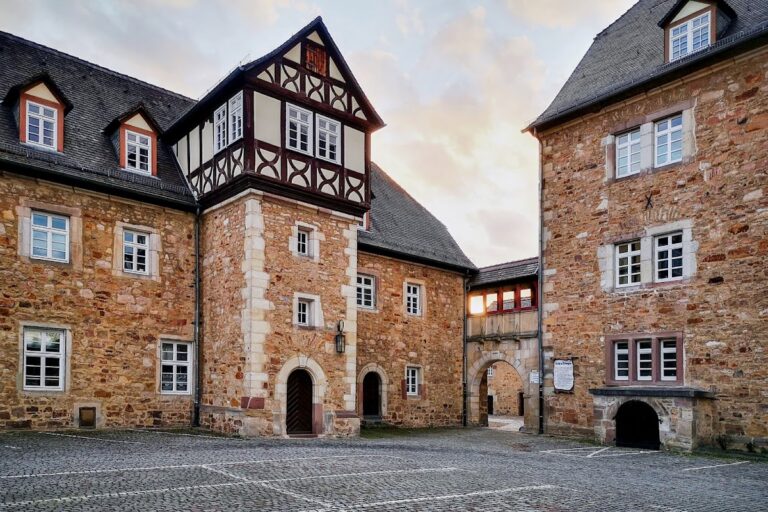
Felsburg occupies a basalt summit about 199 meters above sea level, rising roughly 40 meters above the Eder Valley. The castle has an almost trapezoidal plan and survives as a partial ruin. Its surviving defenses and buildings reflect repeated strengthening and adaptation from the medieval period into later centuries.
Fortifications and Keep
Outer Defensive Enclosures
Late Gothic outer defensive enclosures extend along the north and west sides of the castle. Dating from the fourteenth century, they contain keyhole loopholes, narrow openings widened at one end for missiles or firearms. Together, these walls formed part of the castle’s strengthened outer defenses.
Entrance Gate
The entrance gate also dates from the fourteenth century. Two flanking towers protect it, while two machicolations, projecting openings through which defenders could attack people below, are positioned at its base. These features allowed defenders to strike at attackers approaching the gateway.
Keep
The keep, the castle’s principal fortified tower, stands near the northern wall at the center of the complex. Its present form dates from 1388, when an original 15-meter tower was raised by another 14.5 meters to reach 29.5 meters. This strengthening made it one of the tallest castle towers in Hesse.
A covered wall-walk was attached at the setback below the keep’s upper section. The present entrance was cut through walls 3.5 meters thick and leads to the dungeon. Steep internal wooden ladders connect the entrance with two viewing levels on the surrounding wall-walk, at approximately 15 meters and 26 meters. Four small windows provide views from the upper level.
Chapel and Later Adaptation
The castle chapel stands against the southern wall and is dedicated to Saint Pancras, an early Christian martyr whose cult gave his name to churches and chapels in parts of Europe. In 1544, Landgrave Philip the Magnanimous stored 297 barrels of gunpowder there. The chapel consequently served as a powder magazine, a facility for storing gunpowder, for 300 years before that use ended during the Electorate period.
Apart from the keep, the chapel is the only building in the complex preserved intact. It now houses the castle museum, while its restored cellar has a ceremonial function for civil and church weddings during the summer. These adaptations form part of the surviving complex’s present use.