Hohenrechberg Castle: Ancestral Seat of the Rechberg Family


Site at a Glance
- Rating
- 4.7
- Popularity
- Medium
- Country
- Germany
- Primary era
- Medieval
- External website
- Open
- Eras represented
- Medieval
- Civilizations
- Holy Roman Empire
- Site type
- Military
- Remains
- Castle
On this page15 sections
History
Hohenrechberg Castle is a medieval castle in Germany associated with the Hohenstaufen, or Staufer, dynasty. Its oldest parts date generally to the beginning of the thirteenth century, while its principal stone fortifications were built between 1200 and 1250. The castle became the ancestral seat and historical and administrative centre of the Rechberg family’s territorial lordship.
Staufer Origins and the Rechbergs
Ulrich of Rechberg was first recorded in 1179 and was probably responsible for building the castle. The Rechberg knights served the Hohenstaufen as ministeriales, knightly officials who performed military, administrative, or court duties for a higher lord despite not originally belonging to the free nobility. Ulrich served as a castle guard at Hohenstaufen Castle in 1189, became marshal of the Hohenstaufen family in 1194, and spent several years among the ministeriales of Frederick Barbarossa, the Hohenstaufen king of Germany and Holy Roman Emperor.
Ulrich’s sons continued the family’s prominent service. Hildebrand became a marshal, while Siegfried became bishop of Augsburg and died during a crusade in 1227. The name Hohenrechberg appears in 1274, and the castle itself is explicitly mentioned in 1355.
Territorial Lordship
After the Hohenstaufen dynasty fell in 1268, the Rechbergs rose from ministerial status into the lower nobility. Hohenrechberg served as their own seat and as the centre of efforts to consolidate and govern a territorial domain. These ambitions faced opposition from Schwäbisch Gmünd, the Duke of Württemberg, German kings attempting to recover former Hohenstaufen possessions, the counts of Helfenstein, and ecclesiastical forces.
By the beginning of the nineteenth century, different Rechberg branches had acquired territories, castles, and offices across southern Germany and had secured the hereditary title of count. Until 1585, the Rechberg rulers governed directly from Hohenrechberg. They later lived mainly in more comfortable residences in the valleys, although the castle continued to be enlarged, renovated, and adapted to changing military developments.
War, Occupation, and Destruction
Soldiers from the imperial cities of Schwäbisch Gmünd and Schwäbisch Hall plundered the areas around Hohenrechberg between 1448 and 1450 but did not besiege the castle. During the German Peasants’ War in 1525, the castle was spared. Its occupants could not prevent the nearby monasteries of Lorch and Adelberg, along with Hohenstaufen Castle, from being burned.
The Schmalkaldic League, a defensive alliance of Protestant German princes and cities formed against the Catholic emperor Charles V, approached Hohenrechberg in 1546 but did not capture it. Its troops instead took Schwäbisch Gmünd. The Dukes of Württemberg occupied the castle from 1554 to 1555, 1599 to 1601, and 1633 to 1634.
During the Thirty Years’ War, the major European conflict that lasted from 1618 to 1648 and involved religious, dynastic, and political struggles, French troops attacked, plundered, and severely devastated Hohenrechberg in 1648. French forces occupied it again in 1796 during the wars of the French Revolutionary period, but the complex was not wholly destroyed. On 1 August 1796, General Jean Victor Marie Moreau is said to have held a large dinner at the castle with eight other generals, more than forty officers, and other guests.
A lightning strike caused a major fire on 6 January 1865. The blaze destroyed the residential buildings inside the inner ring wall and turned Hohenrechberg into a ruin. Parts of the buildings were later reconstructed. The castle chapel, known as the Old Chapel, ceased to be used in 1806. American troops occupied the ruined castle for several months during the Second World War.
Ownership and Conservation
Hohenrechberg remained in Rechberg family ownership, apart from the brief Württemberg occupations, until 1986. The ruin and its surrounding land were then sold to Hans Bader, a factory owner from Göppingen. After his death in 2006, ownership passed to the Rechberg Stiftung Hans Bader, a private foundation. In 1977, municipal authorities carried out work intended to make the former castle’s appearance more visible from the valley.
Remains
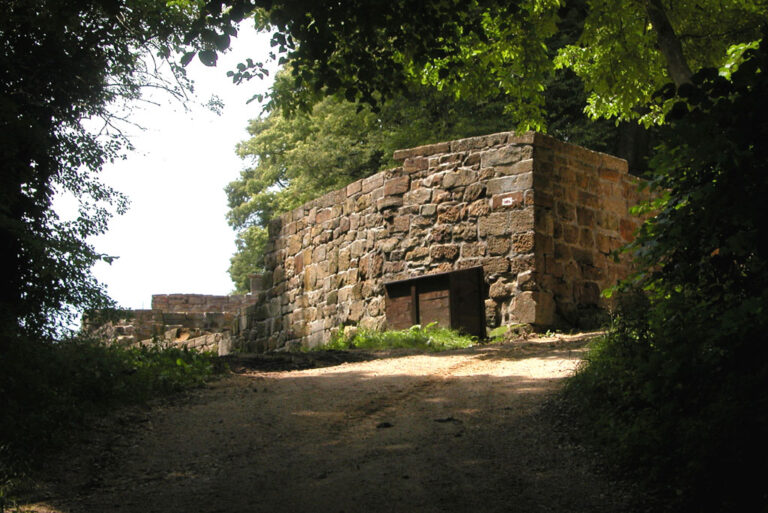
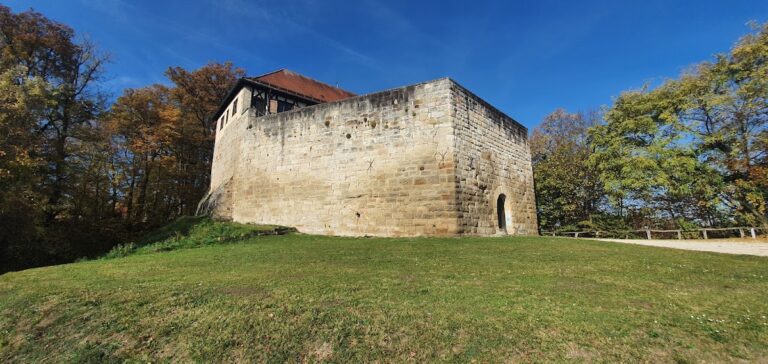
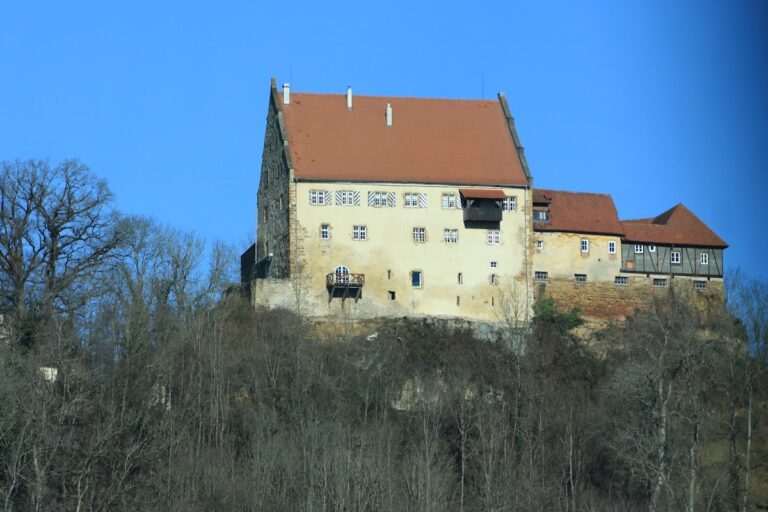
Hohenrechberg occupies a rocky spur called Schlossberg on the western shoulder of Rechberg Mountain, at approximately 644.2 metres above sea level. Rechberg is one of the Three Emperor Mountains at the northern edge of the Swabian Jura. Steep rock faces surround the complex. An irregularly polygonal enclosure follows the site and is protected by a ring wall whose masonry includes humped ashlar, roughly dressed blocks with raised faces characteristic of the Staufer period.
Citadel and Main Defences
Residence and Gate Structure
The western part of the enclosure contained the main residence, including a Staufer-period palas, the principal residential and representative building of a medieval castle. It stood beside a rectangularly projecting gate structure. Access to the citadel was protected by two successive rows of high defensive walls. The gatehouse’s lower floor served as a prison at certain periods, while late-medieval stirrup-shaped embrasures survive at the gatehouse and elsewhere in the complex.
Walls, Towers, and Bridge Approach
The castle received a ring wall with Romanesque window arcades in the thirteenth century. Later additions included second and third stone defensive walls, a staircase tower, and a machicolation tower, a defensive tower with openings through which attackers below could be targeted. Entry was possible only across a drawbridge spanning a deep moat, with additional fortifications positioned in front of the bridge in the outer bailey.
Outer Bailey and Water Supply
Bailey Buildings
The outer bailey contained a concealed storage tower, a storehouse, an apartment, and further rooms and fortifications. Parts of this area have been adapted for a restaurant and café. The surviving complex also includes sections of former residential buildings, defensive walls, gate structures, towers, and the bridge approach.
Castle Well
A historic castle well lies inside the enclosure and is approximately 30 metres deep.
Chapel and Reconstructed Eastern House
Old Chapel
The castle chapel, also called the Old Chapel, has not been used since 1806. It remains part of the surviving castle complex alongside the defensive and residential structures.
Eastern House
The former Eastern House has been partly reconstructed with a new roof. It is used for weddings and parties and contains a small exhibition of castle models and archaeological artefacts. Hohenrechberg remains in a ruined condition overall, although parts of its buildings have been reconstructed.
Nearby sites