Ivangorod Fortress: A Russian Stronghold on the Narva Frontier


Site at a Glance
- Rating
- 4.7
- Popularity
- Medium
- Country
- Russia
- Primary era
- Early Modern
- External website
- Open
- Eras represented
- Medieval, Early Modern, Modern
- Civilizations
- Russian, Swedish
- Site type
- Military
- Remains
- Fort
On this page15 sections
History
Ivangorod Fortress is a Russian fortress in Ivangorod, Russia, founded by the Muscovite state in the summer of 1492 on the Narva River opposite Narva Fortress. Ivan III, the Grand Prince of Moscow, ordered its construction to protect Novgorod Land and Muscovy’s western frontier from Livonian and Swedish forces, strengthen access to the Baltic Sea, and challenge the Livonian fortress across the river. The new stronghold became a western Russian outpost, while the settlement around it eventually developed into the town of Ivangorod.
Foundation and Muscovite expansion
The first fortress stood on Devichya Mountain, about 12 versts from the Gulf of Finland and near the border with Livonia. Its position placed it directly opposite Narva, but the original enclosure was small and could accommodate only a limited garrison. The open ground between the riverbank and its walls also made a prolonged defense difficult.
A Swedish force of about 5,000 men reached the fortress from Stockholm in 1496, traveling in 70 light vessels under Svante Sture. After an assault lasting no more than seven hours, the Swedes captured Ivangorod. Russian forces led by Prince Ivan Gundor and Mikhail Klyapin later retook it, repaired the first enclosure, and began a much larger reconstruction. The fortress was strengthened repeatedly during the late fifteenth and sixteenth centuries, developing into a complex with several defensive lines.
The enlarged stronghold withstood a Swedish siege in 1502. Its expansion continued with the addition of the Castle in 1507, the Front City by 1509, and the Boyar Rampart in 1558. These works extended the defenses across Devichya Mountain and increased the garrison space available to the fortress.
Swedish rule and return to Russia
Swedish forces captured Ivangorod in 1581 after several assaults. The fortress changed hands during the conflicts of the late sixteenth and early seventeenth centuries. The Treaty of Teusina returned it to Russia in 1595, but Sweden took it again in 1612 after a six-month siege. Under the Treaty of Stolbovo in 1617, Ivangorod was ceded to the Swedish kingdom.
During Swedish rule, Ivangorod served chiefly as an outwork, an advanced fortification outside a main defensive enclosure, for Narva. Its defenses were technically more modern and in better condition than those of Narva itself. The Swedes built a powder magazine, a fortified storehouse for gunpowder and explosives, inside the original fortress. Plans for four bastions, projecting fortifications designed to support defensive fire along adjoining walls, were never completed. A proposal to divert the river around the eastern side of the fortress also remained unrealized.
From 1659 to 1660, the imprisoned Duke Jacob Kettler of Courland and his family were held at Ivangorod after the Swedish invasion of Courland during the Lesser Northern War. Russian forces under Peter the Great captured the fortress from Sweden in August 1704 during the Great Northern War, a conflict in which Russia and Sweden fought for dominance in the Baltic region. Ivangorod again received a Russian garrison, and a provisions store, a military building for food and other supplies, was constructed during the second half of the eighteenth century.
Declining military role and modern conflicts
Advances in military technology reduced the fortress’s defensive importance from the early eighteenth century. An inspection in 1728 found the complex neglected and militarily inefficient. Restoration was ordered, but a further inspection in 1738 judged it unsuitable for defense. The roofs were renewed in 1840, followed by additional modernization in 1863 and between 1911 and 1915.
German forces captured Ivangorod on 25 February 1918 during the First World War, and the Red Army recovered it in November of the same year. From 1919 to 1940, the fortress belonged to Estonia. Between 1920 and 1921, it served as a transit camp for former prisoners of war being repatriated to Germany and Russia. An Estonian infantry unit was stationed there, and the fortress formed an Estonian bridgehead on the eastern bank of the Narva River.
During the Second World War, the site was controlled by the Soviet Union from 1940 to 1941 and by Nazi Germany from 1941 to 1944. German authorities established two prisoner-of-war camps inside the fortress. Before withdrawing, German forces destroyed six corner towers, a concealed chamber, substantial stretches of the walls, and interior buildings. The town and fortress were liberated on 25 July 1944.
Restoration and present status
In January 1945, Soviet authorities made the Narva River the administrative boundary between the Estonian Soviet Socialist Republic and the Russian Soviet Federative Socialist Republic. This transferred the fortress from Narva to Kingiseppsky District in Leningrad Oblast. After Estonia restored its independence in 1991, the town and fortress remained under Russian control and subsequently became part of the Russian Federation.
Restoration began in 1964 under a group responsible for restoring monuments in the administration of the Estonian Soviet Socialist Republic, led by architect Henno Potti. Between 1964 and 1974, restorers rebuilt the first two floors of three towers, filled breaches in the connecting walls, and partly restored their stone facing. Russian restorers continued the work from 1985 to 1993. Restoration resumed after a lengthy interruption in 2001.
An agreement between Estonia and Russia in 2012 initiated joint restoration connected with the fortresses of Ivangorod and Narva. The work restored the two-storey Small Powder Magazine, whose first floor and vaults had survived wartime destruction, and cleaned and conserved the walls of the 1492 Quadrilateral Fortress, including waterproofing along their tops. Ivangorod Fortress is a federally significant cultural-heritage monument of the Russian Federation. It now functions as a museum and forms a distinctive cross-border fortress ensemble with Narva Castle.
Remains
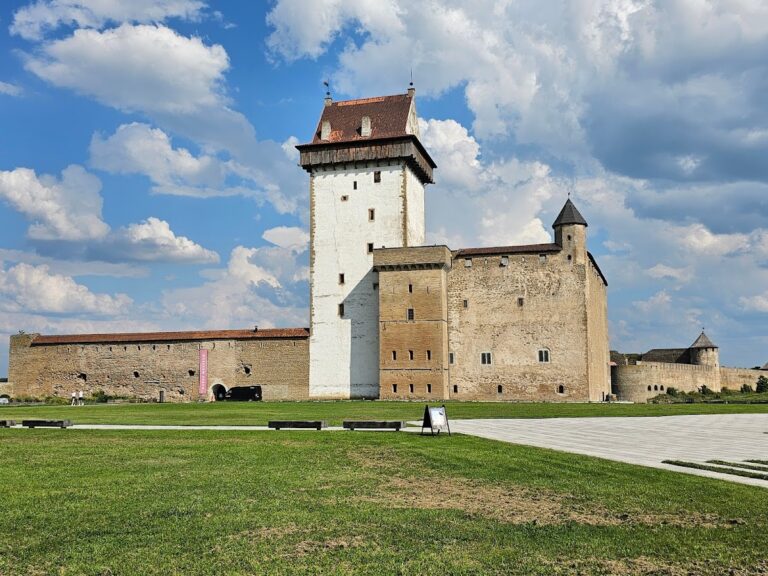
The fortress occupies Devichya Mountain directly opposite Narva Fortress and the town of Narva. The Narva River bends around the site and protected it on three sides, while successive building campaigns extended the defenses across the mountain. The resulting complex contains the original quadrilateral enclosure, the larger Great Boyar City, the Castle, the Front City, and the Boyar Rampart, together with numerous towers, religious buildings, military stores, and later artillery positions.
Fortified enclosures
Quadrilateral Fortress
The original 1492 fortress was laid out as a strictly regular quadrilateral rather than following the contours of the ground. Its walls rose to about 14 metres. The enclosure was repaired and enlarged eastward in 1496 by the addition of the Great Boyar City, a larger rectangular fortification with large round corner towers and square towers dividing three walls into approximately equal sections. Its fourth wall was shared with the original fortress. The enlargement provided space for a substantially larger garrison and applied contemporary defensive construction methods.
The Castle
In 1507, new walls and towers enclosed the western part of Devichya Mountain to create the Castle. These defenses made greater use of the terrain, reached directly to the river, and blocked an assault from the direction of Narva. Construction was directed by the Russian master Vladimir Torgkan and the foreign master Marcus Grek.
Front City and Boyar Rampart
The Front City was built against the northern wall of the Great Boyar City and completed by 1509. The final major extension, the Boyar Rampart, was added north of the Front City in 1558. Together, these additions produced a sprawling fortress with several defensive lines. Named towers include the Alarm Tower, Upper Tower, Diversion Tower, New or Water Tower, Broad Tower, Provisions Tower, Well Tower, Powder Tower, Gate Tower, Governor’s Tower, and Long-Necked Tower.
Religious and military buildings
Churches
The Church of the Dormition of the Virgin dates from 1496 and belongs to the early phase of the enlarged fortress. The Church of Saint Nicholas was built in the late sixteenth century and later reconstructed. Both churches remain part of the architectural complex.
Stores and powder magazines
A provisions store was built during the second half of the eighteenth century. Its structure is comparable to the provisions building on Narva’s Gloria Bastion. The fortress also retains the Swedish powder magazine and the restored Small Powder Magazine, a two-storey seventeenth-century building. Its first floor and vaults survived the destruction of the Second World War, allowing the building to be restored.
Artillery positions
During the Estonian period, a battery with concrete foundations was constructed for two 229-millimetre mortars and one 76-millimetre gun, along with an ammunition store. Light positions for two additional 76-millimetre guns were built at the Ivangorod postal station, whose stone shed was converted into an ammunition store. One Estonian gun has remained in its original condition since 1938. The mortar identified in Russian usage as an 1891 howitzer is also associated with these defenses.
War damage and museum collections
The destruction of 1944 left six corner towers, sections of the walls, a concealed chamber, and interior buildings destroyed or severely damaged. Later restoration reconstructed the first two floors of three towers, repaired breaches between them, and partly renewed the stone facing. The walls of the 1492 fortress were cleaned, conserved, and protected with waterproofing along their upper surfaces.
The fortress museum holds archaeological finds from the surrounding area, paintings, regional models of fortresses, armaments, and historical documents and letters. Its displays include material on local history and tradition, as well as permanent exhibitions on the Livonian War and the Great Northern War. The collections also include works by Ivan Bilibin, Alexandra Shchekotikhina-Pototskaya, and other artists, together with documents associated with notable figures including Fyodor Dostoevsky.