Stein Castle: A Medieval Cave Castle Complex in Germany


Site at a Glance
- Rating
- 4.6
- Popularity
- Low
- Country
- Germany
- Primary era
- Medieval
- External website
- Open
- Eras represented
- Medieval, Early Modern, Modern
- Civilizations
- German, Holy Roman Empire
- Site type
- Military
- Remains
- Castle
On this page11 sections
History
Stein Castle in Germany is a medieval castle complex in Stein an der Traun, now part of Traunreut in Bavaria, whose upper, cave, and lower sections developed around a steep rock face. The site was first recorded in 1135 and is regarded as Germany’s most important cave castle. Its origins are uncertain, although the upper castle may incorporate an earlier Roman or Celtic fortification.
The Lords of Stein
Stein was a documented knightly seat by the twelfth century. Bernhard von Stein and his wife Elisabeth appear in records from around 1135, while Walchun von Stein was first mentioned in 1156. Walchun’s son Rapoto von Stein held widely dispersed possessions, reaching as far as Elsendorf on the Abens in Lower Bavaria.
In 1192, during a feud between the Babenbergs and the Ortenburgers, Rapoto attacked and burned Baumburg Abbey because the Ortenburg counts protected it. Pope Celestine III then imposed an ecclesiastical ban on him. Stein subsequently passed to the Toerring family, although the circumstances of the transfer are unknown. After returning from Henry VI’s crusade in 1198, Rapoto was recorded mainly in the retinue of the Austrian dukes and adopted the name Falkenberg through his mother’s inheritance.
Legend and divided lordship
Stein is linked with the legendary robber knight Hainz von Stein the Wild, who was supposedly active there in the early thirteenth century. Lorenz Huebner first described the figure in 1783, but the story is only partly supported by historical evidence. It appears to reflect the career of Henricus von Toerring, who held Stein from about 1200 to 1243 and was reputed to have ruled tyrannically in the Trostberg area.
The castle stood on the frontier between Bavaria and the Archbishopric of Salzburg. Treaties made at Erharting altered the border in 1254 and 1275. Under the 1275 settlement, the upper castle became Salzburg territory, while the lower castle and the cave castle remained Bavarian. The Toerrings regained the upper castle as a fief in 1311.
Hofmark and noble estate
Toward the end of the fifteenth century, Stein became the seat of the Hofmark Stein, a landed estate with defined local administrative and judicial rights. The Hofmark was first recorded in 1558. The Toerrings had held Imperial Baronial status since 1566 and were raised to the rank of counts at the Regensburg Electoral Diet in 1630.
Members of the family also held important church offices. Albert von Toerring-Stein was Bishop of Regensburg from 1613 to 1649, and his brother Adam Lorenz von Toerring-Stein held the same office from 1663 to 1666.
Johann Albrecht von Toerring sold the Hofmark Stein to Count Carl Fugger von Kirchberg and Weißenhorn in 1661. Carl Fugger’s daughter Maria Johanna later brought the estate through marriage to the Barons of Lösch, who retained the property until 1829. Although the Lösch family did not live at Stein regularly, the entire complex was remodeled under their ownership. Its appearance around 1700 is recorded in an engraving by Michael Wening. A chapel dedicated to Saint John of Nepomuk was added at the end of the linden avenue in 1737, reportedly in fulfilment of a vow.
Around 1760, the Hofmark comprised 139 farms and was, after Baumburg Abbey, the largest landed estate in the Trostberg district court. It was valued at an estimated 150,000 guilders. Following administrative reforms in Bavaria after the Congress of Vienna, the former Hofmark became a second-class patrimonial court in 1818, meaning that judicial authority was exercised by the landowner rather than directly by the state.
Nineteenth- and twentieth-century transformation
In 1829, the Lösch family sold the estate and castle to Baron Maximilian Joseph von Käser, who resold them in 1835 to the Munich banker Martin Carl von Kraft. At Käser’s initiative, the Georgiritt riding procession was revived in 1833. The procession, associated with Saint George, had formerly taken place each April for centuries along the old Salzburg road from Stein Castle through Weisham to the parish church at Saint Georgen. It sought protection for the community’s animals from disease and epidemics, but had been abolished during the secularization of 1804.
Amélie von Leuchtenberg, widow of the Emperor of Brazil, bought Stein Castle and Seeon for herself and her daughter in 1845. In 1848, she transferred the Stein patrimonial court to the state in return for compensation. Under Amélie and her nephew and heir, Prince Nikolaus von Romanowsky, fourth Duke of Leuchtenberg, the castle became a social center for the family’s high-nobility connections, including the Bavarian royal house. Nikolaus spent most of his life there, and his children grew up at the castle. He also gave the complex its present English Neo-Tudor appearance, a nineteenth-century revival style based on architectural forms associated with Tudor England.
Stein passed to the underage Count Joseph zu Arco-Zinneberg in 1890 and later to his son Maximilian. In 1928, the Arco-Zinneberg family felled the extensive Saint George’s Forest to raise money through timber sales and pay debts. The estate still had to be sold, while the forest passed into state ownership and was immediately replanted. In 1929, the castle and estate were acquired by the industrialist and farmer Max Wiskott, his wife Ilse, and Otto Coninx.
The Wiskotts founded a residential educational institution at Stein in 1948, which later developed into a state-recognized secondary school. The lower castle has housed the Schule Schloss Stein boarding school since that year. The Wiskott family has owned the wider complex since 1934, and the Stein Castle Brewery, newly built in 1907, forms part of the present castle and brewery complex. It was regarded as the most important brewery in Upper Bavaria outside Munich.
Stein Castle is protected as both a listed architectural monument and an archaeological monument. The archaeological protection covers underground medieval and early-modern remains, including an earlier fortification, the high-medieval upper castle, the late-medieval cave and lower castles, the chapel, early-modern gardens, estate buildings, and hermit cells. The cave castle has also been protected as a wintering site for barbastelle bats and four other bat species since 2016, within the Natura 2000 Fauna-Flora-Habitat area 8041-301.
Remains
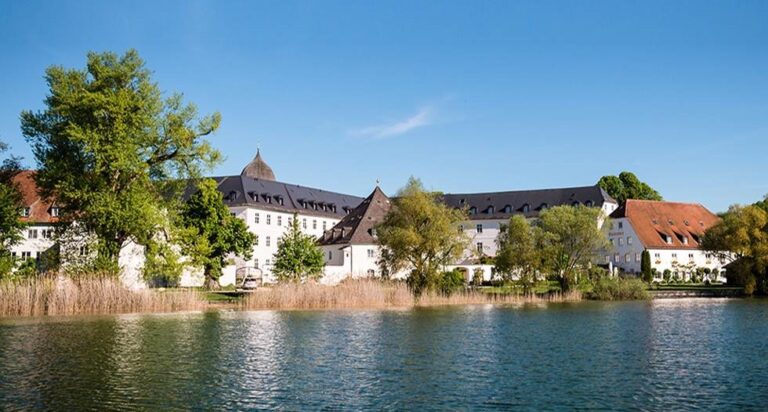
The complex is arranged in three principal elements. The upper castle occupies a steeply sloping Nagelfluh rock face nearly 50 metres high, while the cave castle is concealed within the rock below and the lower castle stands in Stein. Nagelfluh is a conglomerate formed from rounded stones cemented together, and at Stein it provides the natural rock mass into which the cave castle was built. A passage through the rock leads toward the Traun valley. The wider complex also includes a late-medieval chapel, early-modern garden areas, estate or service buildings, and hermit cells.
The three castle sections
Upper castle
The upper castle is positioned on the high Nagelfluh face and forms the elevated part of the complex. Its beginnings remain uncertain, with the possibility that it incorporates a fortification from the Roman or Celtic period. The upper castle later became a high-medieval stronghold and, after the border settlement of 1275, belonged to Salzburg before returning to the Toerrings as a fief in 1311.
Cave castle
The cave castle lies within the rock beneath the upper castle. Its passage runs through the Nagelfluh toward the Traun valley, making the rock itself a defining element of its construction. The cave castle belongs to the late-medieval group of remains and forms part of the underground archaeological monument. Its protected spaces provide wintering habitat for barbastelle bats and four other bat species.
Lower castle and associated buildings
The lower castle stands in Stein and forms the third principal part of the complex. It remained Bavarian under the 1275 border settlement and now contains the Schule Schloss Stein boarding school, established there in 1948. The surrounding complex includes the late-medieval castle chapel, early-modern gardens, estate buildings, and hermit cells, together with the brewery built in 1907.
Later architectural form
Remodeling under the Lösch family produced the appearance shown in Michael Wening’s engraving from around 1700. The complex later acquired its present English Neo-Tudor character under Prince Nikolaus von Romanowsky. The surviving arrangement therefore combines the rock-cut cave castle and medieval castle sections with later residential, estate, educational, and brewery structures.
Nearby sites