Rapperswil Castle: A Medieval Fortress and Cultural Center in Switzerland


Site at a Glance
- Rating
- 4.6
- Popularity
- Low
- Country
- Switzerland
- Primary era
- Medieval
- External website
- Open
- Eras represented
- Medieval, Modern
- Civilizations
- Habsburg
- Site type
- Military
- Remains
- Castle
On this page13 sections
History
Rapperswil Castle is a medieval fortress in Switzerland, located in Rapperswil-Jona on the eastern shore of the upper Lake Zurich. Built by the House of Rapperswil in the early thirteenth century, it secured a settlement, waterway, and route that connected the Zurich region with the Gotthard Pass and Lombardy.
Foundation and Rapperswil rule
The castle’s origins are placed around 1200–1220 or between 1220 and 1230. It was first mentioned in 1229, in connection with the foundation of Rüti Abbey, a former Premonstratensian monastery in the canton of Zurich. The castle and the fortifications at Endingen were established when Rapperswil nobles moved from Altendorf, or Old Rapperswil, across Lake Zurich to the settlement on the opposite side of the Seedamm, the causeway and crossing at the lake’s narrowest point.
Count Rudolf II and his son Rudolf III are associated with the construction. The move may have enabled the family to establish its own parish church and avoid crossing the lake to attend Mass at St. Martin in Busskirch. The Counts of Rapperswil had served as Vogts of Einsiedeln Abbey during the eleventh and twelfth centuries. A Vogt was a secular official who exercised administrative, judicial, or protective authority for a religious institution or territorial lord.
Rapperswil’s position gave the castle control over the narrow waterway between Lake Walen and Lake Zurich, the medieval route across the Gotthard Pass between Lombardy and Zurich, and the Way of St. James leading toward Einsiedeln Abbey. The Rapperswil family line ended in 1283 with the death of the eighteen-year-old Count Rudolf V. Emperor Rudolf I of Habsburg then acquired the family’s fiefs.
Habsburg succession and destruction
Through the marriages and succession of Countess Elisabeth von Rapperswil, Count Rudolf von Habsburg-Laufenburg, and their descendants Johann I and Johann II, Rapperswil passed through the houses of Homberg and Habsburg-Laufenburg. The castle became involved in the political struggles of Zurich. After the guild revolution of 1336, which brought Rudolf Brun to power as Zurich’s burgomaster, exiled Zurich patricians took refuge at Rapperswil and formed a government in exile.
With Count Johann I of Habsburg-Laufenburg, the exiles planned a retaliatory action later associated with the Zurich Night of Murder. In 1350, an aristocratic coup in Zurich, in which Johann II played a central role, was suppressed by Brun. Zurich forces besieged Rapperswil, destroyed the town walls and castle, and probably burned the complex after the town surrendered. The traditional Rapperswil Carnival custom known as Eis-zwei-Geissebei, held on Shrove Tuesday, may derive from the siege and destruction.
Duke Albrecht II of Austria ordered the castle and its fortifications rebuilt between 1352 and 1354. The reconstructed complex became an important Habsburg stronghold against the expanding Swiss Confederation until the middle of the fifteenth century.
Confederation administration and decline
After the Habsburg-Laufenburg line became extinct in 1442, the castle passed to the citizens of Rapperswil. From 1458 to 1798, Rapperswil was administered as a Gemeine Herrschaft under the Old Swiss Confederation. This was a territory governed jointly by members of the Confederation rather than by a single canton, usually through a representative called a Vogt.
During this period, the castle served as an administrative center, military base, and prison. A separate agreement placed the city’s “perpetual agreement” with the Confederation in 1464. French Revolutionary troops plundered the castle’s interior in 1798, after which the complex fell into disrepair.
Polish museum and modern interpretation
In 1870, local authorities leased the castle for ninety-nine years to Count Wladyslaw Broel-Plater, a Polish political émigré and cultural patron associated with the aftermath of the November 1830 Uprising. Broel-Plater restored the building at his own expense, and the Polish National Museum was established there on 23 October 1870.
The museum became an outpost of Polish culture in Switzerland. Its activities were interrupted from 1927 to 1936 and from 1952 to 1975. A new Polish museum opened in 1936, and during the Second World War it also provided cultural care for interned Polish soldiers. In 1952, the collection was transferred to Poland. The castle then housed an international institute for the study of castles and, from 1962 to 1975, a Swiss castle museum. Comprehensive restoration in 1975 was followed by the establishment of a third Polish museum by Polish émigrés.
Since 1870, the castle has remained associated with the Polish National Museum. Its future became uncertain in 2008 when some Rapperswil residents sought its removal because maintaining two historical museums in the town was considered too costly. The nearby Stadtmuseum was retained and renewed at the Breny House in 2012–2013. The castle and Polish Museum are listed as Class A objects of national importance in the Swiss inventory of cultural property of national and regional significance. In 2011, the city and local authorities introduced a new operating concept that opened the tower, battlements, and herb garden to the public and presented the castle as a cultural meeting place.
Remains
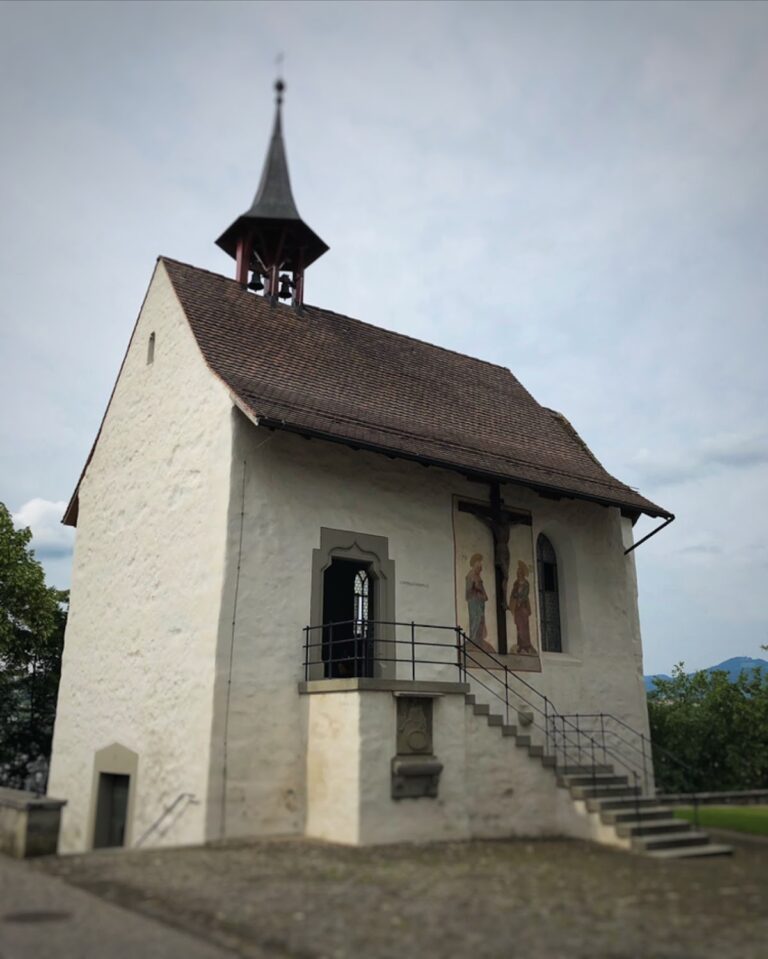
Rapperswil Castle occupies a long, rocky hill above the eastern shore of Lake Zurich’s upper lake, or Obersee. The hill is called Lindenhof on its western side and Herrenberg on its eastern side. Lake Zurich surrounds it on three sides, while the Seedamm lies nearby at the lake’s narrowest section. The castle stands beside the parish church of Rapperswil and the Liebfrauenkapelle, or Chapel of Our Lady, with the former small castle, now the Stadtmuseum, to the east.
Castle plan and defensive circuit
Since the rebuilding of 1354, the castle has formed an almost equilateral triangle, with a tower at each corner. A six-storey residential palace occupies the space between the southwestern donjon and the eastern clock tower. Sandstone from Lützelau island was used for the castle, the town walls, and the city. Ramparts and covered battlements connect the principal towers and create the fortified circulation around the complex.
Southwestern donjon
The southwestern donjon, commonly called the Gügeliturm, is the highest tower. A donjon is a principal fortified tower used for defense, observation, and refuge. The tower’s Hochwächter, or high watchman, warned the inhabitants of approaching danger and fires. Frescoes survive within the donjon.
Eastern clock tower
The eastern Zeitturm is a five-sided clock tower containing three bells. Its exterior has two large clock faces and a sundial, making it both a defensive element and a visible timekeeping feature of the castle.
Northwestern Powder Tower
The northwestern Pulverturm, or Powder Tower, is connected to the castle by the ramparts and covered battlements. A powder tower was a fortified structure intended to store gunpowder or other military supplies.
Approaches and interior spaces
The town-side approach includes double gates and a long fortified passage beside the wall leading to the castle terrace. A late-medieval portal opens from the terrace into the inner courtyard, and its inner side bears a relief of the Rapperswil coat of arms. A drawbridge occupied the present lower gate toward the former castle chapel from 1698 to 1837.
The palace interior includes the Rittersaal, or Knights’ Hall, along with historical wooden architecture, paintings, and tapestries. A restaurant is situated beside the Polish Museum in the palace. The chapel adjoining the ossuary stood outside the castle walls and was separated from them by a trench. Its predecessor, an ossuary or charnel house, was built around 1220–1253 and was first recorded as a church in the cemetery.
Hilltop landscape and associated features
The castle terrace occupies the eastern part of the Lindenhof hill area. It contains a small rose garden and the Polish Freedom Pillar, an iron monument installed in 1868 in support of people struggling for freedom. On the southern slope of Lindenhof, also called Schlossberg, a vineyard was mentioned in 981 and is described as probably the oldest vineyard on the shore of Lake Zurich.
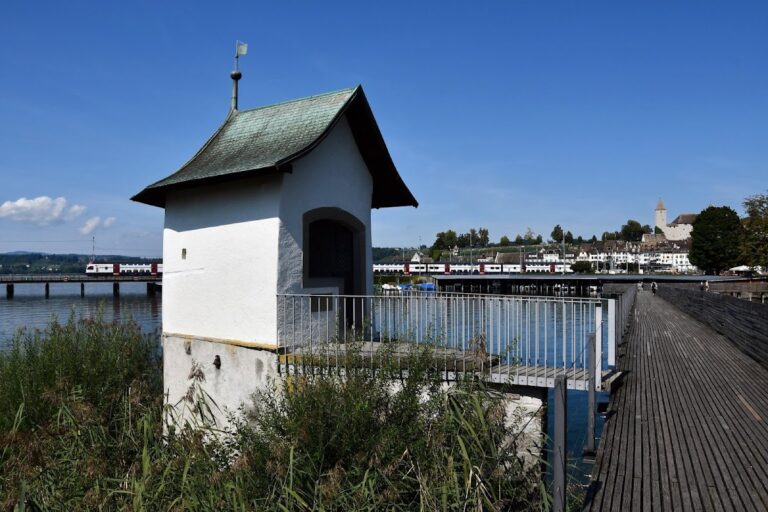
A supervised deer park on the northern side of the Lindenhof plateau contains between ten and fifteen fallow deer and recalls the legend of the castle’s foundation. The terrace and hill look across medieval Rapperswil, the upper and lower parts of Lake Zurich, the Seedamm, the wooden bridge from Rapperswil to Hurden, the Frauenwinkel protected area, the Glarus Alps, and Bachtel Mountain.
Polish memorial objects
Since 1895, one of the castle towers housed a funerary urn containing the mummified heart of Tadeusz Kosciuszko, a Polish military and national independence leader who also served in the American Revolutionary War. In 1927, after the establishment of the Second Polish Republic, the urn was transferred to Warsaw together with the museum collection.