Tapeley Park: A Historic Country House and Estate in Devon


Site at a Glance
- Rating
- 4.5
- Popularity
- Low
- Country
- United Kingdom
- Primary era
- Modern
- External website
- Open
- Eras represented
- Early Modern, Modern
- Civilizations
- British, English
- Site type
- Domestic
- Remains
- Manor House
On this page9 sections
History
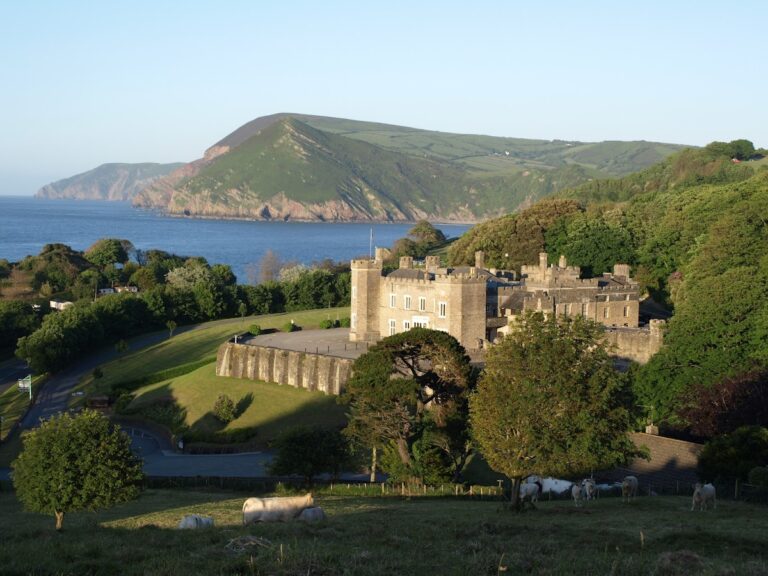
Tapeley Park is a historic country house and estate in Bideford, United Kingdom, situated in the parish of Westleigh in North Devon. The present mansion was built or enlarged from an existing structure about 1704 and was remodelled during the nineteenth century and again in the early twentieth century. The estate is a Grade II* listed country house, while its gardens also hold Grade II* status on the National Register of Historic Parks and Gardens.
Medieval ownership
The earliest recorded holders of Tapeley were the Baudrope family. Medieval records also connect the estate with Walter de Tapeley in 1295 and 1314, and with Robert Tapeley in 1345. Marriage later transferred Tapeley to the Grant family through the heir general of the Tapeley family. By an uncertain process, it subsequently passed to the Coblegh family of Brightley.
Margaret Coblegh, heiress of Brightley and Tapeley, married Sir Roger Giffard, who died in 1547. Through this marriage the estate entered the Giffard family, which retained it for several generations.
The Clevland estate
John Giffard of Brightley sold Tapeley in 1704 to Commander William Clevland, a Scottish-born Royal Navy officer. Clevland is said to have seen the estate from a ship in Bideford in 1702 and to have been drawn to its position above the estuary of the River Torridge. He made Tapeley his residence, and his son John Clevland inherited the property.
About 1750, John Clevland purchased the lordship of the manor of Bideford, a historical territorial status connected with authority over a manor and its customary local administration. The lordship thereafter descended with Tapeley.
Nineteenth-century succession
John Clevland, the last male heir of his branch, died without children in 1817. Tapeley passed to his great-nephew Augustus Saltren-Willett, who had inherited the estate that year and assumed the Clevland surname and arms by royal licence in 1847. Augustus died in 1849. His only son and heir, Archibald Clevland, died unmarried at the Battle of Inkerman in 1854, ending the Clevland and Saltren-Willett families in the male line.
William Langham Christie inherited Tapeley through his marriage in 1855 to Agnes Hamilton Clevland, Archibald’s sister and co-heiress. Christie and Agnes rebuilt the house with a severe Victorian brick facade. The estate later remained with the Christie family. Augustus Langham Christie and his wife, Lady Rosamond Wallop, undertook major further remodelling and created the landscaped gardens.
The Christie family and later uses
John Christie later inherited Tapeley. He was an assistant headmaster at Eton College, served in the First World War, and founded the Glyndebourne Opera Festival, an annual opera institution established at his family estate in Sussex. He left Tapeley to his daughter Rosamund Christie rather than to his son Sir George Christie, who inherited Glyndebourne. Rosamund later left Tapeley to her nephew Hector Christie.
During the Second World War, Tapeley housed children evacuated from Plymouth. It later became a home for the Invalid Children’s Aid Association and subsequently operated as a hotel. Hector Christie also briefly ran the estate as a hippie commune. Tapeley is now mainly owned by the Christie Devon Estates Trust, trustees of the Christie family, and the estate comprises about 6,000 acres. Its holdings include Saunton, with its foreshore and beach, Braunton Burrows, partly a nature reserve and leased to the Ministry of Defence, Instow with its foreshore acquired from the Crown Estate, and the village of Westleigh.
Remains
Tapeley Park combines a country house remodelled in several architectural phases with formal terraces, working and experimental gardens, commemorative monuments, and historic interior collections. The house’s appearance reflects the transition from an earlier Georgian building through Victorian rebuilding to an early twentieth-century Queen Anne-style design.
The mansion and gardens
About 1704, the mansion was built or enlarged from an existing structure. Before the later changes, it was described as a plain Georgian stucco building, with some front windows blocked. It had no terrace walk or garden at that time, and the drive approached between iron railings.
William Langham Christie and Agnes Hamilton Clevland gave the house its severe Victorian brick facade. Lady Rosamond Wallop later employed the architect John Belcher to remodel it over an extended period, as finances allowed, before, during, and after the First World War. The work added pilasters, a portico, a pediment, and a parapet, producing a Queen Anne-style appearance. Queen Anne style was a revival associated with brick or brick-like facades, classical details, pediments, pilasters, and prominent entrance porches. Wallop also placed a commemorative plaque to Belcher on a wall of the house.
The gardens include Italianate terraces, a working kitchen garden, and a permaculture garden. Permaculture designs cultivated spaces around ecological sustainability and recurring natural processes. Two monuments to Archibald Clevland were also erected in the grounds. A 50-foot obelisk was destroyed by lightning in 1933, leaving its base, while his mother placed a statue near the lake depicting a mourning lady.
Sculpture and furnishings
Lady Rosamond Wallop assembled a collection of fine sculpture at Tapeley. It included John Gibson’s marble Tinted Venus, 120 centimetres high, Giovanni Maria Benzoni’s marble Cupid and Psyche, 168 centimetres high, and Sir Alfred Gilbert’s bronze works Perseus Arming and Comedy and Tragedy. The collection was accompanied by French and English furniture. These sculptures and furnishings were offered for sale from Tapeley in 2025.
Paintings from British India
Three paintings of Indian scenes by William Hodges remained at Tapeley Park until 2025. Augustus Clevland, a younger son of John Clevland, commissioned them. Augustus served as an East India Company officer and as Collector of Bhagalpur in Bengal, linking the paintings to the family’s eighteenth-century connections with the East India Company administration.