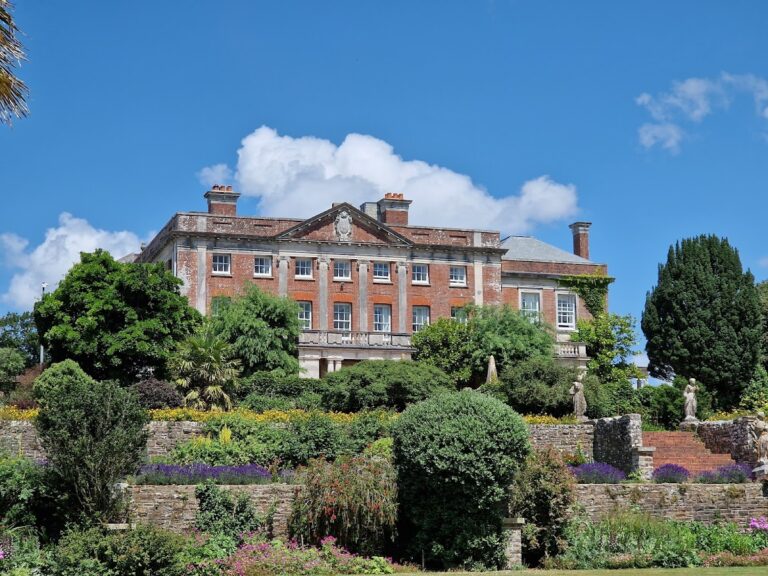
Watermouth Castle: A Country House Designed as a Medieval Castle


Site at a Glance
- Rating
- 4.5
- Popularity
- Medium
- Country
- United Kingdom
- Primary era
- Modern
- External website
- Open
- Eras represented
- Modern
- Civilizations
- British
- Site type
- Domestic
- Remains
- Castle
On this page7 sections
History
Watermouth Castle is a country house in Watermouth, near Ilfracombe in North Devon, United Kingdom, completed in 1825 and designed to resemble a medieval castle rather than serve as a true fortress. It was built as the principal residence of Joseph Davie Bassett after he sold Orleigh Court in 1807, and was later altered by the architect George Wightwick.
The earlier Palladian residence
The present house replaced an earlier Palladian residence. Palladian architecture is a classical style based on symmetry, proportion, and forms inspired by ancient Roman buildings. In 1796, the Devon topographer Reverend John Swete visited Watermouth before construction of the present house and found the earlier building already being deliberately allowed to deteriorate in preparation for enlargement.
Swete described the surrounding inlet, peninsula, cliffs, and fishing settlement, as well as the earlier house’s small and simple plan. Its service rooms lay beneath the main building in an underground passage with numerous winding turns. The proposed enlargement included large bow windows on the north and south fronts, serving a drawing room and dining room while extending their views across the bay and toward the Combemartyn coast and Hangman’s Cliff. The earlier design was attributed to a plan by Lord Clinton, whose classical ideas were associated with the Roman architectural writer Vitruvius, Andrea Palladio, and the temples at Castle Hill.
The Bassett family
Joseph Davie Bassett was the son of John Davie of Orleigh Court and Eleanora Basset of Heanton Court. After his mother inherited from her childless brother Francis Basset, Joseph adopted the Bassett surname and armorial bearings. He was succeeded by his eldest son, Arthur Davie Bassett, who died in a horse-riding accident. Arthur’s surviving son, Reverend Arthur Crawfurth Davie Bassett, later died unmarried at Watermouth Castle, and the inheritance then passed to Arthur’s sister Harriet Mary Bassett and her husband, Charles Henry Williams.
War, sale, and changing ownership
In 1908 the castle passed to their daughter Edith Bassett Bassett, formerly Edith Basset Williams, who was married to Captain Ernest Charles Penn Curzon. During the First World War she began selling the Bassett estates, and Watermouth Castle was used as a military hospital. Most of the castle’s contents were sold in 1942, and the Bassetts left the house in 1945.
The property subsequently passed through several short-term owners and property speculators. Richard L. Haines and his wife acquired the castle from Keith Wickenden in 1977, together with 24 hectares of land. The Haines family converted the property into an amusement centre, with their sons Antonie and Jonathan particularly involved in its operation. In 2023, the Escapade Group, owners of Hobbledown, took over the park. Watermouth Castle is a Grade II* listed building, a category in England reserved for buildings of particular importance or more than special interest.
Remains
Watermouth Castle stands near the shore of the Watermouth inlet, on an elevated site associated with a narrow peninsula between the bay and the sea. Rocky points and cliffs enclose the cove, while the position provides views over the inlet and the surrounding landscape. The surviving building presents the appearance of a medieval castle but remains a country house. Its listed extent includes the front retaining wall and the walls of the rear courtyard.
Castle structure and setting
The building’s castle-like character belongs to its nineteenth-century design rather than to a documented medieval defensive function. Its relationship with the inlet and the elevated ground continues the setting described by John Swete when the earlier Palladian house occupied the site. The present house incorporates later alterations by George Wightwick, a nineteenth-century English architect associated with country houses and other buildings.
Collections and themed grounds
The house contains a collection of Victorian antiques centred on domestic tools and amusement machines. The attraction also includes Castle Treasure, Dungeon Labyrinths, and The Watershow Extravaganza. Nine rides are distributed among the themed areas Adventure Land, Merry go Land, and Gnome Land, reflecting the property’s later conversion from a family residence into an amusement centre.