National Preserve of Tauric Chersonesos: Ancient Greek City and Archaeological Park in Ukraine
Site at a Glance
- Rating
- 4.8
- Popularity
- Medium
- Country
- Ukraine
- Primary era
- Classical
- External website
- Open
- Eras represented
- Classical, Medieval, Modern
- Civilizations
- Ancient Greek, Byzantine, Roman, Russian
- Site type
- City
On this page16 sections
History
National Preserve of Tauric Chersonesos is an archaeological preserve in Sevastopol, Ukraine, incorporating the ancient Greek city of Chersonesus, founded by Dorian settlers from Heraclea Pontica in the Classical period. The foundation date is uncertain, although a tradition connecting the settlement with colonists from Delos makes a date around 422 BC possible. The city occupied a strategically valuable position beside the Taurians, with deep-water harbors on the Black Sea.
Greek foundation and expansion
At first, Chersonesus was associated with its mother city, Heraclea Pontica, a Greek settlement on the southern Black Sea coast in Asia Minor. It later became known as Tauric Chersonesus, while the Byzantine form of its name was Cherson. The Greek name referred to a peninsula and did not describe the whole of southern Crimea.
During the Classical period, the city was governed as a democracy through elected archons, senior civic magistrates, and a council. Over time, political influence became increasingly concentrated among the archons. A civic oath sworn by citizens in the third century BC survives as evidence of the city’s political organization.
Chersonesus remained relatively small until the middle of the fourth century BC. It then expanded across northwestern Crimea, incorporated the colony of Kerkinitida, and constructed extensive defenses. The city’s interests brought it into conflict with the Bosporan Kingdom, the Scythians, and the Taurians.
Pontic and Roman rule
Around 110 BC, Chersonesus appealed to Mithradates VI, king of Pontus, whose wars with Rome reshaped the political order of the Black Sea region. His general Diophantus led the campaign connected with the city, which subsequently became subject to the Bosporan Kingdom. In 107 BC, the northern Pontic Greek city-states were annexed by the Kingdom of Pontus.
After Pompey defeated Mithradates VI in 63 BC, Chersonesus placed itself under Roman protection. It developed into a Roman military and commercial outpost, and a Roman garrison remained there from approximately the middle of the first century BC until the 370s AD, when the Huns captured the city. Burned remains indicate that Chersonesus was plundered and destroyed during this turbulent history.
Byzantine and Khazar periods
Chersonesus became a possession of the Byzantine Empire, the medieval continuation of the eastern Roman Empire centered on Constantinople, during the Early Middle Ages. Byzantine control was limited, allowing the city to retain a degree of self-government. It served as an observation point and as a place of exile for figures who had fallen out of favor with Roman or Byzantine authorities, including Pope Clement I, Pope Martin I, and the deposed Byzantine Emperor Justinian II.
A Khazar governor probably resided at Chersonesus in the late seventh century. From approximately 705 to 840, elected officials administered the city under a title meaning “father of the city.” During the eighth and ninth centuries, Khazar influence increased, and Chersonesus functioned more as a Byzantine trading station than as a major military base.
In 833, Emperor Theophilus sent Petronas Kamateros, who had supervised construction of the Khazar fortress of Sarkel, to take direct control of Chersonesus and its surrounding territory. This action established the Byzantine administrative district of Klimata, also called Cherson.
Rus, Genoese, and final abandonment
Around 985, Vladimir I of Kievan Rus occupied Chersonesus in an effort to pressure Byzantium to permit his marriage to Anna, the sister of Emperor Basil II. The political settlement required Vladimir’s baptism, and the episode became associated with the Christianization of Kievan Rus. The traditional account remains historically uncertain, and some historians instead connect the event with the Rus–Byzantine War of 1043 and another ruler named Vladimir.
After the Fourth Crusade in 1204, Chersonesus became dependent first on the Byzantine Empire of Trebizond and was later associated with the Principality of Theodoro. Genoa gained control in the early thirteenth century and restricted Greek trade there. Mongol forces under Nogai Khan sacked the city in 1299.
Byzantine writers last mentioned Chersonesus in 1396. The city was abandoned around 1400 and was not rebuilt. Its ecclesiastical organization, a Roman and later Greek Orthodox bishopric that had been elevated to an archbishopric, disappeared after the city’s destruction and the Turkish conquest of 1475.
Excavation and modern preservation
Russian archaeological excavations began in the 1820s, with 1827 marking a major excavation date. The uncovered settlement became an archaeological park and open-air historical museum. Since 1992, the Institute of Classical Archaeology of the University of Texas at Austin and the local archaeological park have investigated the site.
Chersonesus and its chora, the agricultural territory controlled and cultivated by an ancient Greek city, were inscribed on the UNESCO World Heritage List in 2013 under criteria (ii) and (v). The property includes the city and six agricultural areas, reflecting cultural exchange among Greek, Roman, and Byzantine societies and their organization of agricultural land. UNESCO continues to recognize Crimea and its heritage sites as belonging to Ukraine despite Russia’s annexation of the Crimean Peninsula in 2014. The preserve is also protected as a nationally significant archaeological monument of Ukraine.
Urban encroachment and coastal erosion have threatened the archaeological setting. A Russian Black Sea Fleet automobile depot inside the reserve was identified as an obstacle to UNESCO inscription, while a road project approved in 2015 without the permits required for protected areas led to a dispute between the preserve’s director and Sevastopol authorities. In the same year, governor Sergey Menyaylo dismissed director Andrey Kulagin and appointed Sergiy Khalyuta, the head priest of Saint Vladimir’s Cathedral. The preserve’s 109 staff members refused to work under the new director, who later resigned under pressure from employees and local residents.
A historical park built near the ancient fortifications in 2024, in the area of the suburbs and necropolises, introduced pseudo-Byzantine reconstructions. It was criticized for presenting a propagandistic interpretation of Crimea and Chersonesus as the origin of Russia, while emergency excavations associated with its construction were considered inadequate. On July 23, 2026, Chersonesus and its chora were placed on the List of World Heritage in Danger because of damage attributed to new construction and archaeological excavations carried out by Russian authorities.
Remains
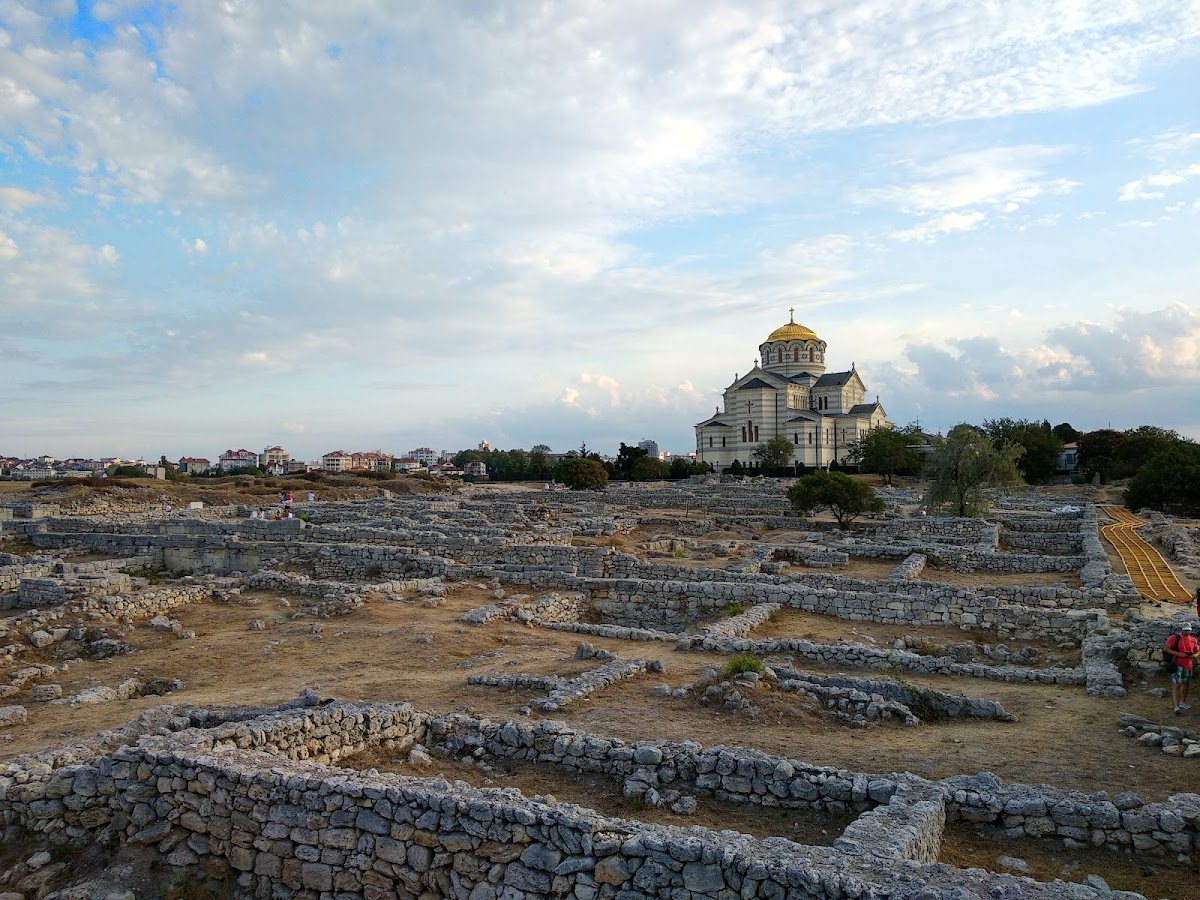
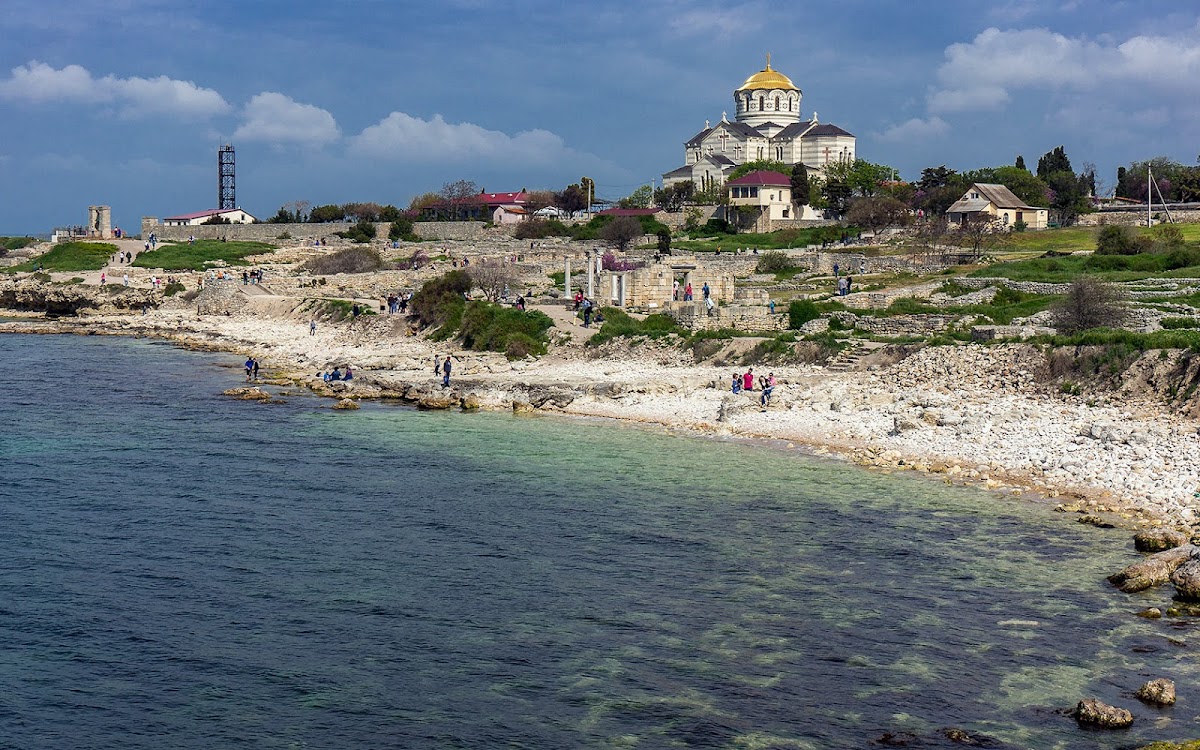
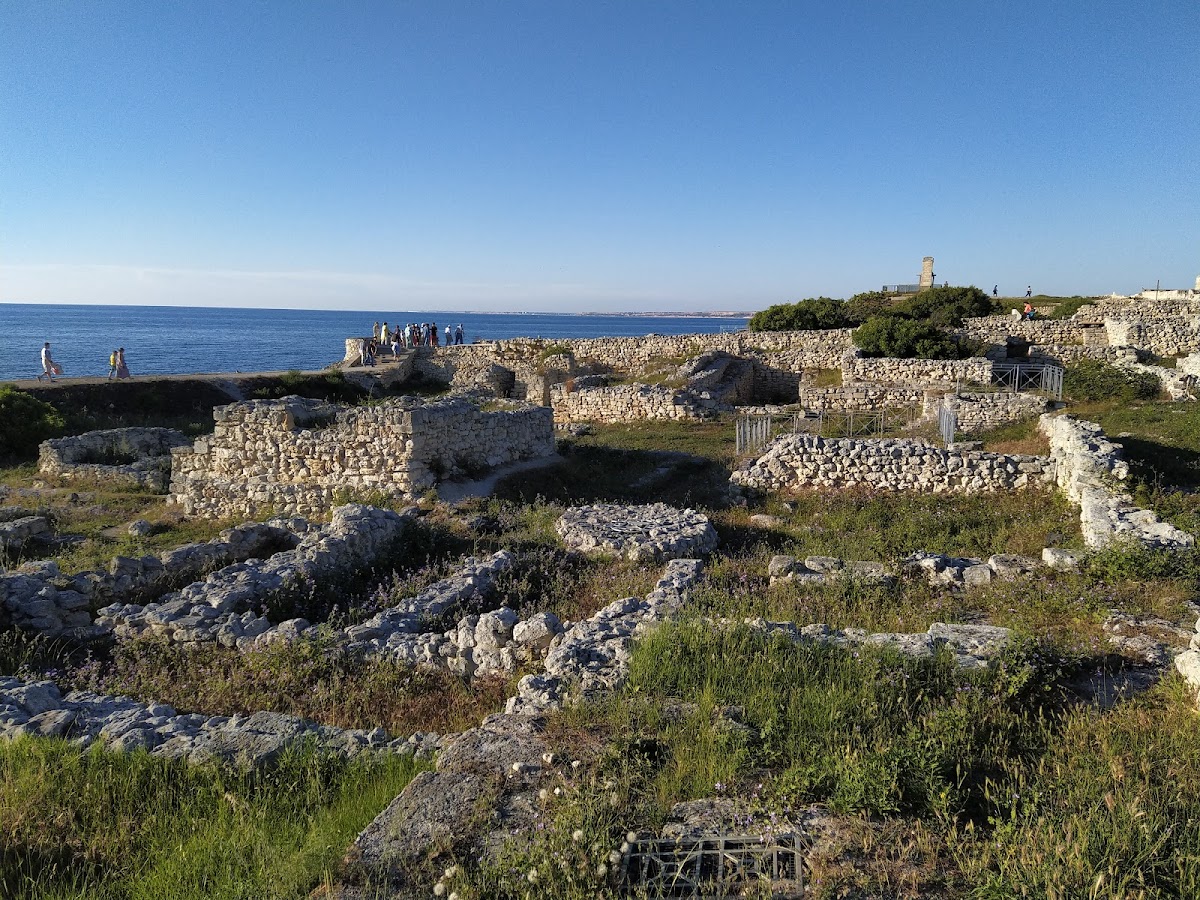
The ancient settlement stood on the southwestern Crimean Peninsula, along the southern shore of Sevastopol’s largest bay and behind several hills. The excavated city covers approximately 30 hectares. Its surviving architecture combines Greek, Roman, and Byzantine influences, while the surrounding agricultural territory preserves evidence of the city’s wider organization and economy.
City defenses and agricultural territory
Fortifications
The defensive circuit extended for approximately 3.5 kilometers. Its walls were about 3.5 to 4 meters thick and 8 to 10 meters high, while the towers reached approximately 10 to 12 meters. These defenses belong to the period when Chersonesus expanded into northwestern Crimea and provide the principal surviving outline of the ancient urban settlement.
Chora and rural installations
Outside the city, the chora covered several square kilometers of agricultural land controlled by Chersonesus. Its remains include wine presses and defensive towers. Archaeological evidence indicates that agricultural laborers were paid rather than enslaved, providing evidence about the organization of rural production beyond the city walls.
Burial areas and archaeological collections
Necropolises
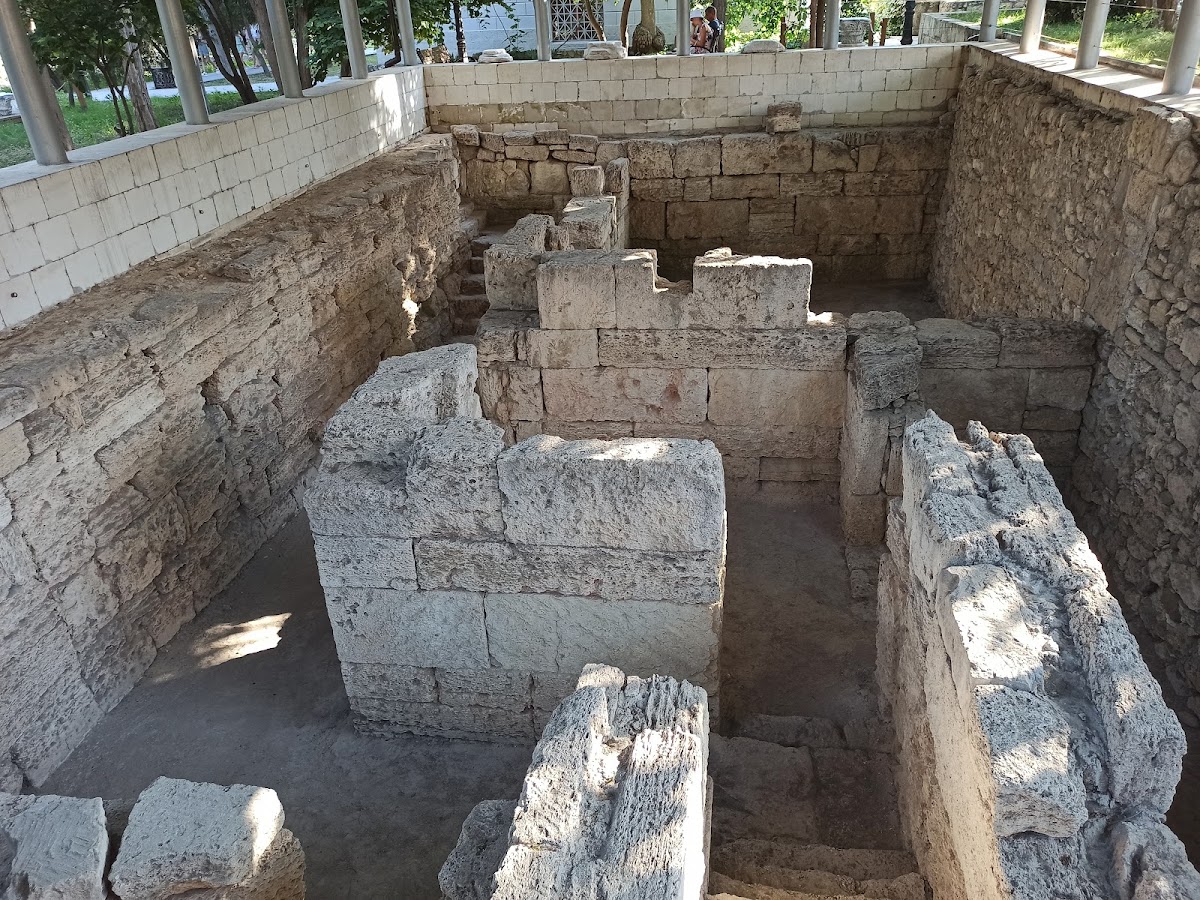
Excavated tombstones show burial customs that differed from those of Greek communities. Each stone marked an individual burial rather than a family tomb, and decoration included objects such as sashes and weapons instead of funerary statues. More than half of the excavated tombs contained the remains of children.
Human skeletal remains from a necropolis in the northern part of Chersonesus date from the earliest period of the colony, between the fifth and fourth centuries BC. Most individuals had been buried in a flexed position, with the legs drawn toward the chest, while a smaller group lay extended on their backs. Genetic similarities among the individuals challenged the interpretation that burial position distinguished local Taurians from Greek colonists.
Museum collections
The site museum holds approximately 200,000 smaller objects dating from AD 5 to the fifteenth century, with more than 5,000 exhibited. The collections include the third-century BC civic oath, second-century BC decrees honoring Diophantus, coins, ancient ceramics, and a mosaic made from black and white pebbles and colored stones. Architectural fragments include ancient and medieval abacuses, reliefs, and remains of ancient murals.
In 2017, archaeologists found fragments of an ancient Greek altar with figures of gods on the outskirts of Sevastopol. The discovery adds to the material evidence for religious activity in the wider area of Chersonesus.
Religious and civic architecture
1935 Basilica
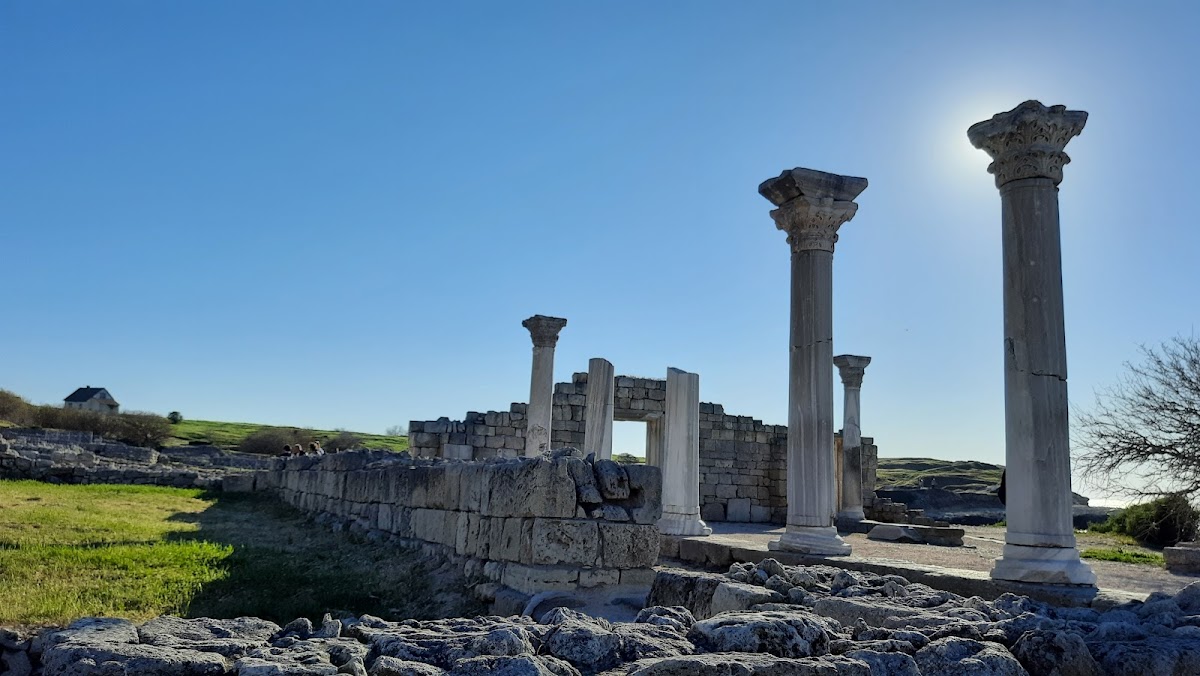
The 1935 Basilica was uncovered in 1935, which explains its modern name because its original dedication is unknown. It was probably built in the sixth century on the site of an earlier temple. Historians have assumed that this earlier building was a synagogue, which itself replaced a small temple dating from the early Christian period.
Saint Vladimir’s Cathedral
Saint Vladimir’s Cathedral stands on a hill overlooking the excavations. Built in the late nineteenth century and completed in 1892, it was designed in the Byzantine style to commemorate the traditional location of Vladimir I’s baptism. Its position and purpose connect a modern religious building with the medieval tradition surrounding Chersonesus and Kievan Rus.
Soviet Black Sea Fleet military structures were erected within the excavation area during the Soviet period and later removed. More recent construction in and around the archaeological area has damaged both the setting and surviving remains.