Assisi Roman Amphitheater

Site at a Glance
- Rating
- 3.6
- Popularity
- Low
- Country
- Italy
- Eras represented
- Classical
- Civilizations
- Roman
- Site type
- Entertainment
- Remains
- Amphitheatre
History
The Roman amphitheater of Assisi is situated in the upper part of the city of Assisi, Italy. It was built by the ancient Romans during the first half of the 1st century AD, when the settlement was known as Asisium. This structure was funded entirely by the Gens Petronia, a distinguished local family whose patronage is confirmed by two fragmentary inscriptions connected to the amphitheater.
Originally, the amphitheater stood outside the city walls of Asisium, in the area now called Porta Perlici. Over time, as the city expanded and evolved, the amphitheater became integrated into the urban fabric. During the medieval period, parts of the ancient structure were repurposed and incorporated into new buildings, including the Monastery of Santa Caterina. This reuse reflects the changing functions and meanings of the site across centuries, from a Roman entertainment venue to a component of religious and residential architecture.
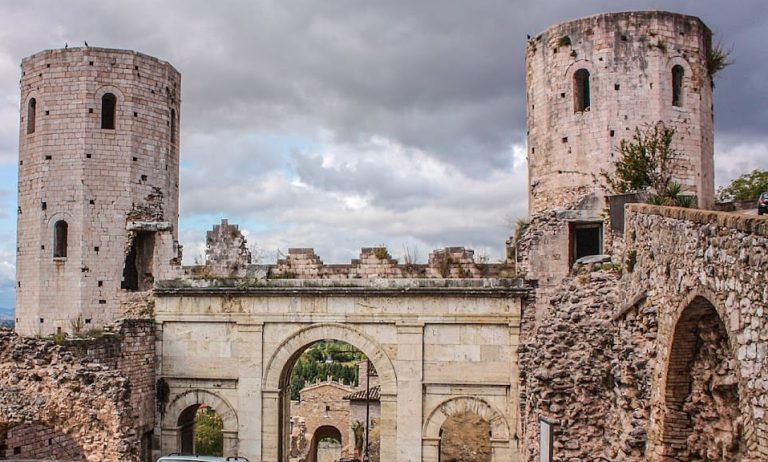
The amphitheater also played a role in the city’s layout as one of eight gates providing access to the historic center. This positioning marked a transition zone between the outside and inside of the ancient city, highlighting its continued importance in the urban landscape beyond its original Roman context.
Remains
The remains of the Roman amphitheater in Assisi reveal an elliptical layout that can still be traced today along Via Anfiteatro Romano. This street follows the original outline of the arena, with the ancient arena wall now enclosing a garden space. Surrounding this, medieval buildings have been constructed into the cavea, the tiered seating area where spectators once gathered.
The amphitheater’s base was organized into wedge-shaped sections arranged radially, a design that allowed staircases to lead visitors up to the seating tiers. The surviving seating consists of two levels, or orders, built upon concrete walls faced with two Roman masonry techniques: opus vittatum, which involves horizontal bands of stone blocks, and opus reticulatum, characterized by a net-like pattern of small square stones.
Some structural elements of the amphitheater remain visible beneath the Monastery of Santa Caterina, demonstrating the medieval adaptation of the ancient fabric. Externally, only fragments of the cavea and arena walls can be seen today, offering a partial but tangible connection to the site’s Roman origins. Two inscriptions related to the amphitheater, now housed in the Roman Forum and archaeological collection, provide direct evidence of its construction and the involvement of the Gens Petronia family.