Porta Consolare: Roman City Gate of Spello, Italy


Site at a Glance
- Rating
- 4.5
- Popularity
- Medium
- Country
- Italy
- Primary era
- Classical
- Eras represented
- Classical, Medieval
- Civilizations
- Roman
- Site type
- Military
- Remains
- Gate
On this page8 sections
History
Porta Consolare is a Roman city gate in Spello, Italy, probably built around 40 BC as the formal entrance to Colonia Julia Hispellum. Octavian, the future Emperor Augustus, established the colony for veteran settlers after the civil wars. The gate belonged to the early organization of the settlement and probably predates the later city walls.
The Roman colony and its entrance
Porta Consolare provided the principal entrance to the Roman town from a road that followed the decumanus maximus, the main east-west street of a planned Roman settlement. This route passed through agricultural districts laid out by centuriation, the Roman division of land into a regular grid, before meeting the Via Flaminia at Mevania. The Via Flaminia was the major road connecting Rome with central and northern Italy.
Walls and later changes
The city walls were built during a later phase. They formed a roughly elliptical circuit of about 2 kilometres along the slope of Monte Subasio, with the longer axis extending from northwest to southeast. The walls may belong to Augustus’s restoration of the Via Flaminia in 27 BC. Their appearance suggests that they served primarily an aesthetic purpose rather than functioning as a strongly defensive system. About half of the circuit survives on the western side of the modern town.
The upper part of Porta Consolare was rebuilt in the sixteenth century. Three statues placed above the gate came from a Roman sarcophagus discovered near the Roman amphitheatre during that period. They were thought to represent consuls, which gave the gate its present name. More recent excavations revealed substantial Roman foundations associated with the gate and traces of the ancient road running from north to south across the city. Nearby roads range in date from the pre-Roman period to the Middle Ages, showing the long continuity of movement through this part of Spello.
Remains
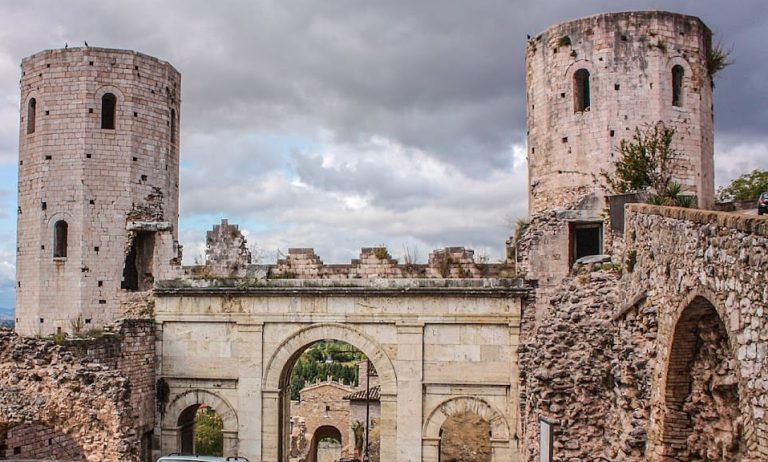
Porta Consolare preserves the lower part of a Roman entrance built from small, squared blocks of local Monte Subasio limestone. The blocks were laid in horizontal courses without mortar, while the outer face of the gate was originally covered with marble. The surviving structure combines Roman masonry with medieval and Renaissance elements that occupy or reconstruct parts of the original monument.
The Roman gate and its foundations
Double-arched entrance
The original gate comprised two gates, each with three arches, separated by a cavaedium, an open-to-the-sky rectangular courtyard. Little of the inner section remains. The lower portion of the outer gate survives in good condition and preserves the principal Roman masonry and the evidence for its monumental marble facing.
Flanking structures
A medieval tower stands on the right of the gate, while a house occupies the left side. Both rest on Roman foundations, indicating that the original entrance was probably flanked by two defensive towers. Excavations have also exposed substantial foundations belonging to the gate and associated structures, together with traces of the ancient north-south road that crossed the settlement.
Reconstructed upper section
The upper part of the monument was probably originally an open loggia, an open-sided roofed gallery or upper passage. It was reconstructed in the sixteenth century. Three toga-clad statues now stand above the entrance, but they were not made as parts of the gate. They were taken from the late-first-century-BC Roman sarcophagus found near the amphitheatre and later placed in the reconstructed upper section.