Ancient City of Xanthos: Political and Cultural Center of Lycia


Site at a Glance
- Rating
- 4.4
- Popularity
- Medium
- Country
- Turkey
- Primary era
- Classical
- Eras represented
- Iron Age, Classical, Medieval
- Civilizations
- Achaemenid, Ancient Greek, Byzantine, Lycian, Roman
- Site type
- City
On this page26 sections
History
Ancient City of Xanthos is an ancient Lycian city in Türkiye, near the modern village of Kınık. Built by the Lycians, it became the political, cultural, and commercial center of Lycia, and was regarded as the region’s capital. Strabo described it as Lycia’s largest city. Its early history remains uncertain, but the city’s acropolis dates to the eighth century BCE, and Xanthos had become the most important Lycian city by the fifth century BCE.
Early Lycia and Persian Rule
Early references to the Lycian name Arna suggest that the site may have existed between approximately 2000 and 1200 BCE, although no Bronze Age remains have been found. The city’s political importance grew during the first millennium BCE. Around 540 BCE, during the reign of Cyrus, the Persian Empire conquered Xanthos under the command of Harpagus, a Median general serving Persia.
Herodotus described a final act of resistance during the Persian assault. The Lycians destroyed their acropolis, killed their families and slaves, and then attacked the enemy. About 80 families survived because they were away from the city at the time. Xanthos was rebuilt after the conquest, with new settlers joining the survivors. Persian authorities installed a local leadership, and the city was minting coins by 520 BCE. By 516 BCE, it belonged to the first tribute district established by Darius I.
Athens and Hellenization
Athens captured Xanthos in 470 BCE under Kimon, an Athenian statesman and military commander. Archaeological evidence places the destruction of wooden structures around 475 to 470 BCE, but the cause is uncertain. It may have resulted from Kimon’s campaign, Persian action, natural forces, or another event. The city was later rebuilt in stone.
Xanthos may have belonged to the Delian League, the alliance of Greek communities led by Athens, if the Lycian entry in the league’s tribute list of 446 or 445 BCE refers to the city. During the later fifth century BCE, Xanthos conquered nearby Telmessos and incorporated it into Lycia. The city became increasingly Hellenized during the fourth century BCE. Inscriptions from that period appear in Greek as well as in bilingual form, while fifth-century inscriptions were mainly written in Lycian. Greeks and non-Greek Lycians continued to live in the city, which functioned as a fully Greek polis, or self-governing city-state and surrounding territory, only after this transformation.
Alexander and the Hellenistic City
During the latter half of the fourth century BCE, Xanthos submitted to Alexander the Great, the Macedonian conqueror of the Persian Empire. Accounts differ over whether the surrender was peaceful or followed by plunder. After Alexander’s death, the city passed among his successors. Ptolemy I Soter is said to have taken it from Antigonus I Monophthalmus.
In the Hellenistic period, Xanthos served as the religious center of the Lycian League, a federation of Lycian cities. The city recorded at least six victories in the Olympic Games during antiquity. It was also associated with historical writing: the fourth-century BCE historian Menekrates of Xanthos composed a two-book history of Lycia.
Roman Civil Wars and Reconstruction
Xanthos supported Rome during the Mithridatic Wars, a series of conflicts between Rome and King Mithridates VI of Pontus from 88 to 66 BCE. Around 42 or 43 BCE, during the civil wars that followed the assassination of Julius Caesar, Brutus besieged and captured the city after the Lycian League refused to provide funds. The inhabitants again set fire to Xanthos and died in a mass act of resistance. Only about 150 Xanthian men survived. Mark Antony rebuilt the city, but it never completely recovered its earlier position.
Xanthos remained occupied through the Roman and Byzantine periods. It prospered during the later Roman period, when its urban plan was regularized and many of the surviving buildings were constructed. An earthquake in 141 CE caused extensive damage, and further earthquakes in the sixth century required additional repairs. The walls were reinforced in response to the Arab threat, but Arab attacks in the seventh century ultimately destroyed and abandoned the city.
Christian, Byzantine, and Modern Rediscovery
During the early Christian and Byzantine periods, Xanthos contained several churches and a large monastery. Ecclesiastically, it was a suffragan diocese of the metropolitan archbishopric of Myra. It later survived as the titular diocese of Xanthoupolis in the Eastern Orthodox Church, while the Catholic titular bishopric of Xanthus was restored in 1933.
Charles Fellows identified and documented the ruins in the nineteenth century. In 1842 and 1843, he transported a large collection of marble sculptures, chiefly funerary works, to England. Archaeological excavations and investigations have continued since 1950. Xanthos and the nearby sanctuary of Letoon were inscribed together as a UNESCO World Heritage Site in 1988. Lycian, Greek, and bilingual inscriptions from the city have also helped scholars understand and decipher the Lycian language.
Remains
The archaeological site covers approximately 126 hectares on a hill beside the River Xanthos, near Kınık. Ancient Xanthos stood about 12 kilometres inland from Patara, within a territory that probably included agricultural land beyond the city. Kragos Mountain lay to the west, Massikytos Mountain to the east, and the southern coast formed a plain. The city was enclosed by walls, with the northern and southern sides extending for slightly less than one kilometre. Some wall sections date to the fourth century BCE, while others belong to the Hellenistic period.
Acropolises and City Walls
Lower Western Acropolis
The lower western acropolis, close to the river, served as the Lycian acropolis during the Archaic and Classical periods. Its sanctuaries included one dating to the sixth century BCE and another from the fifth century BCE, possibly dedicated to Artemis. The walls surrounding this area date to approximately 475 to 450 BCE.
Higher Northern Acropolis
The higher acropolis occupied the northern part of the walled city and belonged to the Hellenistic and Roman periods. Byzantine remains in this area include luxury houses and a small chapel, adding later layers to the elevated urban quarter.
Southern Gate
Remains of a southern gate date to approximately 190 BCE. A Roman arch dedicated to the emperor Vespasian stood nearby, representing a later monumental addition to this part of the city.
Agora, Theatre, and Urban Buildings
Roman Agora
The Roman agora, or forum, lay between the two acropolises. It formed an approximately square space measuring about 50 by 50 metres and was bordered by porticoes. An inscription records a temenos, a formally bounded sacred precinct, dedicated to the twelve Lycian gods.
Theatre
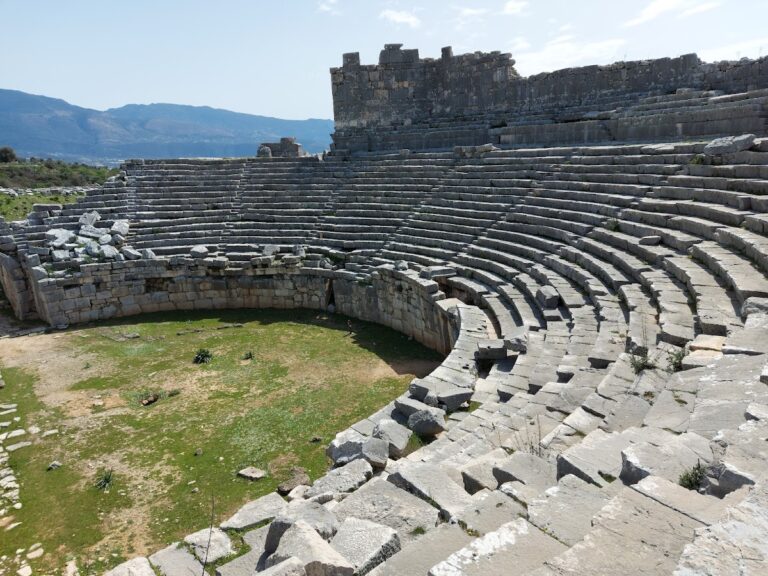
South of the agora stands a relatively well-preserved theatre. It began as a Greek theatre in the second century BCE and was converted into a Roman theatre after the earthquake of 141 CE. Two Lycian pillar tombs beside it were retained within the later theatre design.
Roman and Byzantine Structures
The later Roman town followed a grid plan. A large porticoed piazza probably occupied the area of the Classical agora. A triple-aisled building may first have served as a pagan basilica before becoming a church, and a large porticoed avenue probably ended in a gateway. Byzantine remains include several churches, a large monastery, and two large basilicas. The northeastern basilica measures approximately 74 by 29 metres.
Sanctuaries and Religious Buildings
Urban Sanctuaries
Religious buildings within Xanthos included a temple dedicated to Sarpedon, a temple of the Lycian Apollo, and cult places associated with Basileus Kaunios and Arkesimas. These sanctuaries formed part of the city’s religious landscape alongside the sacred precinct recorded near the agora.
Letoon
The sanctuary of Letoon stood on the western bank of the river, approximately four kilometres southwest of Xanthos, and was connected to the city by a sacred road. Dedicated to Leto and her children Apollo and Artemis, it was the principal cult center of Xanthos and Lycia. The sanctuary remained under Xanthian control, and decisions made by Xanthos were displayed there in inscriptions.
Letoon was enclosed by its own wall. Its remains include three Hellenistic temples dedicated to Leto, Apollo, and Artemis, together with a nymphaeum and a theatre. Twentieth-century excavations revealed numerous Lycian, Greek, and Aramaic texts, including a trilingual inscription referring to King Artaxerxes.
Monumental Tombs and Heroons
Xanthos contains numerous monumental tombs and heroons, monuments or shrines associated with heroes or exceptionally honored people, dating from the fifth century BCE to the first century CE. Many are pillar tombs, burial monuments built above tall stone columns and topped by a sarcophagus or burial chamber. The tallest examples reached approximately 11 metres.
Nereid Monument
The Nereid Monument was a heroon near the southern entrance, built around 400 BCE in the form of a small Ionic-style temple. Only its foundations remain in their original position. The surviving sculptural elements are in the British Museum. The monument influenced the design of the Mausoleum at Halicarnassus.
Tomb of Payava
The Tomb of Payava dates to the fourth century BCE. Its surviving structure and sculptures are in the British Museum.
Lion Tomb
The Lion Tomb is the earliest known Lycian tomb and dates to approximately 545 BCE. Its reliefs are preserved in the British Museum.
Ruler’s Pillar Tomb
A ruler’s pillar tomb stood at the northeastern corner of the agora. Dating to the end of the fifth century BCE, it was approximately 11 metres high and carried a burial chamber and a statue of the ruler. Reliefs on the chamber depicted the ruler’s victories, while the pillar bore inscriptions in Lycian and Greek. The reliefs are now in the Istanbul Archaeological Museums.
Harpy Tomb
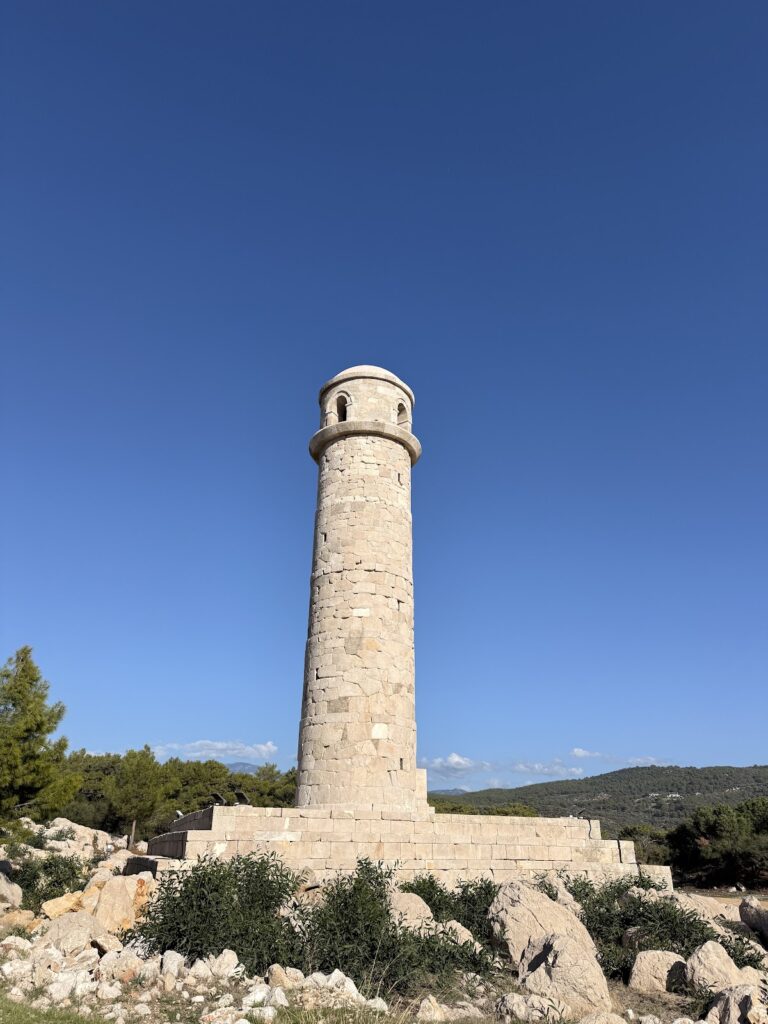
The Harpy Tomb, also possibly called the Siren Tomb, stood beside the theatre and dates to the beginning of the fourth century BCE. It was approximately nine metres high. Reliefs of siren-like figures carrying female figures that represented souls decorated its summit. The original reliefs are in the British Museum, while replicas occupy their places on the tomb.
Southern Pillar Tomb
Immediately south of the Harpy Tomb is a well-preserved pillar tomb approximately 8.6 metres high. It dates to the fourth century BCE and is topped by a sarcophagus.
Inscriptions and Ancient Languages
Excavations and surface investigations have uncovered Lycian, Greek, and bilingual inscriptions. The Xanthian Obelisk, also called the Inscribed Pillar, is a trilingual stele found in the city. Its text records an older Anatolian language conventionally called Milyan, while the wider body of inscriptions from Xanthos has contributed to the understanding of Lycian.